

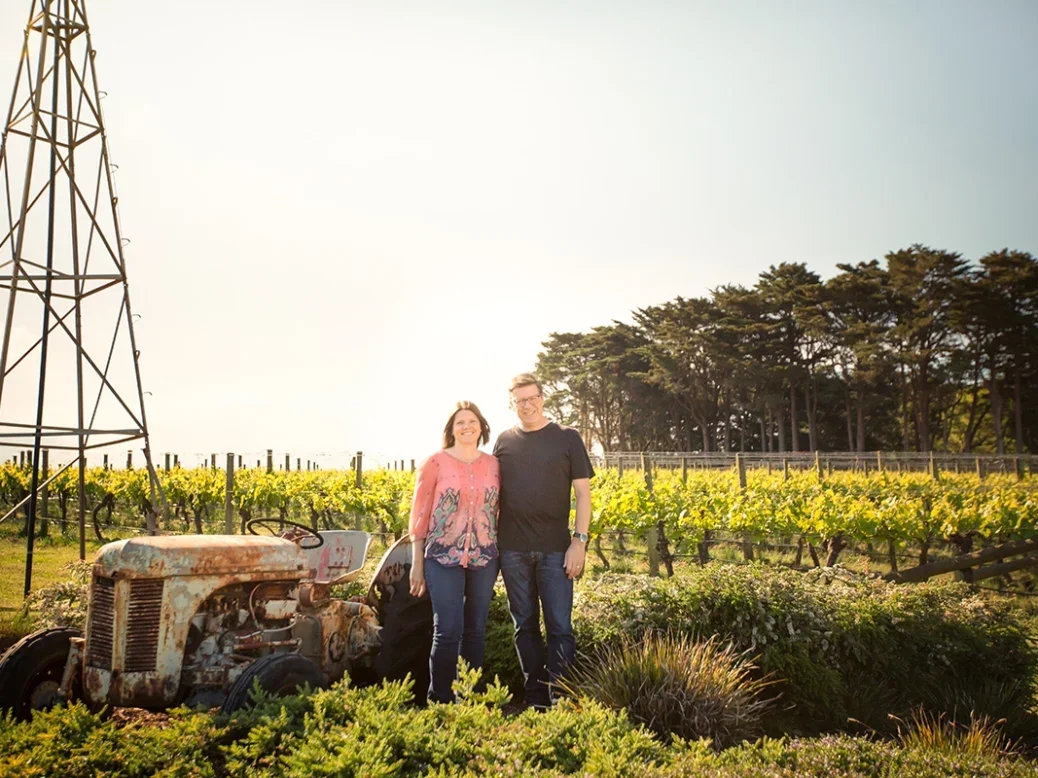
Proximity to the ocean inevitably plays a key role in the wines of Mornington Peninsula, not just Chardonnay. The region enjoys high natural acidity, and the cooler nature provides for pristine styles, exhibiting elegance and pure fruit. Citrus, stone fruits, and melons are all evident here.
Main Ridge
When Nat and Rosalie White established the Main Ridge winery in 1975, it was one of the very earliest in the region’s resurgence. Time finally caught up with the Whites, and this winery, perhaps the most renowned in the entire Mornington Peninsula region, was sold to the Sexton family. Needless to say, there were considerable concerns as to whether the high quality of the wines would be maintained. It seems that any such concerns were unfounded.
The fruit for the estate Chardonnay comes from the Home Block, which is now believed to be the P58 clone, planted in 1975. In the ’90s, attempts to make Cabernet were finally shelved, the results unacceptable, and the vines were grafted over to I10V5 Chardonnay. They have approximately 3ha (7.5 acres) of Chardonnay vines. The grapes are handpicked, destemmed, and lightly crushed before spending four to eight hours on skins. After gentle pressing and two days’ settling, the juice goes into French barriques (Sirugue, 30% new) for fermentation. Full malolactic fermentation follows. The wine remains on lees for one year, during which time it will be stirred on two or three occasions. Bottling takes place without filtration. Several trellising systems have been employed in the vineyard, but “as the vines enter their senior years and vigor has declined,” a conversion to VSP has taken place.
The team now sees the wines sitting somewhere between “old school and new wave.” They look to build richness in the wines and for ripe aromas, particularly peaches and melons, where possible. Complexity comes through wild fermentation, extended lees contact, and the use of oak. Closure? “Screwcap, and no turning back.” They have used screwcaps here since 2002 and believe that, under it, their Chardonnay can age gracefully for 20 years. Their experience has been that, under cork, the fruit is dulled after five to ten years. Production, in a good year, will be around 300 to 400 dozen.
Related


Chardonnay 2023
This is something very special—a Chardonnay that is all class. A deep lemon hue, then there is refinement throughout. On the nose, we have lemons, stone fruits, peaches, gunflint, ginger, and other spices, with a line of citrusy acidity. Coiled power sits below an intensity that never wavers. Energetic, balanced, and with amazing length, this will live and improve for at least a decade. Sadly, only 100 dozen bottles made. | 98
Chardonnay 2019
Content from our partners
A deeper yellow hue here, and the nose gives a range of delightful aromatics, with apricot skins, hints of lemon curd, stone fruits, lemongrass, and cashews. The texture is utterly sensual and seductive, and the wine has great length. The intensity is maintained for the full, seamless journey. It will impress for the next six to eight years. | 97
Elanto
Sandro Mosele is one of those winemakers who seemingly everyone knows. He has been a respected figure in Mornington Peninsula for many years. Elanto is his latest project, and the 2023 is the first wine from it.
They have three blocks of Chardonnay—Verge, Buckshot, and Seawinds—totaling around 4ha (10 acres), which should provide around 2,000 bottles annually. They operate with high-density planting. Sandro’s experience with Chardonnay in Mornington Peninsula meant that, when it came to choosing a white variety, there was no other option. Each of the blocks is harvested discreetly and vinified individually. The juice goes into a mix of new and older French oak barriques for a natural fermentation. The wine then spends ten months in barrel before it is blended in large concrete vats and given another couple of months’ rest before bottling. Sandro has gone with Diam closures, not least because he wanted a point of difference and likes the wax seal.
Balnarring Chardonnay 2023
Sourced from a high-density vineyard, the wine is still exhibiting an attractive layer of oak, but integration is proceeding well. There are notes of spices and figs, with nectarines, florals and stone fruits. The palate exhibits hints of oatmeal. Good focus and energy, and a lingering finish. Enjoy this over the next five years. | 94
Ten Minutes by Tractor
This is one of the wineries that should be on every wine lover’s bucket list. Not only does it make superb wines, but put simply, it does everything well. And the cherry on top is an absolutely brilliant restaurant with a world-class wine list. When I mentioned writing about Chardonnay to owner Martin Spedding, his excitement and enthusiasm knew no bounds. “Is there another variety being produced in Australia that, across the board, is better in terms of both quality and consistency than Australian Chardonnay? And has it ever been better?” The focus at Ten Minutes by Tractor has very much been on single-vineyard wines, and it has recently added a new flagship to the range, the Trahere Chardonnay, made from high-density vineyards.
The McCutcheon, Judd, and Wallis single-vineyard wines are produced from the three original vineyards, which are, no surprise, all ten minutes by tractor apart. They were planted in the early 1990s, all with the same clone, P58, and used the same trellising (Scott Henry). Since 1999, the vineyards have been managed in the same manner. Martin’s excitement at having these three sites is something that he simply cannot contain. He notes the subtle differences in “aspect, elevation, and the cool winds that flow from the Western Port, Port Phillip, and the Southern Ocean,” and that the “intrigue and magic of these wines has only grown over the years. As we get closer to them, the clarity of their personality and terroir grows deeper, and we fall deeper into the rabbit hole. And it is Chardonnay that takes you there.” If that does not make you want to reach for a bottle, I have no idea what will. He notes the differences: “McCutcheon has a stone-fruit lift, is mouth-filling, richer, and layered with nectarine and white peach. Wallis has an enticing white-blossom lift and a beautiful, linear acid drive that provides incredible focus and persistence. And Judd, which has a distinct saline, sea-spray, oyster-shell type mineral drive, is very textural and has high energy.”
There has been tinkering over the years. The proportion of new oak has been reduced, larger-format barrels have been included, and the team picks a little earlier to take advantage of the Mornington Peninsula acidity. They see the major changes over recent decades as having taken place in the vineyards. Under-vine mowing, the use of cover crops, composting, and planting native flowers and shrubs to enhance biodiversity, and employing sheep in winter months to assist with weed control and pest management have all helped improve the wines. Between 2011 and 2020, much of the Chardonnay was either grafted or replanted to Dijon clones, clone 95 in particular. They have also moved to much higher-density vineyards. It is these vineyards that have provided the fruit for the Trahere releases. Density is 12,400 vines per hectare—many times the standard.
McCutcheon Chardonnay 2021
A classic Mornington Peninsula Chardonnay from an excellent vintage. The nose weaves its way through notes of beeswax, apricots, peaches, spices, mandarins, and even a touch of honey. Really good concentration and serious underlying power here. The structure is supple and seamless, the texture creamy, and the length impressive. Eight years. | 95
McCutcheon Chardonnay 2015
Anyone concerned as to the longevity of top-notch Australian Chardonnay should add this to their drinking list. A mature, complex, and intriguing style, with notes of dry herbs, hazelnuts, spices, orange rind, and glacé ginger. Give it time in the glass to open up, and it will reward. There are also hints of a briny, chalky backing and attractive melon notes emerging on the palate, along with touches of bitter almond. It still has several years of providing pleasure ahead of it. | 95
Trahere Chardonnay 2021
A limited-edition release that is still oozing the promise to come, this is fresh and youthful, with hints of lemon sponge cake, grapefruit, citrus, dried herbs, and a touch a deft oak handling. Excellent length and focus. The wine has balance and a line of bright, zesty acidity. This has much more to give over the next decade. | 96.


