Rosa Kruger left behind a conservative family, and careers in journalism and law, to become one of the earliest and foremost proponents of the cultural and social value of old vines. Margaret Rand meets a woman on a mission.
The thing (well, one thing) about Rosa Kruger is that she was a journalist, so she asks questions. She probably knows more about me now than I do about her. She was, I would infer, a good journalist.
But that was then. She first did a BA in communications; then when she did a master’s in journalism, “everybody frowned.” She was a Kruger, great-great-granddaughter of the Paul Kruger who fought the British in the Boer Wars, took part in the Great Trek, and was four times president of the South African Republic. It was a considerable inheritance, and a conservative one. She has nothing but praise for her parents—“My father and mother were wonderful people. I don’t come from a family of money but a family of vision”—but nevertheless, growing up as an independent-minded woman in a conservative milieu in a male-dominated country wasn’t easy. “I found it tough. But I’m tough, too. I never wanted to be a wife, but I wanted to be a mother, and I am a mother.”
“I’m the opposite of what my family was,” she adds later, “but I still admire them for what they have done, though I don’t share their beliefs.”
Related
Being the opposite of what her family was is channeled through viticulture, via a passion for old vines and projects for keeping people on the land: It is another way of fighting.
She worked at a newspaper, Beeld, in the 1980s, “but politics under the previous government didn’t feel right for me,” and she turned to law, doing a law degree at the University of Johannesburg. “I loved law, but I’d have been a useless lawyer.” (She has a legal eye for accuracy, so for the avoidance of doubt, this piece is not necessarily strictly chronological.) She married, became pregnant, had a son, and moved out of the city. “I don’t like enclosed spaces or people around me. I like a sense of space around me.”
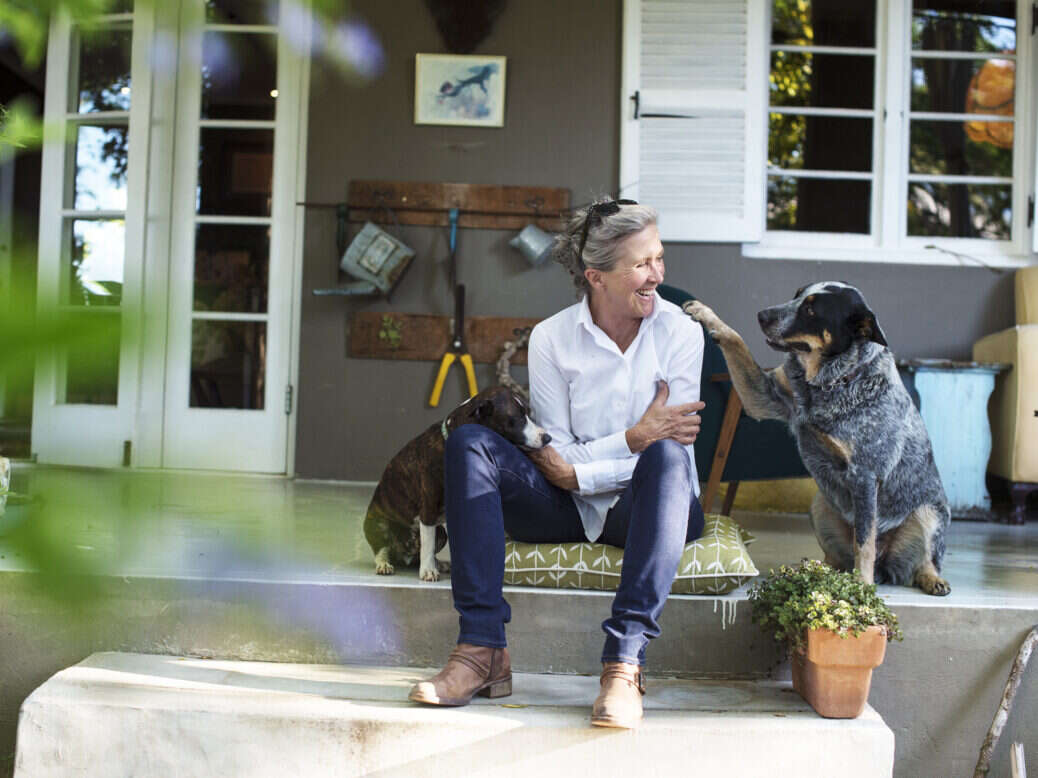
So, now Rosa lives in what sounds like the back of beyond, with six stray dogs (“I pick them up by the road; I know it’s ridiculous”), 30 chickens (“40 by now”), lots of guinea fowl, and sugar birds that she feeds. She has 10 acres (4ha) of land, and 80% of what she eats she grows herself: “spinach, avocados, apricots, tomatoes, kale, whatever is in the garden. I like living simply.” She looks after her gardener “and the wonderful woman who cleans my house; I’ve bought each of them a house.” She hates opulence; she’ll take a doggy bag back from a restaurant for supper and says she can’t afford an iPhone; she recounts discovering a smart second-hand clothes shop in Paris and trying on things trying not laugh while an informal panel of smart Parisiennes assessed each potential buy: “Ah! Quel chic!”
Content from our partners
Rosa Kruger: A crusader through and through
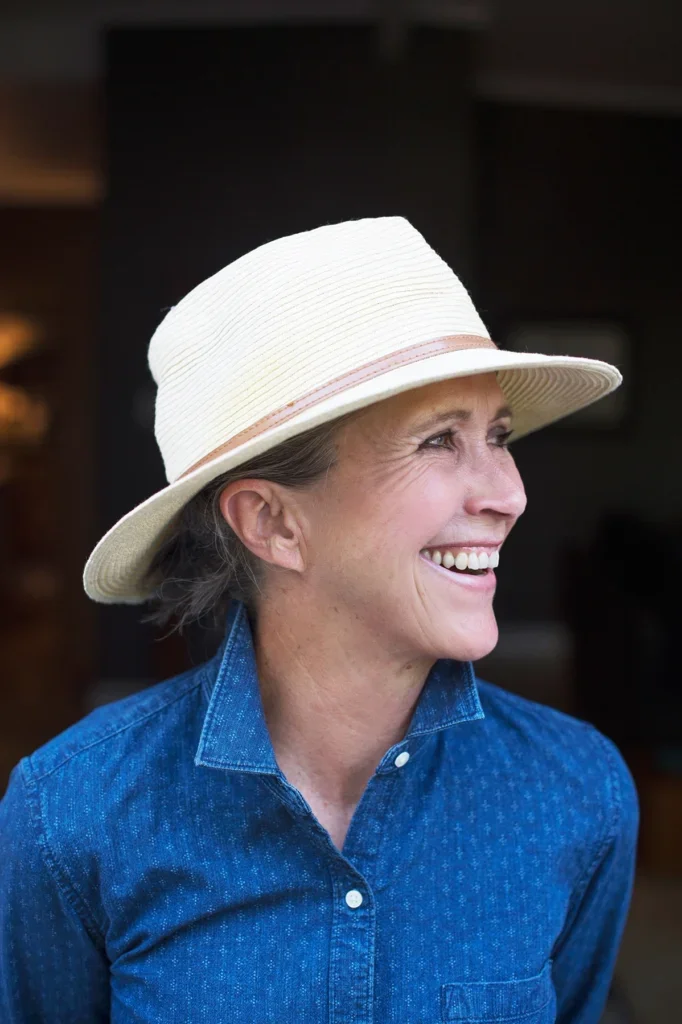
Rosa Kruger: “I can’t change the world. I can’t change Sudan, Gaza, rainforests. But I can make change in my little world. I can make a difference.” Photography by Maria Schiffer.
Funny, isn’t it, how rebellion and finding your own way so often reflect your roots? It’s TS Eliot’s “time future contained in time past.” Rosa Kruger grew up on a farm in the Northern Transvaal, one of six children, and here she is running wild again—or would be if she had time to run wild, which she mostly doesn’t. But she does take the dogs up the mountain in the morning and talks of spending nights out on the veldt. I said, But what about, I don’t know, marauding zebras? And she told of the time she was woken by a very large buffalo—dangerous animals, buffaloes—and the time she was discovered by a group of young elephants—imagine a gang of feral teenagers egging each other on—who mercifully decided to leave her alone.
And she loves to be alone. She can be alone for months at a time, she says—although she comes over as sociable, even gregarious, and certainly enormous fun. She seems to lack all vanity: “extravagance, show, and wealth are a bit vulgar. Showing your wealth is a bit vulgar. Or that you’re clever, or pretty. When I was 14, I was really sick; I spent almost a year in hospital, in and out, and in the hospital were seriously sick children. It shifted my brain. I think about it a lot, those children, and what they and their parents suffered.” It made her want to be a nature conservationist, living on the veldt, working for animals.
And again, in my end is my beginning—or the other way around, if you want to refer to TS Eliot again. If I’ve painted a picture of somebody who lives simply and responsibly—yes, certainly. But not passively. Rosa is a crusader through and through. She fights, fights, fights. We know her best for the Old Vine Project, which she founded in 2016 and which started a worldwide movement to save old vineyards and make them viable. She also runs schools, educating vineyard workers in pruning and all aspects of viticulture, partly so that they can grow better grapes but also so that they can be employed all year round rather than just for a couple of months a year, and thus feed their families and stay on the land. It sounds a bit like Plato’s Academy but with straw bales to sit on.
Law, then, didn’t last very long. “I used to work from 6am to 8pm every day because I was a single mother, and I had to pay for my own studies for most of my life. I had three different jobs at times.” She never qualified as a lawyer and, instead, took a job managing an apple orchard in Elgin. That was in 1997. The apples were hit by hail, and one day a neighbor drove by and started talking—“quite an attractive neighbor. I said I’d had no harvest because of hail, and he said, Why don’t you consider grapes?” And she did.
She contacted Eben Archer, who was professor of viticulture at Stellenbosch University; he said he would see her the following day at 7am. It was an hour and a half’s drive, and she was there. “He took pity on me, and [soil scientist] Dr Dawid Saayman did, too. I would cook for them, and they would teach me. A lot of farmers took pity on me; they probably thought they had to save me from myself. Just farmers driving by would say, Do it like this. I’ve been so lucky.”
Archer and Saayman told her to travel, and she did. She worked three harvests with Didier Dagueneau and got to know the Perrins and Henri Bourgeois. “It was so easy to travel then; for a month, for a weekend. I was invited a lot, and I traveled mostly to learn, because I always felt uneducated. I slept in trains or in airports; it was tough, but I learned a lot. Travel is the best education for many things. And when I did the first old-vine tasting in South Africa, the Perrins sent a box of wine, free, which was very gracious of them.”
She made Sauvignon Blanc at Iona, the erstwhile apple orchard in Elgin, and then moved on to other roles, including one for Johann Rupert at L’Ormarins in Franschhoek, where she hunted down old vines. And it was Rupert who provided the first funding for the Old Vine Project. “He said, How much do you need? So, I told him, and he gave it to me. It was a lot. Now it’s self-funded. But I had a lot of help.
“At first I worked on bits of paper, in my truck; it was very disorganized. Then an accountant friend said, You have to formalize it.” So, it became a non-profit organization. But it all started as early as 2002, when Rosa began that hunt for old vineyards. The potential of old vines in Europe had sparked the idea, and she knew that because vines had been planted in South Africa since 1655, old vineyards must exist. It was just that nobody knew where they were. So, she asked vineyard workers, and they told her.
KWV already had a list but wouldn’t release it. “They kept saying it was confidential but wouldn’t say why it was confidential. This went on for five years.” Eventually she got her hands on it, “and it was easier then, because we could find people. But we would ring, and they were either out in the fields, or harvesting, or sheep-shearing. I brought in five friends who came to my office and phoned people.”
The word began to spread. Eben Sadie released his first old-vine wine in 2006, and within a few years names like Duncan Savage and Chris Alheit had caught the bug. Rosa launched her I Am Old website in 2010, with a list of old vines. When the Old Vine Project was officially launched, André Morgenthal became project manager. It inspired other organizations, including the UK’s Old Vine Conference; Jancis Robinson MW started her register of old vineyards at much the same time. The point is to give old vines a point: Rosa rescues stray dogs, but then their job is to protect her. Rescued old vines give better, more expressive wine, and if they are valued properly they should make wine that sells at a premium, thus encouraging both their preservation and the livelihoods of their farmers. There’s economic and social logic behind it.
In 2011, Rosa went freelance as a vineyard consultant. “Marc Kent gave me a job; I went there unannounced and said, Can I consult for you? He was amazing, and I am always grateful.” Apart from someone to do social media, she works alone. “I’ve made my own way since I was 17. I’ve tried bringing on someone to work for me, but it didn’t work—they don’t get it. They just learn what to do in viticulture, but they can’t keep up, and they don’t carry it further. Michel Rolland said to me that I have to write down what I know, and I said, I don’t know what I know.” She works a lot by instinct: “In South Africa, I can stand in a vineyard and know the sort of wine it will make.”
Terroir, viticulture, and the wider picture
So, what does Rosa Kruger actually do now? It’s all about terroir and all about viticulture—and viticulture as part of a wider picture. In my experience, if you’re in a vineyard and you ask a viticulturist what that bird is, or that herb or tree, they will look blank. All too many viticulturists only ever see vines and can barely tell other plants apart. That is not Rosa’s sort of viticulture. Instead, it’s all about working with nature.
She wasn’t thrilled, in California, to see old vines being fertilized with pellets of nitrogen, magnesium, and potassium; she also wasn’t thrilled to see where weedkiller had been applied under vines. Nor was she thrilled to see old field-blend vineyards with the fruit unsold and left for the birds. Old-vine wine still doesn’t always have the cachet it should.

Rosa has never made wine, but she does feel a sense of ownership when she passes a vineyard she planted ten years ago. “It’s an emotional thing. I still regard them as my vineyards; I planted them.”
She has consulted for names such as Boekenhoutskloof, Mullineux & Leeu, Reyneke, and Fairview, and consulted free for others—Donovan Rall, Duncan Savage, Eben Sadie… Now she’s trying to focus on design—vineyard design, contouring vineyards so that they work with nature rather than fighting it. There must be rainwater channels so that rain trickles down and eventually reaches a dam, rather than cascades down taking topsoil with it. The contours must be designed to work with the wind. “I feel the temperature and the air; I feel it. I look at the fynbos: Does it grow low or high, sparsely or vigorously, with big leaves or small? That tells you how vines will grow, more than the soil does… The soil type is a good way to start, but it’s not the only part.” The rock, temperature, water, and scrub tell more about a site.
To reduce soil compaction from tractors, she will have seven or eight rows close together, with space for a tractor to pass either side of the block rather than between the rows; she has wide strips of native vegetation between every two or three strips of vines. This vegetation must connect forest with water; the connection with water is key. She builds the contours with GPS but plans them by talking to the vineyard workers. “They know where the wind blows, where the water goes, where the baboons are.”
“Design takes up most of my time now,” Rosa says, “and matching vines to the terroir, planting and managing.” She made one mistake once, in planting Cabernet Franc in the wrong place at the owner’s insistence. Now she’s trying to specialize in high-altitude vineyards, seeing just how far she can push terroir in South Africa. A current project is planting at 5,250ft (1,600m) at Sutherland in the Western Cape—“Not easy,” she says. “What I do is not easy.”
What is also not easy is retaining people on the land. Rosa talks about this in South Africa, but it’s a problem everywhere contracted labor and migrant labor is used; people need to live on the land, she says. And that is why she started her schools. “We started sitting on bales of straw, and I got in experts in biodiversity, contour design [herself], legal ramifications, pruning, and we started teaching. We don’t have books; we just transfer information to those working on the land.
“We have a pruning school, with 40 to 50 people in the class, and we show them pictures and open their minds and show them that there’s a whole world out there. People come up to me in the street and say, Can we come to your school? They get promoted. It’s not about money but about pride in what they do.
“I teach a lot. There’s not a single place where previously disadvantaged people can go to learn viticulture. I don’t want machines in my vineyards; I want people in my vineyards.” She shuns the idea that this is paternalistic. “I want to treat them as equals. I want teams so excited that people will come looking for them. If we train them so well that people can employ them for most of the year, then they can put food on their families’ tables as opposed to being employed for two months of the year.”
Rosa is not against technology and, indeed, uses GPS for contouring vineyards, but she says, “People must have a sustainable income and a dignified life; vineyards must pay for themselves… The arguments for old vines extend to the people in the vineyard.” Her heroine is Jane Goodall, who said, “Only if we understand can we care. Only if we care will we help. Only if we help we shall be saved.” Says Rosa, “I can’t change the world. I can’t change Sudan, Gaza, rainforests—I can’t. But I can make change in my little world.
“I can make a difference.”