Whether it’s the widespread granite, the slaty rocks of the Malmesbury Formation, or the hard sandstone of the spectacular Table Mountain Formation, the geology of the Western Cape winelands has long been a source of fascination for scientists, says Alex Maltman.
Naar Culemborg gaan was a saying in old Amsterdam: He’s “going to Culemborg.” It was a euphemism, meaning that the person was financially bankrupt. Culemborg, a remote outpost of the Holy Roman Empire in what is now the Netherlands, used to have its own government, with the right of granting asylum and refuge from creditors. Who would have thought that this tiny walled, sequestered spot would in 1619 see the birth of an individual who went on to travel the world, to see Caribbean islands, Greenland, and Japan, to govern for 15 years in the East Indies, and, before that, to spend ten years effectively founding the nation of South Africa? There, based on the Cape Peninsula, he was to change forever that region’s nature and its culture. Oh, and initiate one of the world’s great wine-producing regions.
Jan van Riebeeck is today much feted in South Africa as the nation’s founder, commemorated in place names, stamps, coins, murals, statues, and much more. But, it has to be said, there is another viewpoint. Bitterness and resentment continue to this day among the few descendants of the indigenous Khoekhoe people, who were callously maltreated and ousted from their ancestral homeland. In contrast to van Riebeeck’s renown, arising from a few years on the Cape, they had husbanded the land for countless millennia, yet they are now all but forgotten.
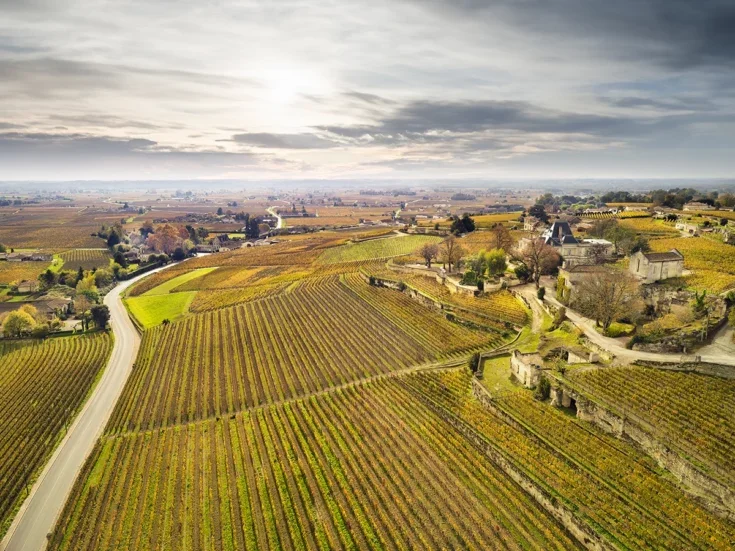
South Africa ranks seventh globally in terms of wine production by volume, and surely some of its vineyards must rate very highly on everyone’s list of the world’s most beautiful. In this article, I will sketch briefly the challenging early years of what is now called the Western Cape and its fledgling wine industry, then focus on its stunning landscapes. Those sweeping plains and isolated hills, craggy mountains towering over graceful vine-covered slopes—how did they come about? The vineyard soils are some of the oldest and most unusual in the world. Why so? It all stems from the region’s unique and monumental geology.
Related

Sowing the seeds
Medieval Europeans long dreamed of a sea route to the fabled riches of the East. So, early Portuguese sailors exploring southward down the west coast of Africa were greatly heartened when they could “turn left,” as it were, and start heading east. That was when they had rounded the rocky headland in the far south of the continent; they named it Cabo de Boa Esperança, the Cape of Good Hope. Sailors soon referred to it just as “the Cape,” and early settlers extended the name way into the hinterland.
In 1503, António de Saldanha went ashore on the Cape in a bay dominated by a distinctively flat-topped ridge he called Taboa do Cabo. He noted water springing from the north end of this “Table Mountain,” so that when in 1652 the fabulously successful Vereenigde Oostindische Compagnie—VOC or Dutch East India Company—directed van Riebeeck to establish a supply camp on the Cape, just north of the mountain was the chosen place. The settlement struggled initially, hit from time to time by fierce windstorms and, in the very first year, by locusts descending “as if snowflakes were falling so that the earth and sky were hardly distinguishable.” But the camp survived, thrived, and eventually developed into today’s Cape Town.
Van Riebeeck’s task as commander was to encourage the settlers to produce foodstuffs—fruit and vegetables, and meat purloined from the Khoekhoe—to replenish the passing VOC ships. It was hard going: One farmer declared that when the wind was blowing “one would hardly chase a dog outside.” Hence the first grapevines, which van Riebeeck planted in 1652, struggled. It took him seven years before he could write, “Today, praise be to God, wine was made for the first time from Cape grapes.”
Content from our partners

Van Riebeeck encouraged other colonists to follow suit, pointing out that vines could be planted “in the poorest soil.” A few of them did plant vines, but they lacked know-how, and they had very little equipment. Imported enslaved people had to crush the grapes underfoot, sometimes in vats previously used to brine meat and sterilized by burning muscat nuts. The standard fining agent was goat’s blood. Small wonder, then, that individuals of any status disdained the local product and drank only vaderlandsche (European) wines.
Two events, however, put Cape wines on a commercial path. One was the appointment of Simon van der Stel as commander of the colony, who with his son brought a sharper focus and commitment to raising grapevines; and the other was the arrival of Huguenots from France, some of whom actually had experience of viticulture.
Van der Stel and the Huguenots
Seventeen years and nine commanders after van Riebeeck’s departure from the Cape, the VOC appointed van der Stel to the position and, 12 years after that, made him the colony’s first governor. He was also given substantial land. (In faraway Amsterdam, the VOC had drawn up documents stating that all the Cape land belonged to the company. That was therefore now beyond legal dispute—neither the Khoekhoe nor anybody else had any paperwork to the contrary.)
Van der Stel’s land grant was right behind Table Mountain, and he promptly named his property for the VOC commissioner’s daughter Constantia. For his estate, van der Stel believed that he should lead by example, so he imported from Europe the most modern winemaking equipment together with some 100,000 vine cuttings. He was convinced that if handled properly, Cape wine could be good—and of course, Constantia wines were to become great.

The governor encouraged new settlers to spread out from the original colony, to the lions and rhinoceroses at Tygerberg, and beyond to the ostriched hills at Paarl. Van der Stel himself oversaw development of the fertile lands to the east, spread along the base of a remarkable craggy mountain. He imported oak trees to grace the farmsteads and “to be planted on the public streets wherever possible.” What to call this bosky place, and its towering mountain? Why, just name it for yourself! And so, we have Stellenbosch and its mighty Simonsberg. Today, of course, the town is central to South Africa’s wine industry and viticultural research.
The other major advance began in 1685, when Protestant Huguenots were suddenly no longer tolerated in France and fled the country in large numbers. Some went north to the United Provinces (Netherlands), where the VOC encouraged those with practical skills to move to its new lands in the Cape. A couple of hundred or so of them did, and those with experience of viticulture were soon granted land to establish vineyards, at Paarl and Wagenmakersvallei (later renamed Wellington), and at an elephant breeding ground called Oliphantshoek.
The elephants, though, moved on when the settlers came, and soon this French-speaking corner was being called Franschhoek. Jean le Long from L’Aigle in Normandy, for example, was allotted the “woods and dale” that are today’s Boschendal, and Pierre Joubert from La Motte-d’Aigues in Provence (who had lost his wife on the sea voyage but married another passenger before reaching the Cape) farmed the land that was to become today’s La Motte.
All wasn’t straightforward, though. Van der Stel found some of the settlers wispelturige (fickle) and complained about “French impertinence”; he implored the VOC not to send any more individuals who weren’t “prepared to get their hands dirty.” But most of the farmsteads flourished, and production of wine grew—together with its consumption. One visitor reported that “at none of the meals is wine wanting, though well-bred people never drink more than three or four glasses between the courses. After the evening meal, one might also drink a few glasses over a pipe of tobacco…”
The VOC insisted on integrating the émigrés, and within a generation spoken French had all but disappeared. But today’s estate names like Haute Cabrière, Grande Provence, L’Ormarins, Allée Bleue, and Bellingham (Bellinchamp) reveal their French origins. The Cape wine industry would later see many ups and downs, but the culture and commerce of winemaking were now firmly established and heading toward what they are today.

Three winescape keys on display
We can think of the geology of the Cape winelands in terms of three key features, and they are superbly demonstrated on the Atlantic coast south of Cape Town. Moreover, they involve principles that underpin the very science of geology.
Charles Darwin spent several days on the Cape during the homeward leg of his epic journey on HMS Beagle. At one point, he was taken to what is now the coastal suburb of western Cape Town known as Sea Point to examine the rocks just below the promenade. The great man was immediately struck by the odd form of the dark, slaty rocks and soon deduced that this was related to the adjacent granite rocks. The appearance was due, he reasoned, to a baking effect taking place way underground as the molten granite cooled and solidified. In turn, the granite showed signs of having chilled as it met the cooler slate.
The significance for geology in this is that in Darwin’s time the origin of granite was highly controversial; some argued that it formed in place by some unspecified alteration of the rock that was already there; others believed that it was due to chemical precipitation from a huge primordial ocean. Indeed, a major proponent of the latter view was none other than the geology professor who had taught Darwin at Edinburgh University. The idea that granite was once molten and intruded its way into place seemed outlandish at the time, but it was evidence such as that at Sea Point that carried the day and gave rise to the concept of igneous (once molten) rocks.
The winescape significance is that many of the Cape’s wine estates are on soils derived from granite and from the slaty rocks nearby, like those at Sea Point. Geologists refer to these latter rocks as the Malmesbury Formation. With the granite, it provides two of our geological keys; the third is the hard sandstone known as the Table Mountain Formation, which constitutes the imposing mountains that tower over many of the vineyards.
Southward from Sea Point, the road becomes the famous Chapman Peak toll road, “one of the most spectacular marine drives in the world.” The road is carved about halfway up the sea cliffs, along an imaginary horizontal line that separates Table Mountain sandstones above the road from granite below. But the granite shows no signs of having chilled against the sandstones or having injected into them. Conversely, the sandstones show no signs of having been changed by heat. That’s because the sandstones were sedimented on a surface already formed, by erosion into the long-solidified and exhumed granite (and, nearby, slates like those seen at Sea Point).
It’s an arrangement known technically as an unconformity, a feature that implies huge amounts of passing time. The formation of the different rocks at different stages, interspersed with intervals of burial and uplift, requires a length of time immensely greater than the few thousand years previously believed. The recognition of unconformities and their time significance was particularly important for Charles Darwin, because it now made available the time needed in an idea he was developing—that biological species came about gradually through evolution.

Uplift of all these rocks took place around 250 million years ago and produced a continent geologically stable from then on; the hallmark of what followed was erosion of the land surface. By about 60 million years ago, the main topographic features of the Cape had been roughed out, and the soils we see today were starting to form. This paucity of geological activity, and in particular the absence of glaciation, is the principal reason why the Cape vineyard soils are so old. Unlike the lands of higher latitudes, such as northern Europe and North America, the geologically recent Ice Age didn’t affect South Africa directly—there was no ice. Consequently, the soils weren’t eroded away.
I must mention in passing a geological curiosity in the Cape regarding ice. Up in the Olifants River wine district, along the R364 over Pakhuis Pass, the rocks do show features diagnostic of ice presence—but they’re about 450 million years old (Ordovician). It’s testimony to Earth’s moving continents: At that time, this region was close to the South Pole. Then, remarkably, a mere 40 miles (64km) away, near Nieuwoudtville, are rocks that also show clear evidence of ice, but in a period about 300 million years ago (Carboniferous). This was at a time when Europe/North America was experiencing the tropical swampy conditions that gave rise to rich deposits of coal. Earth has undergone five different ice ages over the past 2.5 billion years—evidence of two of them is found astonishingly close together in the Cape, and yet there’s none for the recent Ice Age, the one that ended 10,000 years ago, the one most people think of.
There are other geological formations involved in the Cape winescape; alluvial materials such as those along the major Olifants and Breede rivers are obvious examples. I will focus here, however, on those three keys just introduced, together with the erosion that produced the landscape and the weathering that gave the soils.
Mountain majesty
Surely the striking thing about the landscape of the Western Cape winelands is those isolated craggy mountains towering over the vineyards on the lower slopes. The Table Mountain backdrop of Constantia, for example, or the Franschhoek Valley enclosed by the Drakensteins—both have the same geological arrangement: remnants of Table Mountain sandstones making the bare, rocky heights but an unconformity with granite toward the base, where the vineyards lie. (The name Drakenstein, incidentally, comes not from some curious allusion to “dragon stones,” as is often said, but, in another example of van der Stel’s wily diplomacy, from the VOC commissioner of the time, Hendrik Drakenstein.)
Consider Stellenbosch’s Rustenberg estate, nestling below the dramatic crags of the Simonsberg, soaring 3,300ft (1,000m) above. The mountain is made of an isolated remnant of the Table Mountain Formation that, before erosion, spread all around. The stratification of the sandstone is clearly visible in the bare rock, just about horizontal but with a very open saucer-shaped arrangement. About halfway down the mountain are shallower, vegetated slopes of scree, and hidden below these is the unconformity, with the granite below it, just as we saw on the Chapman’s Peak drive.

The granite is exposed in many places across the estate, showing that it underlies most of the vineyard plots, such as Laing’s, Lampies Cottage, and Spekboom. The extent of weathering varies, but in places it gives soils that are 33ft (10m) or more thick. They tend to be sandy, providing excellent drainage, but their antiquity can present problems, as I explain in the next section.
This same arrangement of tough sandstones on top of granite typifies the other mountains of the Stellenbosch region—the Jonkershoek Valley, for example. That’s certainly a dramatic setting, with the valley crowded in by the Stellenbosch and Jonkershoek mountains, made of durable Table Mountain sandstone. But the vineyards in the valley—Stark Condé, Neil Ellis, and Lanzerac, for example—are sited on soils derived from the granite that underlies the sandstone. For the vineyards, the granite below the unconformity is central.
The Granite Suite
This isn’t a piece of music, as in, say, Holst’s Planets suite, but the geological name for the collection of granite masses such as those we’ve just seen around Cape Town and Stellenbosch, together with those that come and go all the way up to Vredenburg. All this granite presents some societal challenges—there’s concern about the levels of natural radioactivity, for one thing—but also benefits. For instance, it’s a much-used building stone. Remember Jan van Riebeeck? In Cape Town there’s a bronze statue to him (and another to his wife), standing, fittingly, on a podium of Cape granite. Here are some more examples of the role of granite in the Western Cape winescape.
When, in 1657, Abraham Gabemma was seeking meat for the Cape’s new supply camp, about 19 miles (30km) north of Stellenbosch, he happened upon a huge dome of rock that was gleaming after a rainstorm. It reminded him, so the story goes, of diamonds and pearls, so he named it de Diamondt en de Peerlberg. With time, the diamond part was dropped (though there still is a Diamant Estate), and today the Paarlberg granite looms over the town of Paarl, until not long ago the center of Cape winemaking activity. Scattered around the flanks of the granite mass today are wineries ranging from large operations like KWV and nearby Nederburg to boutique producers such as Landskroon, Ridgeback, and Rhebokskloof. The Fairview estate produces a wine called Cape Granite.
About 50 miles (80km) northwest of here is another fashionable wine district, Darling, and it’s dominated by yet another granite mass. It’s a tough rock; as you approach Darling town on the R27 West Coast Road, there’s a conspicuous granite quarry on the right. It provided the strong material needed for constructing the nearby Koeberg nuclear power station. But the Darling granite body, more than 34 miles (55km) in length, is weathering to give deep, well-drained soils, valued by producers such as Groote Post, Cloof, Ormonde, and Contrebeg.
Southeast from here, the early settlers came across a mountain with horse-like animals called quaggas roaming on it. So, from the Dutch for horse—paard—they called it the Paardeberg. (By 1878, the quaggas had been hunted to extinction.) It’s another body of granite in the Cape Suite and continues northward through the town of Malmesbury. Producers like AA Badenhorst, Damascene, and Joostenberg have vineyards here. The Chenin Blanc grown here by the Mullineux winery develops deep roots in the thick soils, and (I read) “as to be expected from granite soils, the wine has a long, slow linear progression as it ages.” Just outside Malmesbury, the Swartland winery produces a wine labeled simply Granite Rock Red.
These producers esteem soils derived from the Cape Granite Suite and highlight them in promotional materials—especially their antiquity. Unfettered, it seems, are the competing claims about just how ancient they are: “South Africa boasts the world’s oldest soils, over 400 million years old”; “We have some of the oldest soils in the world, originating one billion years ago”; “Our vines are bedded in growing matter harking back to the beginning of the Earth.” You can’t get much older than that! It all makes a beguiling selling point—but in practice, these very old soils can present challenges to the grower.
Leaching over time may have diminished or even removed the nutrients needed by the vine. The principal constituent mineral of granite, potassium feldspar, normally decays to clay minerals that provide adequate nutrition, but in places here in the Cape the decomposition has advanced to the nearly inert clay called kaolinite, aluminum silicate. (Aluminum is toxic to grapevines.) Nutrient availability therefore has to rely on sparse humus, any remaining fragments of rock that are relatively little weathered—or intervention by the grower. Moreover, the removal of nutrients usually leads to their replacement by hydrogen, and hence soils that have a lower pH—that is, greater acidity. This can impede the uptake of whatever nutrients are available, deter biological activity in the soils, and inhibit root functioning.
In addition, old soils tend to become compacted over time—again not good for root growth—and clays can become more sensitive to saturation followed by shrinkage. Besides disrupting the root network, this can cause subsidence in buildings, first with just hairline cracks but then structural damage. All this is why it is standard practice in much of the Cape for growers on the granite soils to prepare and maintain their soils on a scale virtually unparalleled elsewhere.
A Malmesbury medley
We’ve seen the tough Table Mountain sandstones making craggy mountains, and we’ve looked at some of the granites. Now the third of our keys to the Cape winescape: the Malmesbury Formation. Although at Cape Town’s Sea Point these rocks are slaty, over the region as a whole, they vary in nature. There’s even an unusual variation called hornfels, more of which later.
At the town of Wellington, north of Paarl, the Malmesbury bedrock consists of impure sandstones, slates, and shales, plus some input from the granite to the east. The soils are correspondingly diverse, which is claimed to “contribute to the complexity of the wines.” Their texture is ideal for raising young vines. Typically, young cuttings are grafted onto rootstocks like 101/14 and Richter 110, two of the most widely used in the Cape, before planting out in these Wellington soils and growing on ready for sale. Around 80% of the vine stock produced in South Africa is nurtured here, in more than a dozen commercial nurseries.
Northwest from Wellington are the open-skied wheatfields of the Swartland. There are occasional vineyards, some of them long established. Here the sandstones and shales of the Malmesbury bedrock give soils providing suitable nutrition and good drainage while conserving water sufficiently for dry-farming. It’s the traditional method in the region, using old, deeply rooting bush vines, commonly of Chenin Blanc or Pinotage. But Swartland has, of course, recently become something of a hotspot for Cape wine.
The new epicenter is the lovely old town of Riebeek-Kasteel (yes, it’s that name again!), nestled next to the Kasteelberg Mountain. It’s home to producers such as Allesverloren and Riebeek Cellars. The Kasteelberg is another mountain of Table Mountain sandstone isolated by erosion, which here is resting on top of Malmesbury rocks. In places, the nature of the Malmesbury bedrock approaches being a schist, and that’s especially true to the north of the mountain. There, the geological fault that runs along the Kasteelberg’s eastern flank has displaced upward the once relatively deeply buried schists.
Some producers like having fruit from these relatively nutritious, moderate pH soils, in some cases to blend with grapes from elsewhere. The Sadie Family is based down at Paardeberg but blends grapes from an array of soils including some from Kasteelberg for their “freshness and brightness.” Chris Mullineux, based in Riebeek, believes the Kasteelberg soils limit vine size such that “individual grapes in turn remain smaller, with a higher skin-to-juice ratio” and, hence, denser tannins. Some of the Mullineux wines have soil-specific names—Granite (from Paardeberg) and Schist, for example.
Way to the south, the Helderberg, just north of Somerset West, is another instance of an imposing, isolated mountain carved from Table Mountain Sandstone, but unusually it overlies both granite, to its northwest, and Malmesbury rocks, to the southeast. Consequently, estates such as Rust en Vrede, Ernie Els, and Uva Mira—the last with splendid views down over Somerset West and out to sea—have granitic vineyard soils equivalent to those at Stellenbosch. Estates farther south, however—and Vergelegen must be the best-known example here—have vineyards on schist-like soils from the Malmesbury bedrock below the unconformity.
Now: that mysterious hornfels. Centuries ago, the metal miners of eastern Saxony encountered a hard, splintery rock with an appearance that reminded them of animal horn. So, in their vernacular, they called it hornfels (horn stone). Geologists now know that the appearance comes about through the action of intense localized heat on rock, typically due to the intrusion nearby of some hot igneous material such as granite. The Saxon name has become incorporated into English terminology (displacing the English miners’ equivalent “whetstone”), and the word has even been extended into a verb. Because of all the granite in the Cape, some still unexcavated by erosion and not far below the present ground surface, hornfelsed Malmesbury rocks are common. (Strictly speaking, the strange-looking slates that Darwin saw at Sea Point are hornfels.)
On the western flanks of the Paarl granite, where Charles Back has several vineyards centered on his well-known Fairview (Goats Do Roam and so on), the hornfels extends out from the granite almost a kilometer. On the Diamante estate, there’s an old quarry where the hard rock was extracted for road metal.
Another significant area of hornfelsed Malmesbury slate is in the Tygerberg wine district. If you drive west out of Durbanville on the M13, you climb a ridge made of relatively tough hornfels, past several wineries such as D’Aria, Bloemendal, and, at the top of the hill, Nitida. All have sandy soils with angular beige-weathering fragments derived from the grey hornfels. They’re very well drained and noticeably less acidic than the nearby granite soils. And, we’re told, these hornfels soils “give the wines a distinctive mineral flintiness and freshness.” Farther on is the Hillcrest winery, which is actually sited in a defunct hornfels quarry. (There are a couple of huge working quarries nearby, extracting the rock for construction aggregates and roadstone.) Hillcrest produces a wine labeled simply Hornfels.
The island of sorrow
In this essay, we first met the Malmesbury Formation at Sea Point, scene of Darwin’s damascene thinking about granite. From there, out across the waves about 10 miles (16km) to the north, lies Robben Island, also composed of Malmesbury rocks. The island has been used as a place of banishment ever since the time of van Riebeeck (the first exile was a Khoekhoe man who had tried to take back cattle stolen from him by settlers), but it entered modern public consciousness during the Apartheid era as the place where Nelson Mandela was incarcerated for 18 years. The prison is constructed from Malmesbury rock.

There is also limestone on the island, geologically recent calcareous sand dunes, now hardened, that overlie the hornfelsed slates. Sickeningly, Mandela and the other inmates were forced to quarry the limestone even though it was wholly unwanted. And it was through toiling to extract blocks from this dazzlingly white rock under the brilliant Cape sun that Mandela’s eyesight was damaged—for the rest of his life. (In order to further fill their time, the prisoners were made to carry the blocks they had extracted over to one side of the quarry, then across to the other side, then carry them back again. Go figure.)
We began our Cape Town story back in 1652. Thirty years after that, the VOC decided that the growing settlement should have some buildings of stone and so opened a quarry, at the south end of Robben Island. It’s still there (with a magnificent view back across the bay to Cape Town and Table Mountain), though long defunct. But in 1682, dark Malmesbury bedrock was extracted from here to build Cape Town Castle, now the city’s oldest building. Today the old quarry is part of the Robben Island UNESCO World Heritage site. And the name of this historic spot? Perhaps not surprisingly, it’s Quarry Jan van Riebeeck. ▉