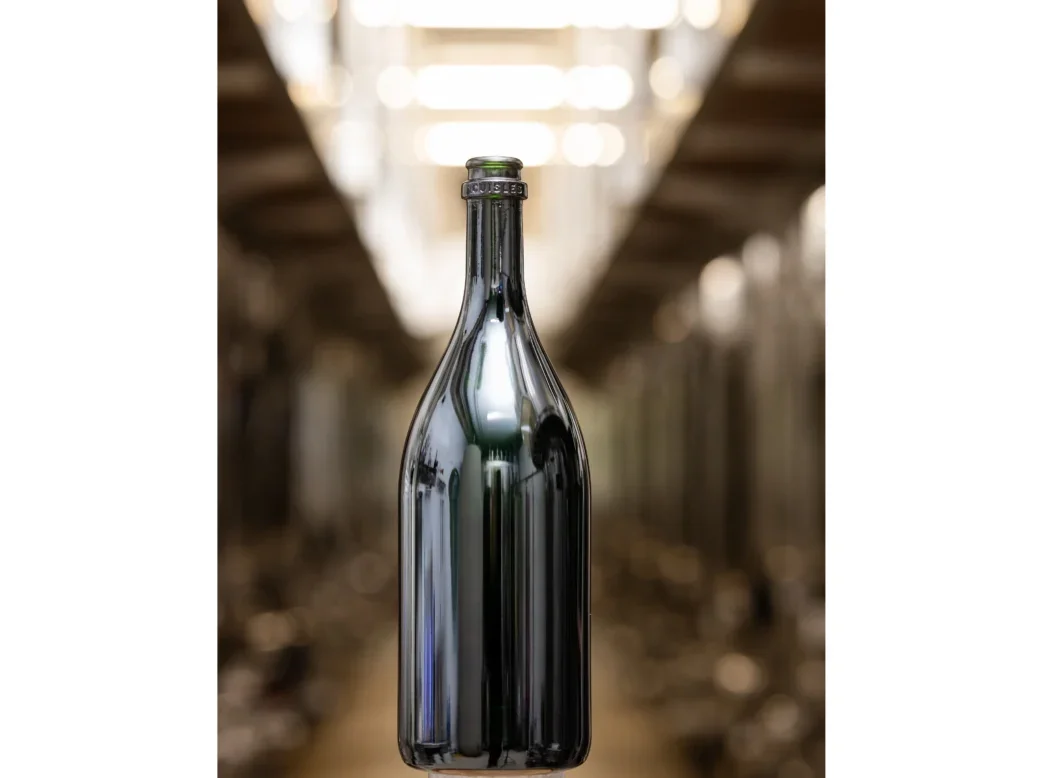
Tom Stevenson on Light-26, a new bottle with the potential to transform the way Champagne and other sparkling wine is made and aged.
Magnums are not only superior to bottles; they are like crystal balls. They reveal the future. They show a quality that already exists but cannot be seen through the clouded lens of the bottle format.
The Holy Grail is, of course, to achieve magnum quality in a 75cl bottle, but is this even possible? Cédric Moussé of Champagne Moussé believes it is and has, in collaboration with Saverglass, a specialist, high-end glass manufacturer, created Light-26, a revolutionary bottle specifically designed to replicate the magnum effect in a 75cl bottle.
The magnum effect is the slower evolution of a magnum, which is the result of its headspace and cork being the same as a 75cl bottle, but holding double the volume, thus halving its rate of oxidative evolution. Actually, the headspace is 33ml for a magnum and 25ml for a bottle, giving a magnum 66% of the rate of evolution, rather than half, but that just muddies the narrative. The magnum effect can be divided into two parts: pre-disgorgement and post-disgorgement. Most attention is focused on the post-disgorgement aging, but the second fermentation is more important.
Related

This magnum effect emerged in the 1920s as glassmakers transitioned from mouth-blown to semi- and then fully automated machine production, driven by the loss of experienced glassblowers in World War I. By 1936 virtually 100% of all Champagne bottles were machine produced, and this enabled the first standardized net ullage (headspace less cork displacement) of approximately 18ml (2.4%) for bottles and 26ml (1.7%) for magnums. Champagne bottles and magnums at that time weighed just over one and two kilos each. Initially, machine-produced glass was weaker and the molds had to be over-engineered and heavy, but as the glass grew increasingly stronger, 75cl bottles to drop to 960g in the 1980s and 900g by the 1990s, yet still maintaining very similar net ullages of 18.75 ml (2.5%) and 26.8ml (1.8%) for bottles and magnums respectively.
With the introduction of crown caps in the 1960s, however, and their almost universal adoption by the mid-1970s, the loss of cork displacement significantly increased the net ullage to 25ml (3.3%) and 33ml (2.1%), increasing the oxygen load, although the relative magnum effect became more pronounced.
Pioneers of light
Jean-Paul Vranken was the true pioneer of lighter Champagne bottles, launching his 800g Demoiselle bottle as far back as 1985. It took the CIVC a quarter of a century to partially catch up, when in 2010 it launched its 835g bottle to cut carbon emissions. If the CIVC been as equally focused on quality as carbon, it would have been easier to achieve a magnum-in-a-bottle with its thicker, heavier glass than Cédric Moussé’s thinner 725g Light-26.
Content from our partners



The Light-26 has a headspace of 2.3% compared to a standard bottle’s 3.3% and is almost identical to a magnum’s 2.2%. To achieve this while thinning the glass walls from 835g to 725g required a radical rethink of the internal geometry, employing the natural strength of the egg-shape for the shoulder and the Fibonacci sequence for the neck. This enabled the headspace to be reduced by 42% and yet still have the structural strength to hold the expanding liquid at higher pressure of a thermal spike to conform to regulatory safety standards. The reduction in headspace was accomplished by shortening the Light-26 to the point where its height and width could be divided by Pi (π), which is a fundamental component of the laws of physics defining how shapes endure loads and pressure, and by narrowing the neck from 29mm to 26mm externally (hence the Light-26 name) and 17.5mm to 16.3mm internally. The latter reduces the oxygen initial release, which is the oxygen inside the cork that is released when compressing the cork for insertion. The effect is very satisfying to the eye (or my eye at least), possibly due to the natural geometrics involved and a very comforting, lower center of gravity.
The Light-26 has a bague carré because a cork and agrafe provides optimal usage. Comparing a bottle sealed with a cork and agrafe to a bottle and a magnum sealed with a crown-cap is not a like‑for‑like comparison, which is why Moussé does not do so in any of his claims. Almost all bottles and magnums are sealed with a crown cap, however, so from a real-world perspective it is a valid comparison for me to make; and when I do, the Light-26 under a cork and agrafe has a net ullage of 1.5%, which knocks the magnum clear out of the park.
The real qualitative difference for Light-26 is its pre-disgorgement magnum effect. Using the same wine with the same yeast preparation, the second fermentation starts later and lasts longer, which has a knock-on effect for autolysis and Maillard reactions. Effectively magnums evolve at 66% of the rate of a standard bottle, while the Light-26 under crown-cap is an almost identical 68%, but when sealed with a cork and agrafe, it is 47%, rendering it 30% better than almost every magnum on the market.
A magnum is no longer “the same wine”: it is fresher and tighter in structure, with more focused, less oxidative fruit. It is not just relatively younger but has been shaped into a different wine. It has a different molecular composition and sensory profile, with a more seamless complexity—and the Light-26 with a cork and agrafe is demonstrably superior.
If a sparkling wine spends five years on lees and ten years after disgorgement, their relative age using the standard 75cl bottle as the baseline would be:
Standard bottle (crown cap): 15 years
Standard bottle (cork and agrafe): 11.5 years
Standard magnum (crown cap): 9.9 years
Standard magnum (cork and agrafe): 9.4 years
Light-26 (crown-cap): 11.5 years
Light-26 (cork and agrafe): 8.1 years
Cédric Moussé has set a new bar for bottles, quality, and aging potential in Champagne.