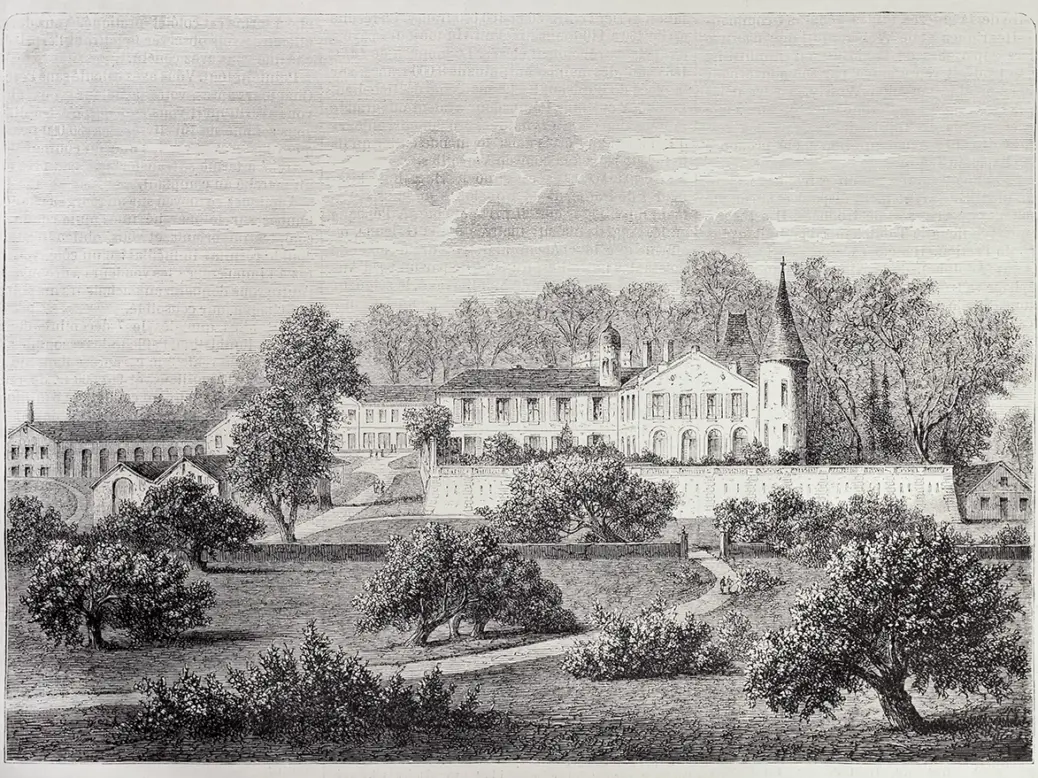
Andrew Jefford is inspired by a single bottle of 1986 Château Lafite Rothschild Pauillac.
Back to the classics. Surveying our world in 2025 from my little corner, a return to these sources feels almost involuntary. The cruel horrors of Ukraine and Gaza; the brushwood of political populism crackling merrily on the fires of social media; the dismantling of democracy by those in democracy’s debt; the tamping of global trade; a newfound fashion for gaudy environmental blindfolds, as catastrophe nears; the vaunting of lies as “free speech”; contempt for compassion, and for the mutual aid that transcends borders and boundaries. How better to respond to all of this, other than by studying the practice of congenial Stoics such as Seneca; other than by gasping at the spectacle of mad rulers run amok in the pages of Suetonius, reminding us that worse is always possible; other than by finding refuge in the love, delight, and tenderness of the personal realm, wine-slaked, in Horace’s spring-loaded lines?
Roman classics supply the antidote, but the Greeks… The Greeks bring something else. Reading them again made me wonder what “classicism” truly means. Classical music, art, architecture, and drama: Each school, each discipline brims with high endeavor and achievement. This is the giving, over 2,000 years or more of genius and craftsmanship, of gifts layered on gifts. Magnificent rewards lie there. So, too, does difficulty; you can’t always stroll in and enjoy. It could hardly be otherwise, since each new generation must strive to exceed what went before, so the foundations never cease to welcome accretion of subtlety and complexity. It means, though, that we’ve come to position “the classical” in opposition to the culturally accessible: the hits, the movies, the musicals. Guys and Dolls and The Godfather welcome their audience of all comers; Götterdämmerung asks effort of its devotees.
Read the Greeks, though, and you’ll see that this distinction is without foundation. Go back to Homer, Euripides, and Sophocles, their texts translated with careful exactitude, and you’ll find extraordinary, luminous simplicity. Open any page of The Odyssey: plain speaking and shocking descriptive economy is what greets you, driving this most restless of narratives. The brilliance is always clear, always crisp. I read Euripedes’ Helen, curious to see it argued that the person who’d caused the Trojan wars had never been to Troy at all, and I found in its place a tense thriller. The Bacchae, essential reading for us drinkers, is clearly mysterious, limpidly shocking. The original audience for these works was unlettered. They just listened; they were drawn in. These were hits, not monuments. They only became monuments later, encrusted with reverence and time.
Related
A thing of beauty
What of wine in all this? I made my way back along the dark, wind-harried beachfront in Deal toward midnight one May evening this year. My old friend Frank Ward—artist, merchant, collector, but above all wine lover—had a bottle of Lafite ’86 he wished to share as its 40th birthday approached, as well as to mark the 20th anniversary of Emile Peynaud’s death the previous July. This we’d just done, with two other old friends. Frank had declared it “the greatest of all 1986s” after he’d tasted it in 1987: “a miracle of subtlety, depth, and harmony,” and “surely one of the greatest-ever Lafites.”
It was, in the glass, very dark, almost opaque; a wine getting on for midnight, despite its four decades. It smelled of currants, mint, and resin—all the right things—and it did so with easy grace; it was an elder that walked with comfort still. You could stop to enjoy the aromas, as you might stop in a clearing in the forest to enjoy the light: They left you strangely ennobled. In the mouth: dark fruits, soft textures, fresh acidity, woven together, unfussy and complete. Keep it in the mouth, though, for a while longer—somehow it encourages this—then you see that it has a restless narrative of its own to tell. The acidity’s wavelength is expansive; it can lift and drive. The wing-beat of refined fruit flavor is still strong. How come? Because of muscular tannin. The muscles, though, are those of a dancer, limb-clinging; you hardly noticed them on the way in. You just saw an athlete in a tunic, standing there, smiling gently, showing you to your seat. Yes, everything is there, you realize with the searchlight of attention, but the wine almost tricked you with its quietness and its grace. It was just lovely red wine. Anyone would have said so.
This is a classic; it is classicism personified. In the Greek sense: It is a thing of beauty that drops its spell on all comers; art whose artistry is self-effacing. (Different, in fact, from the Mouton ’86 I described in issue 83—more a Götterdämmerung.) Lafite ’86 is beautiful red wine, and improbably young for its years. I know nothing about how it was made; Lafite’s own website notes merely describe “the scheme” of today. Can we make anything of the fact that it contains 16% Cabernet Franc and 15% Merlot? Not really. The 45hl/ha yield is generous; the 12.5% alcohol slips down. All I can think of are the vineyard photographs I’ve taken on visits—that great pebble-studded bank rising up next to the winery, to the highest point of the Pauillac appellation: vines under the now-forgotten skies of 1986, a season (like all) with its own restless narrative. Perhaps Lafite is red wine’s own locus classicus: the reference in justice, the authoritative passage, the exemplary elucidation. If you’re lucky enough, as I was in May, to get a look, a smell, a taste.
Content from our partners