

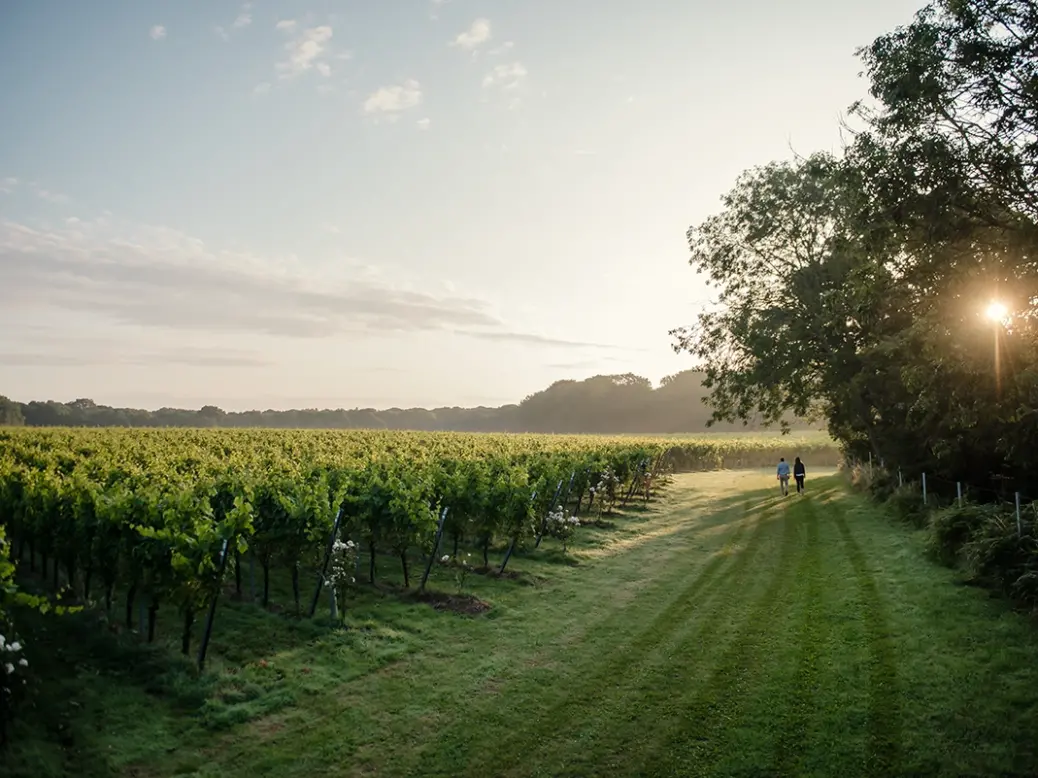
A conversation with an American sommelier about English wine usually revolves around a few touchpoints: climate change, as a factor enabling the grapes to ripen adequately, and they might mention that the south of England has “the same chalk soils as Champagne” and point to the Cliffs of Dover as an example. The other comparison to Champagne would concern cost: many English wines command the same price tag as Champagne. The more jaded sommelier might shrug and say “why bother then?”; the more enthusiastic ones lament the challenge of interesting their guests in the wines, when Champagne’s brand is so much more established, trustworthy, and glamorous. Traditional method sparkling wines from beyond Champagne’s borders—Cava, Cap Classique, even domestic US products—are expected to fill the price gap between proper Champagne and the vast lake of high-margin Prosecco, not compete with Champagne itself.
Visiting English wine country reveals a much more complex world. I’ve done so twice, in 2013 and earlier this year, though my first encounter with English wine was in the mid-1990s, when I lived in London for a couple of years. It was served at a classical music festival in Staines-on-Thames. A sweet red, it did not impress even my then-uneducated palate, and I promptly returned to my Old Speckled Hen. Around that same time, however, the some of the first, highly-regarded vintages of Nyetimber were being released.
On the US side there was essentially no talk of English wine until after the millennium, when rumors about the quality of Nyetimber’s wines began to circulate. Shortly afterward, Ridgeview appeared in the portfolio of the importer Grand Cru Selections around 2012. I was the wine director at the Armani Ristorante at the time, and the price on it was such that I couldn’t offer it by-the-glass, but low enough that I could include it in a pairing menu (themed to the London Olympics, and thereby justifying the presence of an English wine on the predominantly Italian list).
A handful more wines trickled into the US after Ridgeview, but I saw them more in importer tastings than I did on lists and shelves. That changed post-pandemic, though I expect Brexit and changes in the British domestic market were more to blame than Covid-19. We’ve seen a sudden influx of British restaurateurs opening locations in the US including names like Thomas Straker, Evolv Hospitality, Gymkhana, and Dishoon. I have the impression that tax policies and other issues have made the US look more profitable than further growth at home; perhaps the wineries are finding the same. Or maybe the industry has simply matured to the point where it can or even needs to diversify its markets. Today, were I still on the floor, I would have my choice of a goodly number of English sparkling wines, and a few still wines as well.
Related

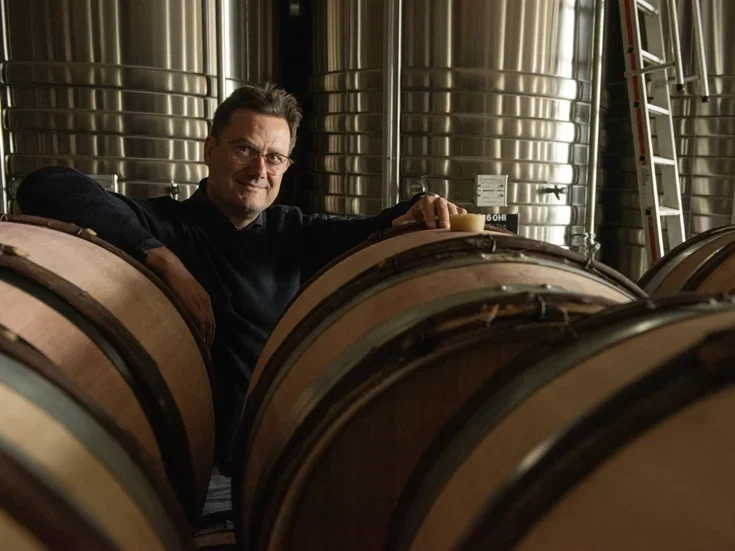

English wine, therefore, has appeared on the US market relatively suddenly, almost fully formed, and with little sense for the decades of work that lies behind it. Aside from the dubious wine mentioned previously, my only personal contact with English wine’s deeper past was a visit to Breaky Bottom, where the late Peter Hall hosted me. I came away with a bevy of anecdotes that seem to be par for the course whenever one spent time with him. When I arrived Peter informed me that a busload of Danish customers was visiting at the same time; concerned that they were expecting a private visit, I was to pretend to be an old friend who happened to stop by. All my questions therefore had to be framed as, “Maybe you should tell them about the …” Only after they left and we took a cautious walk through the then-muddy vineyards was I able to drop my act.
And only after they left did Peter open an older wine from the 1990s. It showed me that even if the unappealing red wine I remember from my student days may have been typical of its time, there were wines that showed England’s potential even then. I was a regular taster and even enjoyer of hybrid grape varieties, but the generally accepted line in the Eastern US at the time was that hybrid grapes could produce pleasant but not exceptional wines, worth planting in places where vinifera wouldn’t thrive. Breaky Bottom’s achievements with Seyval Blanc easily put paid to that idea.

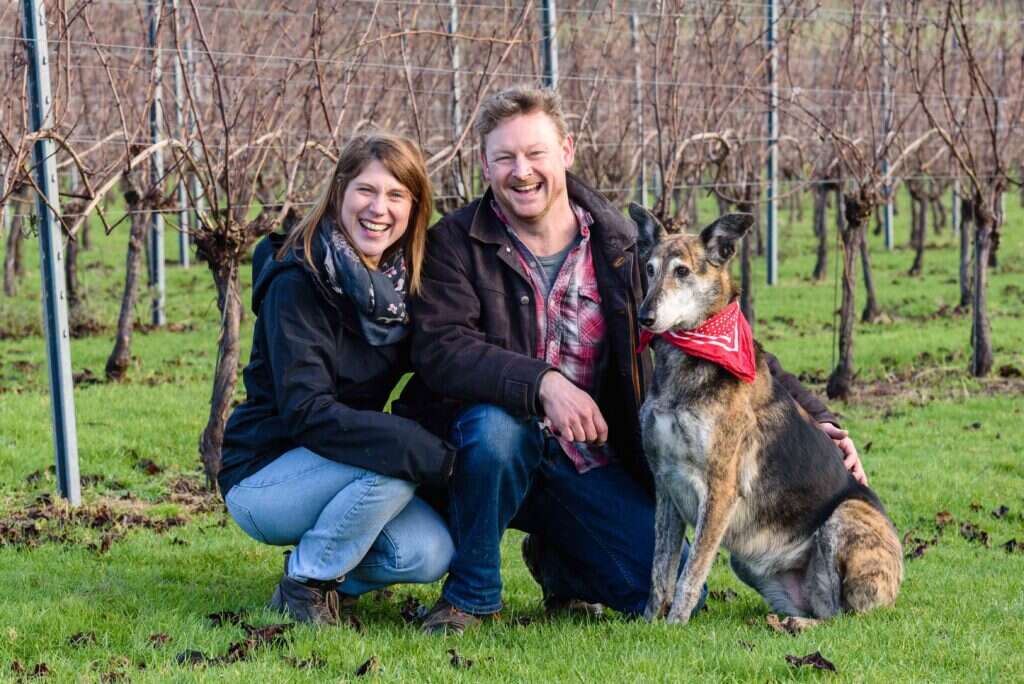
Breaky Bottom was also the first English winery I visited where I sensed the character, drive, and energy of one man shining through in his wines. On my visit this March, Dermot and Ana Sugrue made a similar impression, despite a different approach. Breaky Bottom’s wines are tied to the six acres of vineyards on the farm, whereas Dermot’s work with contract winemaking when he was at Wiston exposed him to vineyards across southern England. Today they farm 12ha (30 acres) of vines across the South Downs. Breaky Bottom’s wines always struck me for their precision and generosity; the Sugrue wines on the whole are more powerful and firm, but in both cases one feels the drive and fingerprints of the personalities behind them.
Content from our partners

But making traditional-method wines is a capital-intensive affair, even in places where the land is affordable. Consequently the story behind many English wineries resembles that of a Napa or Sonoma brand more than that of a winery in a similarly youthful region, often something along the lines of “our founder X made their money in pharmaceuticals/tech/plumbing supplies, but always loved wine and wanted a summer place surrounded by vineyards, so when they saw this beautiful property …” Henry Jeffrey’s Vines in a Cold Climate gives the impression that the gentleman farmer has long been the leading cliché of English vineyard ownership; finance and industry bigwigs have simply replaced retired military pensioners. Nothing wrong with that; it is entirely in keeping with the long-established joke about how to make a small fortune making wine. Those deep pockets brought modern equipment and facilities as well as talent to the English wine industry. Without that level of investment, it’s hard to imagine how any region essentially new to quality winemaking could go from zero to six bars in under three decades.
From this side of the Atlantic it does create a sense of somewhat corporate uniformity to English wine, with little sense of scale. For example, it isn’t readily apparent that Chapel Down is an immense operation, responsible for producing one sixth of all English wine. Their 400ha (1,000 acres) of vines almost matches the resources of Champagne houses like Lanson or Palmer. But in terms of brand awareness, they’re middle of the pack in the US, lacking the name recognition of, say, Nyetimber or Gusbourne. That may change now that Jackson Family Wines is importing the wines, and having a brand that can take up shelf space in a goodly number of shops will be good for the category.
The investment made by the Champagne houses Taittinger and Pommery adds some diversity to the scene. While their presence is certainly newsworthy, Champagne houses have plenty of satellites making traditional method wines outside of France; both Pommery and Taittinger have well-established projects in California, for example. American drinkers, should they opt to try an English wine, will probably tend toward ones that lean into their Englishness rather than being merely a French outpost. That’s not a comment on the quality of the wines, and American bubbly fans will nonetheless see the French presence as validation of England’s potential. On the other hand, Pommery has wisely positioned the English “Louis Pommery” about $15 lower than their French non-vintage Brut Royal, albeit about the same amount above their California NV wine. Taittinger’s Domaine Evremond is on its way but has yet to hit the shelves here.
While it’s clear that sparkling wine will likely dominate England’s winemaking identity for some time, the still wine category adds a great deal of depth and personality to the scene. For one thing, in the still wine space young winemakers are more able to start up their own brands, purchasing grapes and renting cellar space, without relying overly or perhaps at all on investors. The turnaround on still wine is faster, and less capital is tied up in the cellar while a vintage rests on its lees. South African ex-pats Den’e and Ian Louw are exploiting that freedom by taking a nomadic approach. Their current vintage of Chardonay and Pinot Noir is made from Elham Valley fruit, but future vintages are in the works with grapes from the Kit’s Coty vineyard, like Elham Valley also in Kent; Essex, and elsewhere. Domaine of the Rose and Bear is putting a “his and hers” spin on their wines: Sarah Stott’s D.P. Rowe wines, named after her mother, works in a classical manner with Chardonnay and Meunier from the North Kent Downs. Husband James Snowden’s Fennica wines are focused on various forms of Pinot, mostly from Suffolk; his Pinot Blanc spends nine days on the skins, and the Pinot Gris is full-on Northern Italian Ramato in style, albeit with a well-balanced, light grippiness. He’s also working with ceramic aging vessels for all three of his wines.
Most of the best still wines I encountered came from Chardonnay or the Pinot family. Bacchus was a pleasant surprise, and while the less floral examples might appeal to American Sauvignon Blanc drinkers, they didn’t present a strong enough argument as to why said drinker would risk purchasing an unfamiliar variety from an unexpected place.
The greater range of wine styles goes hand-in-hand with a less reductionist understanding of England’s terroir. Southeast England is maritime, not continental, as Champagne is, and not as uniform as Americans might imagine. Kent is sunnier than other counties, with three soil types at play; there may be a chalky bedrock below, but topsoils also include what are known as green sands and other, more clay-rich areas. Some in the industry are considering applying for three different PDOs for the county, based on these soil variations. Sussex, also sunny, seems to be staking a claim for Chardonnay in particular, thanks largely to how well the grape does on the chalky soils of the South Downs. Several winemakers called out Essex, drier than Sussex or Kent, as the best place to make still wines. “The future is Essex,” as Dermot Sugrue put it. Certainly, his Pinot Noir and those of Danbury Ridge and Fennica, the last tasted from the barrel, suggested that Essex’s Crouch Valley was proving to be a very comfortable home for that famously fickle variety.
The marketing of English wines in the US is nonetheless built on proximity to and similarity to Champagne—the talking points US sommeliers have taken on board, as mentioned at the beginning of this piece. It’s clear and easy to comprehend, and it should probably remain at the forefront of the industry’s messaging for US exports for a while longer. But the diversity of the English wine, in terms of what makes it into the bottle, yes, but also as regards producer models and ownership, and especially in terms of terroir, will all need to be brought forward if the category is to have ongoing appeal. It will also be key to getting the wines out from under the shadow of Champagne and thereby both allowing and forcing producers to justify their prices on their own terms. I think that may be a struggle for some; but based on what I’ve seen and tasted it’s a transition the industry is prepared to manage.


