


After attending the first tasting of the first wines ever produced in Bhutan, Chris Howard reflects on humanity’s appetite for novelty.
Why do we want what we want? What does our obsession with the new and novel say about us? What utopian currents might we be adrift upon in the vinous sea?
Such questions were on my mind as I returned from tasting Bhutan’s inaugural vintage in Paris one balmy June evening. As we know, wine is as conducive to thinking as drinking, and this was no exception.
As has been well-documented, the carbon-negative Buddhist kingdom governed by Gross National Happiness rather than GDP has officially joined the wine world. The launch of the Bhutan Wine Company and an auction of its first commercial wines have received a cascade of press from major and minor outlets, all while the nascent wines remained untasted and untouched.
Related

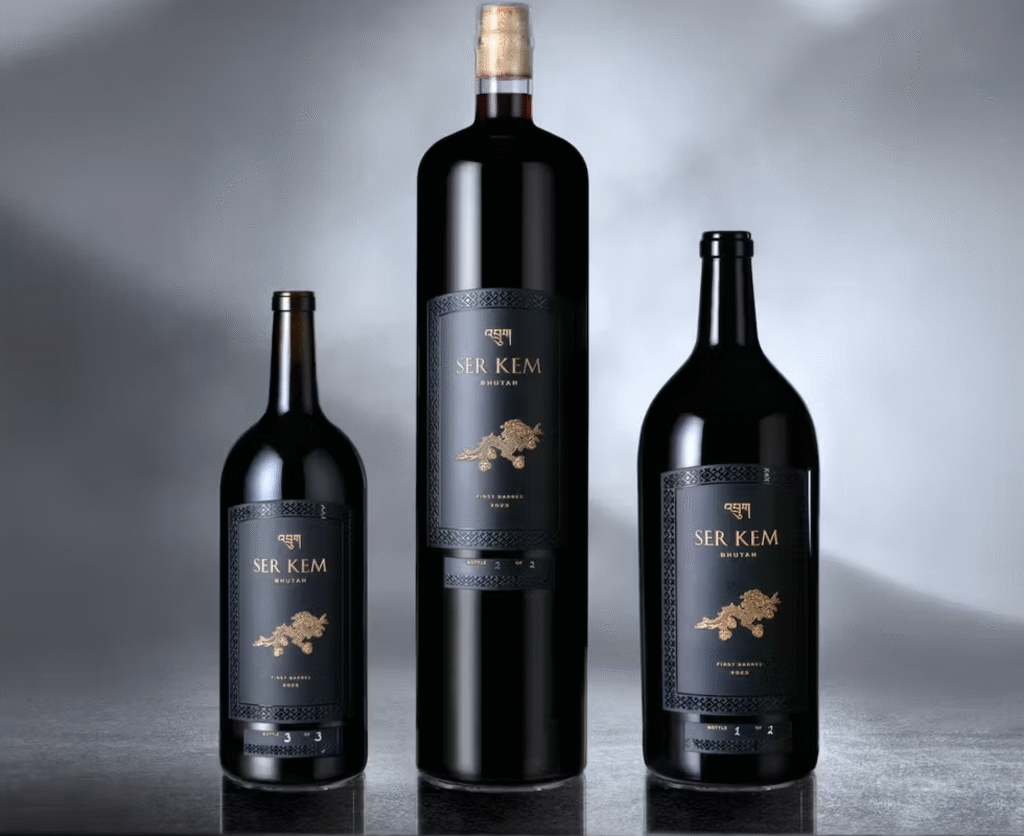
At the Bonhams auction, a 7.57-liter red aptly dubbed “The Himalayan” fetched $18,750. The unique, broad-shouldered bottle references the 7.57km (4.7 miles) summit of Gangkhar Puensum, the world’s tallest unscaled mountain. Amayès Aouli, Bonhams’ global head of wine and spirits, described it as “mythological.”
Remarkable indeed, yet to what extent are we drawn to the new before we even know what it is? Or as political philosopher Hannah Arendt wondered, is the new actually “the longing for the new, not the new itself”?
Now that the thunder dragon has descended from the mountain tops and entered the marketplace, the question on everyone’s mind is … so, how are the wines? They’re good. How good? The answer, as is often the case with wine, is complicated.
Content from our partners


The following essay discusses Bhutan’s first wines, but more importantly, steps back to offer some perspective that has so far been lacking in the coverage—including my own—of Bhutan’s foray into the wine world.
Do the wines justify the attention and valuations? To what extent is the seduction of novelty at work here, the promise of self-transcending renewal and social distinction? Like conquering an unscaled Himalayan peak.
My pursuit of answers led me to a trilogy of overlapping concepts: Utopia, novelty, and desire. While it may appear that I’m singling Bhutan out here, many of the observations below apply to the wine world, consumer culture, and human condition, and I think it behooves us to be aware of them. Before wading into these deeper waters, a few words on the wines themselves.
A First Taste
The tasting was presided over by Bhutan Wine Company founders Mike Juergens and Ann Cross, the energetic American couple who fell for Bhutan’s terroir while visiting the country to run a marathon in 2017. You can find the origin story I wrote here, and in many other outlets.
The first release of the Ser Kim range, with Ser Kim referring to the Bhutanese ritual offering of alcohol to the gods, consists of four whites and three reds. As we prepared to blind taste the wines, Juergens explained that he was simply interested in our impressions and that the important thing was that the tasting was free of bias.
Although we tasted blind, our small group arrived knowing we were about to taste Bhutan’s maiden vintage, our minds alight with associations, representations, projections. While the ideal in wine tasting is neutrality, such phenomena operate largely beneath the conscious mind. There is something to Lacan’s notion that we remain for the most part within the realms of the Symbolic and Imaginary, only ever catching a glimpse of the Real. Hence, despite the advances of modernity, we humans remain inexorably mimetic and mythic creatures, including in the world of wine.
Had we tasted Bhutan’s wines truly blind— that is, with little to no context, which is almost never, if ever the case—I think I would have thought that these were mid-range French wines, the whites in particular. For the style and profile, and probably because I live in France and drink mostly French wine these days. Our mapping minds are generally primed by our most recent experiences and context.
Ferran Centelles, the Spanish sommelier and critic, reflected how one of the habits he chastises himself for is his tendency to only recommend wines he’s tasted and enjoyed recently, versus those of six months or more ago. It’s not that the recent wines are better, they’re just top of mind, he observed. But Centelles should not be so hard on himself. As Nietzsche observed, forgetting isn’t necessarily a weakness but essential to an active, creative life. Forgetting makes space for the new.
The Traminette (an American hybrid that is half Gewürztraminer), with its unctuous texture, rose petals, and lychee, channeled Alsace. The Chenin Blanc and Sauvignon Blanc showed Loire-like vibrance and restraint, while the off-dry Riesling, with its length and poise, stood out, again bringing Alsace and beyond the Rhine to mind.
The reds were less expressive and seemed more New World. Both the Tempranillo and Bordeaux blend had been matured in 100% new French oak and as such were tight and tannic, though the sharp edges should soften with time. The Pinot Noir, made in a glass carboy with Bhutanese oak chips, essentially a garage wine, was juicy and displayed candied red fruits and berries.
So far so good for a first vintage in a brand-new wine country with very young vines and a hitherto non-existent wine culture. But as I wrote up my tasting notes, checking the Bhutan Wine Company website for some details on the winemaking, I couldn’t help but notice the prices. The wines in the Ser Kim range start with an $80 Rosé and run to a $500 Pinot Noir.
When I inquired about the pricing model, the response was that it’s as simple as the law of supply and demand. There are only a handful of these wines available. The question then is what exactly drives such demand?
The Symbolic Geography of the Himalayas
To understand the allure of Bhutanese wine, we might start by considering the symbolic geography of the Himalayas. Coincidentally, this was the subject of my doctoral research in anthropology, published in book form here. There I devoted particular attention to utopian imaginaries and the symbolism of mountains.
Mountains have always functioned as sacred spaces in human consciousness, embodiments of the timeless and transcendent. From Mount Olympus to Moses receiving the tablets on Sinai to the Himalayas as the abode of the gods, mountains carry symbolic significance far beyond their geological reality. As the “roof of the world,” the Himalayas represent this mystique in its highest form—where heaven and earth meet and the material and spiritual realms converge. Along with conducting ethnographic research in Nepal and northern India, I also dove into the vast literature of mountain mythology, from religious quests to modern treks.
Throughout history, mountains have been places of pilgrimage for many cultures around the world. Frequently lying in remote areas and requiring long journeys from villages or cities, mountains have often been represented in mythology as the sacred domains of gods and spirits. The geographer Yi-Fu Tuan notes how peripheral geographic locations, especially mountains, have frequently symbolized anti-structure and timelessness in different cultural traditions: “In Taoist lore, timeless paradises are located myriad miles from any known human settlement, while the European mind also envisions atemporal Isles of the Blest, Edens, and Utopias in remote and inaccessible places.”
The narrative of Thomas Mann’s The Magic Mountain is structured by a contrast between “those up here” and “those down below.” Mountains exist outside ordinary time—places where the profane rhythms of social life dissolve into something sacred and eternal.
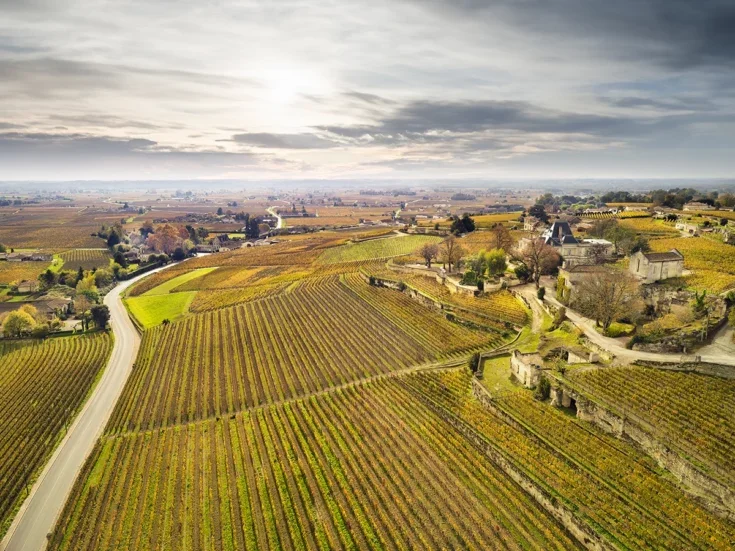
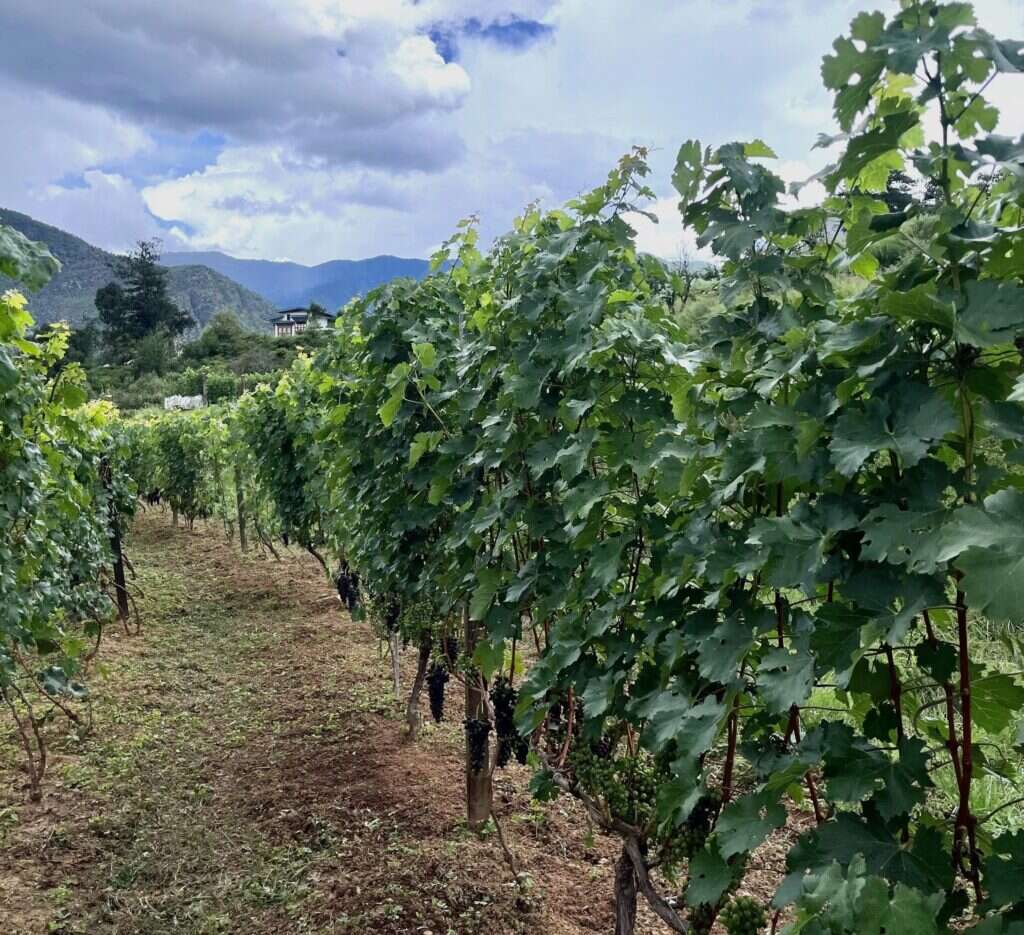
Bhutan partakes in this utopian imaginary through images of a last Shangri-La. Generally presented as the antithesis of an unhappy, spiritually disenchanted West, Bhutan holds the promise that there is at least one place on Earth that is organized around peace, happiness, and harmony. This image in part explains why the launch of the Bhutan Wine Company captured such immediate attention. More than another new wine region, Bhutan signifies a final frontier. Here is virgin terroir in the most literal sense—soil that had never known grapevines, unpolluted mountain air, pristine water flowing from glacial peaks, happy Buddhist farmers. The wines promise not just sensory pleasure, but spiritual purity.
The powerful utopian imaginary surrounding Bhutan and the Himalayas more broadly is at play in the allure of Bhutanese wine, yet there is a related and broader dimension to consider: our fascination with the new and novel.
Neophilia: The seduction of novelty
Having surveyed the spiritual magnetism of mountains, let’s now look at why we are so drawn to the new more generally. In New: Understanding Our Need for Novelty and Change, science writer Winifred Gallagher argues that humans are biologically programmed for “neophilia”—an innate fascination with novelty. From infancy, our attraction to new experiences drives learning, creativity, and adaptability. At the core it’s an evolutionary asset, but in the contemporary, hypermediated world of consumer culture, our natural craving for novelty is hijacked, leaving us distracted, restless, and mindlessly adrift on the latest trends.
In a related vein, Robert Harrison’s Juvenescence: A Cultural History of Our Age explores the late modern fixation on youth. Building on the biological concept of neoteny—the retention of youthful traits into adulthood—Harrison sees youthfulness as a key driver of creativity and innovation. The healthiest cultures, he argues, renew themselves by balancing youthful energy with mature wisdom. But when the “juvenilization” of society overshadows traditions, knowledge and perspective is lost as we risk remaining in perpetual adolescence.
Historian Michael North, in Novelty: A History of the New, takes this further. He shows that Western culture has always oscillated between novelty as renewal—a cyclical return—and novelty as inventive recombination. Even our most celebrated innovations are steeped in tradition. North lingers on Ezra Pound’s misunderstood modernist mantra, “Make it new,” itself a recycled phrase from ancient China, noting the irony that even our cries for change depend on what came before. As North writes: “All that is new, then, is possibly simply a reorganization of that which is old and already present—or not. That is up for you to decide.”
Considering Bhutan’s wines, their novelty is not in undiscovered grapes, but in familiar European varieties grown in soils and an environment that are not “new” but a variation on other earthly contexts. “Novat reiterando,” as Paul Valéry termed it in his Notebooks: to renew through repetition, where repetition literally means to re-petition the source. Repetition not as copying but regenerating to bring fresh life and vibrance to what came before—as Virgil did to Homer, and Dante to Virgil, or Monet did to Turner, and Rothko did to both. Having explored the role of utopia and the power of the new, there is the element of desire, which may be the most powerful and underlying force of attraction of all.
Mimetic Desire and Questions of Value
Mimesis is the human proclivity for imitation in everything from artistic forms to social life, as Aristotle first explained in the Poetics. French philosopher and anthropologist René Girard gives the concept a powerful twist with his influential mimetic theory of desire. Girard observes how we rarely want things for their intrinsic qualities. We want them because other people want them. Desire is a social rather than individual phenomenon. We especially want things that are new, scarce, and valuable.
The $18,750 “Himalayan” sold at the Bonhams auction is a case in point. Here is a wine that no one had meaningfully evaluated—no critics or sommeliers had tasted or rated it. Yet it sold for the same amount as a six-liter bottle of the time-tested, critically-acclaimed Petrus 1986. Its sheer novelty, radical “firstness,” and utopian associations generated immediate market value that bore no relationship to sensory experience. Bhutan’s first wines became almost immediately desirable precisely because they were unavailable and unprecedented.
Economists call this the “novelty premium.” In wine, this can reach extraordinary heights in the premium category, which is organized around scarcity and exclusivity. Stratospheric prices are regularly paid not for a beverage in a bottle, but for the story it tells, the cultural capital it confers, the social distinction it affords, the desire it purportedly satisfies. But to say so is to violate what the anthropologist Pierre Bourdieu calls the “taboo of the unspoken.” Many truths are simply too inconvenient to tell. As the line on a friend’s email signature reads: abandon reality, settle for a good fantasy.
Novelty alone doesn’t explain it, however, as evidenced by a recent trip to Brittany and Normandy to document the nascent wine scenes in regions traditionally associated with cider, oysters, and Camembert. There, perfectly respectable Chenin Blanc, Chardonnay, Pinot Noir, and more are being made and sold for $10-$20. Norman and Breton wines appear new and novel, though once again, this is novat reiterando not tabula rasa. Wine was made here in Roman and medieval times under different climatic conditions, so this too is a regenerative return. The supply is extremely limited since most vineyards have only been planted in the last few years. Beautiful as these regions are, they don’t arrest the desire and demand quite like Bhutan. (Nevertheless, put this area on your wine radar because a renaissance is alive and well in northwest France.)
All of this raises questions of value (and values) that go well beyond standard economics. The buzz around Bhutan’s first vintage takes us into moral, aesthetic, and symbolic territory that cannot be reduced to rational calculation and singular measures, such as price and labor costs. Rather than a fixed, inherent property of the wines themselves, value in the broader anthropological sense is dynamic and influenced by a confluence of factors, from identity, social status, and culture to novelty, scarcity, and mimetic desire.
The Rashomon Effect
I’m not the only one asking such questions. When the subject of Bhutanese wine arises in conversation with friends, family, and those in the wine industry, some ask, in a world with an oversupply of wine and dropping consumption, with vines being ripped out in traditional regions, do we really need a new wine country? Others wonder what the local perspectives are, as so far we have only heard a few voices—mostly those of the American founders. Some go as far to ask whether this is neocolonialism and more American hubris.
We all love the thrill of discovering the next new wine, but these are fair questions to put on the table. Speaking of tables, what might help balance the scale is a blind tasting of Bhutan’s wines placed beside those in similar price brackets from established wine regions. Wine tasting, blind or otherwise, will never be an exact science, but this would get us a little closer to understanding the “true” merit of Bhutan’s wines.
Following the first Bhutan tasting that balmy June evening, we all had dinner at the aptly named Paris bistro, Juvenilles, before ending the night at a corner bar in the Marais. On the way, we came upon a shuttered restaurant by the name “Rashomon.”
“Ah, Rashomon … “ I say.
Nobody responds.
I continue in vain, aware that no one is interested or listening.
“Rashomon, Akira Kurosawa’s masterpiece—it won the Golden Lion at the 1951 Venice Film Festival. Set in a forest in medieval Japan, it’s the story of a murder, told from four perspectives, leaving the viewer unsure who is telling the truth.”
Everyone looks away.
It’s past two when I return to my apartment, wondering what the true story of Bhutan’s first wines is. In a stupor, I find myself writing a long letter to the King of Bhutan, mostly asking his views on the Noble Eightfold Path, particularly the correlation between right aspiration, right speech, and right action. The unsent letter is the first of four versions of this very article.


