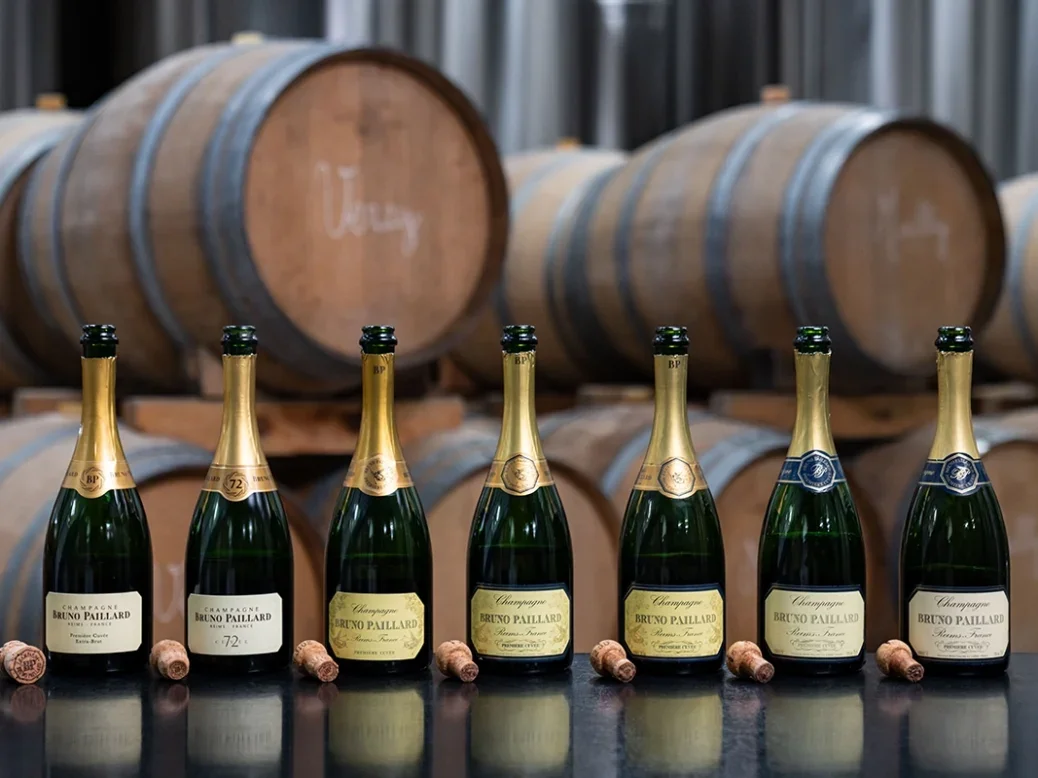
Simon Field MW attends a celebration of 40 years of Bruno Paillard’s Perpetual Reserve, comparing the ever-more complex flagship cuvées made from it with antecedents stretching back two decades.
One of the youngest of what we used to be allowed to describe as Grandes Marques, Champagne Bruno Paillard was created in 1981 by the eponymous négociant, a clear signal of qualitative intent, an elite entity that has been carefully segregated from all of Bruno’s other business interests (Lanson-BCC et al) and that is now run by his daughter Alice, one of Champagne’s most thoughtful chefs de caves.
Youth notwithstanding, La Maison Bruno Paillard was among the first to initiate its Perpetual Reserve, which now celebrates its 40th anniversary. Necessity being the mother of invention, Paillard was dismayed by the quality of the 1984 vintage and realized that it was not good enough to keep for posterity as a reserve wine. The only way to overcome similar potential problems, it seemed to him, was to inaugurate a system whereby the reserve wines were added together year after year, thereafter to gain in complexity as an inevitability. For each annual contribution from the Perpetual Reserve (PR) to the latest base wine, there would be an equal and opposite addition made to top up the PR in order to refresh and energize it and, of course, to keep its containers full and thus protected from oxygen. The 1986 Première Cuvée was therefore two thirds wine from 1986 and one third added from the PR, which at the time was almost exclusively 1985, and so on. Forty years on, the 2025 version of the PR may be described as 40 times more complex than its progenitor, containing residual wine from each of the previous four decades, albeit in vanishingly small quantities when one considers the early years. An “inverted pyramid,” per Alice, who also describes it as “a perfumed elixir”; the quintessence of the house style, to be added to the base wines to imbue textural layers of complexity and a subtle historical perspective. Quantities added are generous, averaging around 33%, and sometimes climbing to 50%. This may be an elixir, but its application is generous and transformative.
It is not, however, and nor is it intended to be, a Solera, famously “pioneered” in Champagne by Jacques Selosse and now a few others. In a Solera, the blending is fractional, with different levels (criaderas in Sherry terms) holding wine of different ages, and with a deliberately oxidative regime in place. Alice’s PR may be stored in different vessels (which de facto will influence the style of the wine therein) but all of it is aged similarly. The age of the PR wine kept in stainless steel is the same as that kept in barrel, and the decanting will always be mirrored by a fresh fill from the base year. It is what Alice describesas a “thread of integrity,” carrying the identity of the house and, with it, its reputation. The vast majority of the PR is kept, in any event, in four large stainless-steel vats.
Related

Alice’s London masterclass focused on the flagship Première Cuvée, together with its big brother, the longer aged Cuvée 72, and a still Coteaux Champenois wine, the last shown to give a snapshot of how the elixir actually tastes before it undergoes its autolytic transformation. The alchemy before and the alchemy after… For once, there is little focus on the specifics of terroir or varietals, but it should be noted that the wine is sourced from more than 30 sites, 12 or so of which are grand cru, and that the blend cuts through all three of the key varietals, favoring Pinot Noir (45%) over Chardonnay (33%) and then Pinot Meunier (22%). First-press juice only is used, and the malolactic fermentation is not suppressed. The dosage regime is pragmatic, but these days the wine is kept within the Extra Brut perimeter (i.e. under 6g/l). It is worthy of note that the two oldest wines in the tasting were dosed at slightly higher levels, underlining the ensuing change in attitudes.But idées reçues are often challenged by Alice, whose approach is distinctly cerebral… without, of course, overthinking things! She maintains, for example, that the level of the dosage should actually mirror the character of the vintage, rather than providing a counterweight, therefore often adding more sugar in warmer years. In the same vein, she advocates particular attention on the reserve wines from cooler years such as 2017 and 2013, this in the name of structural harmony and perfect integration of the acidity. She also reminds us that there are other completely independent PRs created to nourish other members of the Paillard Multi-Vintage range, wines such as the Blanc de Blancs and the Blanc de Noirs.
The focus of the tasting is, of course, primarily concerned with the Perpetual Reserve itself, a paradoxical beast in that it is called upon to imbue a consistency of style, yet with each passing year it becomes more complex and nuanced. The passage of time is to blame, here and elsewhere, specifically in the duration of the post-disgorgement aging, which, to Alice, is every bit as important as the tirage itself. The counterbalance between a younger PR and a longer post-disgorgement age is fascinating in itself. Is there a precise moment when the pendulum should be frozen in alchemical perfection? Maybe, but it is impossible to achieve; time present and time past are perhaps both present in forging the structural integrity of what we taste and in what we are to taste in time future. Complexity thus has different routes to the palate. This is underlined by the inclusion in the tasting of the Cuvée 72, which has a guaranteed aging of at least 72 months, with at least 36 months both before and after disgorgement, often more, as with the current release. This guaranteed extra aging makes for an instructive comparison. The final trio of the tasting—wines disgorged in 2014, 2009, and 2005—serves to illustrate a capacity to age and evolve on the cork. The wines are delightful; perpetually fascinating and beautifully harmonious.

Tasting
The Chef’s Table, The Dorchester, London; October 14, 2025
Content from our partners
Coteaux Champenois Réserve Perpetuelle (Bottled April 2025)
No fewer than 39 vintages make up this, the latest bottling of the still wine, an intellectual rather than a commercial exercise, but one that does not abdicate the task of offering pleasure. A very distinctive pleasure, sui generis, from the deep, more orange-garnet than faded gold, color, through to a seam of crystalline acidity. Purity abounds, in the sense of the absence of autolysis, but is challenged by inherent complexity and multiplicity of flavor, which ranges from earthy, cherry, and black tea through to lemon pith, sourdough, and bruised apple. Tension in Champagne plays out between the bubbles and the fruit; here it assumes a vinous identity, an inherent fascination only enhanced by its highly unusual gestation and the ongoing refreshing gift from the annual ritual of topping-up. | 92
Première Cuvée Extra Brut (Current release; base 2020; disgorgement January 2024; dosage 5.4g/l)
Pale gold, with an elegant and persistent mousse, ensuing aromatics juxtaposing fresh citric and orchard-fruit notes, with a generous, almost creamy texture, itself held in check by a chalky backdrop and a persuasive line of acidity. Red fruits and spice remind us of the Pinot presence and its quietly persuasive power. The influence of the Perpetual Reserve broadens the appeal and provides eloquent respite from the riper inclinations of the warm 2020 vintage. | 93
Cuvée 72 (Current release; base 2017; disgorgement August 2021; dosage 5.4g/l)
The 72 stipulated months between bottling and release has been exceeded, in this instance, by a year, but Alice is disinclined to change the name to Cuvée 84! She cites 2017 as one of her “favorite” years, somewhat controversially, given the tricky conditions, and considers its character ideal for the extra aging. And so it proves, from the generous honied aromatic, through to the complexity of the palate, which is symphonic in scope and which effortlessly marries fruit, flowers, and spice, a more savory undertow betraying its relative maturity, all buttressed by crisp acidity. Gastronomically inclined, toasty, and rich, the wine evolves beautifully in the glass, surprising us with notes of lavender and tobacco leaf. A pleasant surprise, for sure. | 94
Première Cuvée Extra Brut (Base 2020; disgorgement May 2014; dosage 6g/l)
Burnished gold, a Rembrandt dinner party; Belshazzar’s Feast, say. A suitably noble nose, leafy rather than flowery, its fruit character dried and gently spicy. There is no desiccation on the palate, however, with bright acidity and vestigial citric charm and a comforting forest-floor foundation. Generous in scope, with a teasing, bittersweet finish. | 93
Première Cuvée (Base 2005; disgorgement December 2009; dosage 6.5g/l)
Two decades on but still bright, albeit with crepuscular hints of amber to betray age. Significally more evolved, even appearing to be oxidative of temperament, with mushroom and white tobacco dominating the aromatic, and thereafter a velvety, almost caramelized texture and a vinous attitude. Notes of fig and biscuit, acacia and walnut; a slightly smoky, nostalgic finish. | 92
Première Cuvée (Base 2001; disgorgement 2005; dosage 8g/l)
The final wine, in the vein of the third, has as its base an apparently weaker vintage, this time the rain-sodden 2001. Alice is unabashed, relishing what she describes as a “joyful aromatic,” in which she detects candied orange, Christmas spice, quince, nutmeg, and saffron. Not a bad combination! The Pinot Noir is in control at the moment, she says, imparting notes of sourdough savories, and umami, all nobly supported by firm acidity and a faint thread of salinity on the finish. Intriguing and rather delightful. | 94