If you are not familiar with the wines of Irancy, it’s a good time to become acquainted, since there is now a decent chance of ripening Pinot Noir and even César, the local red variety. This picturesque village lies 18km (11 miles) south-west of Chablis. The wine was classified as Bourgogne until 1998 when it gained AOC status in its own right for red wines which are made of Pinot Noir but which can include up to 10% of César.
Martin Charriat and brothers Gabin and Félix Richoux are part of the new generation injecting youthful energy into promoting Irancy and Gabin kindly took me for a vineyard walk to get to grips with the lieux-dits. Between them, these domaines own about one tenth of the 315ha (780 acres) appellation of which about 220ha (540 acres) are currently under vine.
There is archaeological evidence that the César was grown here some 2,000 years ago at Escolives-Sainte-Camille and documented evidence from the 800s when vines in Veaupessiot were gifted to a monastery. More recently the Charriat family have tended vines since the 1550s. “We have been making wine with César for five centuries now and we do not want to lose this tradition.”
But Irancy is also known for its cherry trees. Gabin’s great, great grandmother was typical in making cherry wine as well as planting cereals. Grapes were simply one crop in the polyculture surrounding the village, but in the past ten years many of the cherry trees were cleared for the more lucrative production of wine. The Irancy growers’ syndicate (Syndicat des viticulteurs d’Irancy) are hoping to upgrade the best climat to premier cru status, but protecting the biodiversity within their appellation comes first on their agenda. To this end they are petitioning the local authorities to protect the woodland which covers the five principal combes.
Related
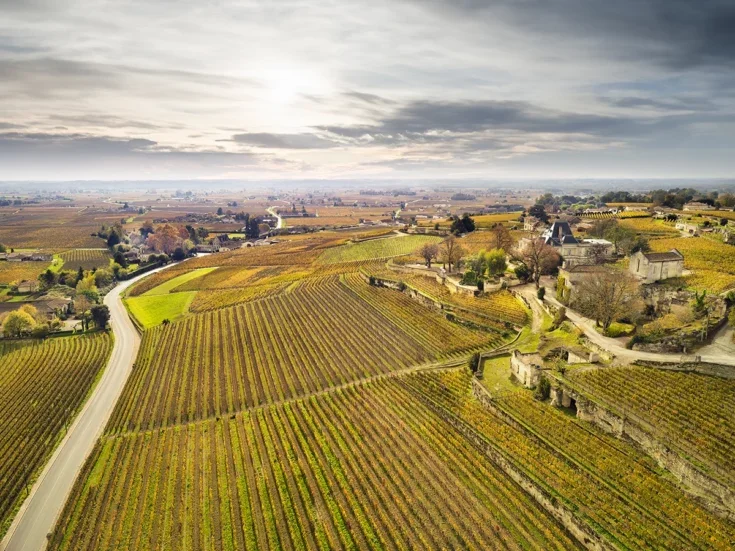
The vineyards drape across slopes surrounding the small community of just 290 inhabitants clustered around a surprisingly large church. The hills form a natural amphitheater open to the south-west where the landscape rolls onto an open plain. The steep hills which hug the village on its other flanks offer shelter from bad weather—the north wind and rain—which funnels around the outside of the hills. The vineyards within enjoy a microclimate protected from frost which is sufficiently warm to ripen Pinot Noir. It’s worth remarking that Irancy wasn’t affected by the 2021 and 2016 frosts in Burgundy.
Gabin tells me the soils are a mix of Kimmeridgian limestone and clay, deeper at the bottom of the slopes. The highest vineyards reach an altitude of about 270m (890ft).
An amphitheater of many climats
There are numerous climats, among which there are ten or so recognized as the best. Within the amphitheater, which is created by four hills grouped immediately around the village, it comes as no surprise that vineyards on the south-facing slopes have traditionally been the high performers.
Content from our partners

On the Mouroux hill, many of the climats are well sited—including Mouroux, La Bergère, Chérelle, and Chérelle Ouest. We passed by Beaumonts, which is precipitously steep and difficult to work. Gabin looked relieved not to have vines there. On the neighbouring concave slope there is Mazelots, Haut de Boudardes (slightly tipped westwards) and Boudardes facing south-west. On the adjacent hill, the large lieu-dit of Les Cailles is a good place.
Rather more south of the village, and on the sunnier side which overlooks the River Yonne, but on the outside face of the ring of hills are some interesting climats including south-facing Palotte and Veaupessiot. In fact, there are south-facing slopes to be found on all the hills in one place or another, which makes Irancy rather fascinating.
Inside the amphitheater it is naturally warmer than the outer vineyards, with its own special microclimate, and here the soil is variable. Mouroux for example has quite a lot of clay and this combination of a warmer and drier microclimate and clay soil produces some of Irancy’s richer fuller-bodied wines. In contrast, the vineyards of Palotte and Veaupessiot have more limestone—the clay has been washed away by the river—and although south-facing, they are exposed to the plain and receive more rain.
From various tastings it appears that Veaupessiot, which has south-west and south-east facing sections, (Charriat on the the more south-eastern flank and Richoux opposite) produces the most elegant and salty style, while Palotte is quite grippy and Mouroux is burlier and has more matter.
Although there are only 12 winemaking families living in the village, 53 producers make Irancy either from their own vineyards or with purchased fruit. There is a patrimony of old vines—both Richoux and William Charriat have vines planted in 1937, but climate change has brought opportunities to make use of previously marginal terroir, demonstrated by new vineyards on cooler slopes which are now able to ripen Pinot Noir. Gabin estimates there are about 40–50ha (100–125 acres) of new plantings and goes on to tell me that 40% of the vineyard surface in Irancy is managed organically. His father Thierry Richoux made the decision to work organically following a disastrous spray in 2000 which damaged some vines. In 2010 the domaine was certified organic and although they also work bio-dynamically, they have no intention of applying for certification.
At Domaine Richoux 2019 is the current release and at Domaine William Charriat it’s the 2020. It appears there are two seemingly interdependent traditions in Irancy which some producers are reluctant to relinquish: The inclusion of César and prolonged élevage. Three years is traditional to soften the tough tannin of Cesar. Charriat’s extended ageing takes place in barriques, 600l barrels, and foudres (avoiding new oak) before further ageing in stainless steel and then in bottle. It may well have been useful technique in the days when reaching phenolic ripeness was a challenge, but I am not convinced such long ageing is necessary or beneficial now.
“Not everyone in the village uses César,” remarks Charriat, “it depends on the estate as more are producing wines to drink earlier.” Charriat considers César as a point of difference when compared with Bourgogne Côtes d’Auxerre. “It is something very specific and unusual.” All the same, he recognizes that his new customers want something different and started producing the lieu-dit of Veaupessiot made solely from Pinot Noir separately in 2022. “For a lighter wine for those who prefer a style for earlier drinking and do not want to wait for our wine.”
I had the opportunity to taste César on its own at Richoux where Gabin made a single barrel from Palotte in 2022. This wine, matured in new oak, was grippy with dark fruit and robust tannins. This rustic grape variety has to be fully de-stemmed and in the pursuit of phenolic ripeness the resulting alcohol can be pretty high. This was 14.5%. Some César, co-fermented in a blend, had a potential alcohol of 15%. Clearly it is necessary to take care with extraction in Irancy, particularly when fermenting César. Gabin Richoux relies on remontage.
There’s another tradition here which evolved thanks to the difficulties in obtaining sufficient concentration in the past: Making rosé using the saignée method. Bleeding juice from the tanks of fermenting red wine, which concentrates the solid matter, was a useful technique to beef up the color and structure of Irancy’s reds. Since this is no longer necessary, Gabin Richoux is among those who now dedicate a vineyard to producing rosé wine in its own right, which he makes by quickly pressing Pinot Noir. Rosé has to be labeled as a simple Bourgogne because a classification for Irancy rosé was not requested or included in the appellation upgrade.
Tasting Irancy red wines
A few tasting notes: Domaine Richoux have 0.4ha (1 acre) in Palotte with some vines dating back to 1937. In contrast with the grippy and muscular 2023, the fully de-stemmed 2022 is smoother and fruitier, while the ripe 2019 vintage, with a touch of César, is smooth and succulent, surprisingly supple, and rounded, while Veaupessiot 2019 is very attractive with its cherry fruit and floral aroma. Smooth tannins and black cherry richness contrast with a fresh and juicy bite and a hint of almond.
At Domaine William Charriat I also favoured the 100% Pinot Noir Veaupessiot 2022 from vines planted in 2000, which is the purest and most elegant of the wines I tried here. Charming and fruity with salty minerality. You sense the limestone. Palotte comes from old parcels planted in 1936 and 1997 including some César as a field blend and the 2018 is ripe, generous and spicy on the finish. While Mouroux includes 8–9% César. I tried the 2017 which is robustly tannic with a liquorice note. Still needing time to soften. I can’t say I enjoyed the inclusion of César in this wine.
I definitely favour Veaupessiot and preferably made with 100% Pinot Noir, but Martin Charriat tells me that “Palotte is the most famous place in Irancy.” Every year the Charriat family taste a bottle of 1967 and it seems it never fails to please. He adds “You can keep Irancy wines for a very long time.”
There’s no doubt that appreciation of Irancy’s wines has grown, and that the market has expanded. Some of the credit must go to leading producers, most notably Vincent Dauvissat, and those with good marketing and wide reach including Simonnet-Febvre, but the popularity is based on decent quality and a keen price point in the context of Burgundy. It is no accident that ten years ago Domaine Richoux exported only to the UK and Belgium, but their wine is now in demand across 15 countries.