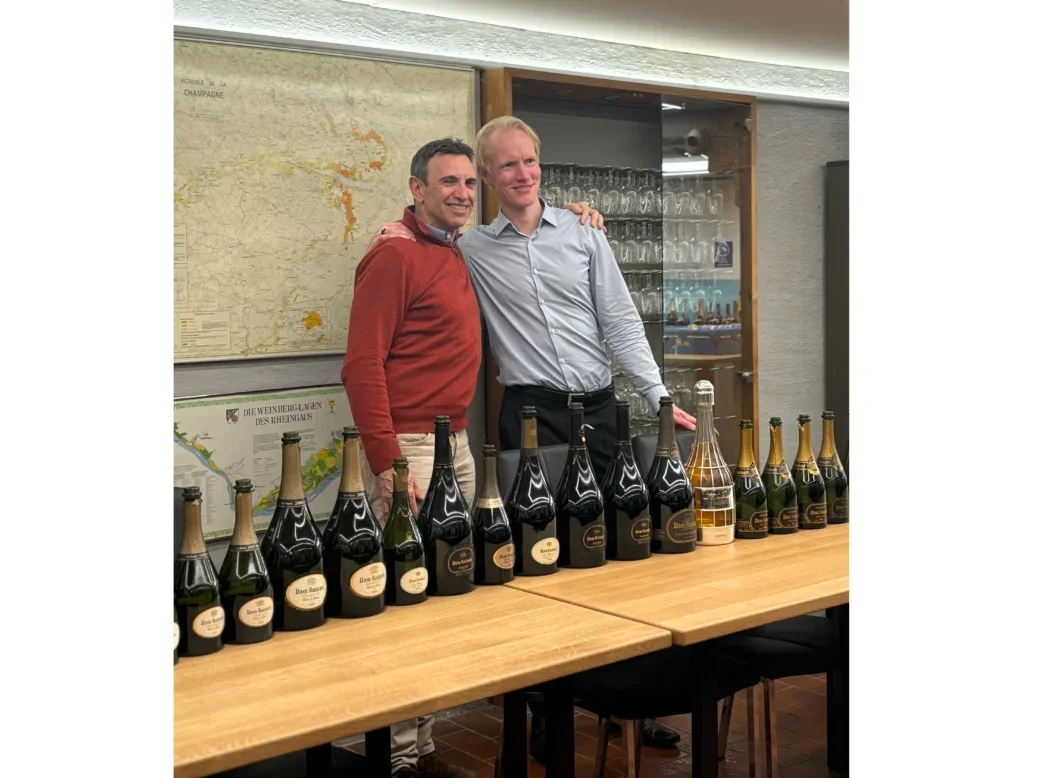
A year on from the tragic death of the house’s visionary chef de cave Frédéric Panaïotis, Essi Avellan MW reports on a once-in-a lifetime tasting of Dom Ruinart with him and Champagne collector Henri Kujala.
0pportunities like this rarely come around, even for the most devoted Champagne aficionados. In April 2025, I had the privilege of joining Champagne collector Henri Kujala and a small circle of Finnish wine lovers for an almost complete vertical of Dom Ruinart—an achievement so rare it borders on the miraculous. Of the 29 Dom Ruinart vintages ever released, only two were missing: the inaugural 1959, produced in minute quantities and shipped only to the United States, and the 1983, heartbreakingly lost in transit.
The scope of the Helsinki tasting was so compelling that it reached all the way back to Reims. When Ruinart chef de cave Frédéric Panaïotis heard what was being assembled, he did not hesitate—he asked if he could fly in and join us. Even after 18 years at the helm of one of Champagne’s most historic houses, such an opportunity was irresistible. For Frédéric, it became one of the most complete Dom Ruinart tastings of his career; for the rest of us, it was nothing short of a once-in-a-lifetime experience.
The evening itself was unforgettable: a procession of historic bottles, each revealing its own story, punctuated by a lot of learning, as always happened with Frédéric. Tragically, it would also be the last time I ever saw him. Frédéric passed away in June 2025 in a diving accident (see Tom Stevenson’s obituary in WFW 89, pp.28–30), leaving behind a profound and widely felt void in the world of Champagne. What brings me some comfort is that I was able to tell him that, based on what we had just experienced, I firmly believe the greatest Dom Ruinarts ever made are still lying quietly in the cellars, thanks to his work and that of his team. That remark, a tribute to his life’s work, became one of the very last things I ever said to him. It remains etched in my memory as a moment of recognition for a career devoted to elevating Champagne and as a poignant reminder of the fleeting nature of both wine and life.
Related

The other Dom
Cuvée Dom Ruinart was first conceived in 1959, at a time when many Champagne houses—following the lead of Moët & Chandon’s Dom Pérignon and Louis Roederer’s Cristal—were introducing prestige cuvées of their own. Bertrand Mure, a descendant of the Ruinart family who assumed leadership of the house in the aftermath of World War II, chose to elevate Ruinart’s newly articulated Chardonnay-driven identity into a blanc de blancs prestige cuvée.
Crucially, Mure did not confine Dom Ruinart to a textbook Côte des Blancs blend. Instead, he insisted that roughly one third of the Chardonnay should come from the grand cru villages of the Montagne de Reims—notably, Sillery, Puisieulx, and Verzenay. This was a deliberate and historically conscious decision, an homage to villages that had historically played a fundamental role in Ruinart’s grape sourcing, long before Champagne’s modern map had been drawn. The result was a blanc de blancs of greater breadth, depth, and structure.
Naming the wine Dom Ruinart was equally meaningful. Dom Thierry Ruinart, who died in 1709 at the Abbey of Hautvillers, never lived to see the founding of the house in 1729. However, his writings and early advocacy for the wines of Champagne profoundly influenced his nephew, Nicolas Ruinart, the house’s founder.
Content from our partners
Bertrand Mure’s bond with Ruinart was so deep that it endured long after his retirement and decades after the Ruinart family had sold the house to Moët & Chandon. Remarkably, he still kept an office at Ruinart. “When I started at Ruinart in 2007, Bertrand would come to his office regularly. He still behaved as if he owned the house,” Frédéric Panaïotis recalled fondly. It is from Bertrand Mure that Panaïotis inherited the vision to Ruinart’s deliciously drinkable house style. “Ruinart Champagne must be drinkable from 9 in the morning until 9 the next morning,” Mure famously insisted. It is a deceptively simple credo but one that has shaped Ruinart more profoundly than any technical choice.
The Panaïotis fingerprint
Under Frédéric Panaïotis’s leadership, the house has gone from strength to strength. While the Non-Vintage Blanc de Blancs has achieved unprecedented global success, his most transformative work has arguably been with Dom Ruinart. In recent vintages, the cuvée has moved into an entirely new dimension, driven by a series of closely interlinked decisions. Upon his arrival at Ruinart, Panaïotis quickly set about refining the management of malolactic fermentation with near-surgical precision, seeking to eliminate unwanted diacetyl and lactic expressions (notes of butter, toffee, and yogurt) that were felt to detract from the wine’s purity and crystalline elegance. Equally transformative has been the optimization of harvest timing: The green, herbaceous tones of underripe fruit and the jammy excesses of any overripeness have all but disappeared, replaced by a striking increase in both clarity and precision.
Once all this was achieved, Panaïotis took over a long-term project initiated by his predecessor, Jean-François Barot, as early as 1998, replacing the traditional crown cap with a cork for the tirage of Dom Ruinart—“a high-risk, high-reward initiative,” as Panaïotis described it. After tasting the results, Panaïotis became convinced of cork’s superiority for the long tirage periods of Dom Ruinart (typically eight to ten years on lees). We were given a tantalizing preview of this direction with the discreet release of a handful of bottles of Dom Ruinart La Réserve 1998 in 2017. But it was with the 2010 vintage that Ruinart really struck gold. This was the first year in which all Dom Ruinart bottles were closed with cork for tirage. The resulting wine came remarkably close to perfection—it was no coincidence that the 2010 Dom Ruinart was crowned Supreme World Champion by our panel at the annual Champagne & Sparkling Wine World Championships in 2022.
What, then, is the point of cork? Conventional wisdom might suggest that cork allows more oxygen ingress than a crown cap. But research has shown that after six to seven years, cork becomes increasingly resistant to oxygen transmission. With less oxygen involved over time, the wines begin to display the kind of reductive, gloriously gunpowdery and toasty characters we usually associate with magnums.
Climate change and shifting tastes have also reshaped the wine. The dosage levels in Dom Ruinart have fallen steadily—from 10–12g/l in the early vintages, to 6g/l or less today. Ruinart has taken climate change seriously, investing in research on its impact on both vines and wines. The recently released Blanc Singulier acts as a living laboratory for the future of Champagne Chardonnay, insights from which Dom Ruinart will inevitably benefit.
It is obvious that under Frédéric Panaïotis’s guidance, the style of Dom Ruinart has evolved. The wine retains its rich, textured, Burgundian breadth but gains an added layer of reductive finesse and striking empyreumatic complexity—traits that Panaïotis deeply valued in great Chardonnay, in Champagne and beyond. Vinification remains entirely in stainless steel, yet the cork introduces subtle aromatic nuances, firmer tannic grip, and greater structural definition. The result is a Dom Ruinart that has risen from merely Burgundian to something akin to Corton-Charlemagne in stature.
Through time, toward the future
This tasting was, above all, a journey through time and an homage to Ruinart’s long and layered history. We tasted a special bottling created for the house’s 250th anniversary in 1979 and savored a perfectly preserved magnum of Ruinart’s millennium wine L’Exclusive, a majestic blend of grand cru Chardonnays from 1985, 1986, 1988, 1990, and 1993. Some of the oldest vintages had moved beyond the realm of analytical tasting (at least, our bottles of the 1969, 1966, and 1964 were out of condition), but their presence lent a profound historical patina to the experience.
Even though Frédéric Panaïotis will not be at the helm for Ruinart’s next major anniversary in three years’ time, we will remember him by raising glasses filled with the Tricentennial Cuvée he set in motion. And his legacy will resonate far longer: The Ruinart cellars are a treasure trove of future revelations shaped under his watch. As important as anything else, he excelled in the most critical task of any cellar master: ensuring continuity. The torch has now been passed, confidently and brilliantly, to Caroline Fiot.
Here is the list of all Dom Ruinart Vintages released so far: 1959, 1961, 1964, 1966, 1969, 1971, 1973, 1975, 1976, 1978, 1979, 1981, 1982, 1983, 1985, 1986, 1988, 1990, 1993, 1996, 1998, 2002, 2004, 2006, 2007, 2009, 2010, 2013, 2015. The blend varies, but typical origins are 70% Côte des Blancs (Avize, Chouilly, Cramant, Le Mesnil-sur-Oger, Oger), 30% Montagne de Reims (Puisieulx, Sillery, Verzenay).
Tasting
2015 Dom Ruinart (preview)
The nose is open and expressive, showing beautifully handled reduction: notes of gunflint and freshly ground coffee layered over pristine orchard fruit, subtle tropical hints, cotton candy, and sweet vanilla. It avoids the vegetal edge often found in the 2015 vintage profile. On the palate, there is a touch of austerity at this stage, with fruit-driven intensity framed by firm, slightly grippy phenolics that promise to soften and integrate with time. The fine, prickly mousse provides lift, enhancing the wine’s sense of airiness. A wine of clear potential, poised to gain depth and generosity as its fruit expression expands and matures. | 94
2013 Dom Ruinart
This iteration of Dom Ruinart is composed of exactly 70% fruit from the Côte des Blancs and 30% from the Montagne de Reims. The nose is cool-toned and precise, showing elegant restraint with chalky nuances, crème caramel, fresh mint, and zesty yuzu. On the palate, the wine is silky, rounded, and gently caressing, supported by a slightly softer, beautifully integrated mousse. A stunning, laser-focused line of acidity drives the wine’s intense yet remarkably light-footed core through to a pure, vibrant finish. Tightly coiled at present, this is a Champagne clearly built for longevity. | 96
2010 Dom Ruinart
The 2010 is the first Dom Ruinart vintage bottled under cork for tirage, and it truly delivers the “magnum effect” in a standard bottle. Bright, youthful lemon in color. The expressive nose is layered with beautifully managed reduction: lime zest, ground coffee, herbs, and a smoky undertone. With air, the aromatics continue to evolve, revealing sweeter tropical nuances, fennel, and notes of cream toffee. The palate is voluptuous and satiny, beautifully combining lush texture with irresistible drinkability. Lusciously delicious, exuberant, and effortlessly charming, this is a Champagne that delights from the first sip. Open, confident, and thoroughly ready to please. | 99
2009 Dom Ruinart
Made exclusively from grand cru fruit, with some 18% sourced from the Montagne de Reims to complement the wine’s Côte des Blancs core. The color shows early signs of development. The nose is rich and expressive, evolving toward notes of coffee and cream, with subtle oxidative nuances emerging in hints of toffee, dried flowers, and honey. The palate is full and generous, with a caressing, oily texture. Broad, textured, and almost Burgundian in character, a gentle phenolic grip providing balance and freshness. | 94
2007 Dom Ruinart
This 2007 is Frédéric Panaïotis’s inaugural Dom Ruinart, marked by an unusually high proportion of Montagne de Reims fruit (37%, from Puisieulx and Sillery). The nose shows gentle development, opening with lemon zest before unfolding into layered notes of candy apple, dark-fruited depth, mirabelle plum, sweet char, and ripe apricot. The palate is firm and feisty, notably more youthful than the nose suggests, with a pronounced Burgundian sense of texture. Energetic and precise, it finishes long, fresh, and spicy, with a lingering echo of cardamom. | 94
2006 Dom Ruinart (magnum)
Puisieulx and Sillery account for 37% of this exclusively grand cru blend, lending Montagne de Reims depth to a Côte des Blancs core from Avize, Chouilly, and Le Mesnil-sur-Oger. Medium-deep lemon in color. The nose is sweetly scented with sun-kissed fruit, where tropical notes intertwine with apple compote, gunpowder, and blossom. Full-bodied and velvet-smooth on the palate; the mousse is exceptionally creamy, fluffy, and airy, enhancing the wine’s overall sense of gentleness. Intense, rich, and sweetly fruited, it is superbly decadent, with the generosity of dosage and fruit beautifully masking a firm phenolic backbone. Built for a long and graceful future in magnum. | 97
2004 Dom Ruinart (magnum)
A vintage combining generous volume with an elegant, airy disposition. The color has evolved toward a luminous golden hue. The nose is pronounced and expressive, showing clear tertiary development: dark, charred, and smoky tones are edged with an herbaceous nuance, followed by toffee-like evolution and vanilla-laced toast. On the palate, the wine is notably fresher and feistier, bringing out its magnum qualities, delivering a sense of lightness and silky finesse. Taut yet flowing, it gains excitement through its textural precision and energetic drive, finishing poised, vibrant, and quietly complex. | 94
2002 Dom Ruinart La Réserve
This long-lees-aged bottle was disgorged in February 2025. Some 1,000 bottles were produced. A come-hither, seductive nose led by oriental spices, unfolding over waves of pineapple richness, vanilla, and a cooling, minty breeze. The palate delivers impressive vinous volume, combining generous richness with exemplary freshness and lift. At a stunning point of maturity, it is sweetly fruited and generous, yet beautifully layered, with autolytic, yeast-driven complexity. Harmonious, complete, and deeply satisfying, this is Dom Ruinart at a glorious peak of expression. | 98
2002 Dom Ruinart (magnum)
A blend of Côte des Blancs Chardonnay complemented by 28% Montagne de Reims fruit from Puisieulx and Sillery. The color has evolved to a deep golden hue. The nose shows advanced development, expressed through honeyed fruit, blown wheat, and marmalade. The palate is firm and feisty, with dried-fruit tones emerging with apricot and golden raisin to the fore. Long and persistent, it retains a welcome line of freshness, yet this magnum does not reach the peak expression one might hope for from the format. | 93
1998 Dom Ruinart La Réserve
Closed for tirage with natural cork, this bottle was aged sur point since 2013 before disgorgement. Deep golden color. A glorious, pristine, and radiant nose, beautifully layered with refined yeast-driven complexity. Harmonious and detailed, it brings together the finest nuances effortlessly. The palate is fresh and lively, led by a precise lemony bite that drives through the wine, lending energy and lift. Now at a perfect point to drink, it is just beginning to reveal its tertiary dimension while retaining remarkable purity and vibrancy. | 96
1998 Dom Ruinart La Réserve (magnum)
A captivating, delicious nose, marked by extraordinary reductive, magnum-format complexity. Subtle café latte and gently roasted nuances meld seamlessly with impeccably pure, pristine fruit, creating clarity and depth. Airy, graceful, and exquisitely refined, this is the most ethereal expression of mature Dom Ruinart. Absolute precision and harmony throughout, with reductive finesse carried effortlessly from nose to finish. Utterly complete and at a point of perfection. Produced in just 200 magnums and available exclusively at the winery. | 99
1998 Dom Ruinart (magnum)
This original disgorgement in magnum opens with sweet toffee aromas, cream, and caramel, followed by buttered popcorn, vanilla, and a distinct sweetness. Baking spices add further depth as the wine moves firmly into its tertiary register. The palate is luscious and vinous, marked by silky roundness and mature generosity. Fully evolved yet still in good condition, this is a complete and expressive bottle, now at full maturity rather than on an upward trajectory. | 96
1996 Dom Ruinart (magnum)
A controversial vintage, defined by its reputation for searing acidity. Here, the nose is fully mature and resolutely tertiary, opening with dried fruits, marmalade, apricot, and orange blossom. There is a slightly sudsy, evolved character, yet the acidity feels more moderated than the vintage stereotype would suggest. On the palate, the acids begin to assert themselves more with time, lending structure and tension, though never to a detrimental degree. Fully evolved and unmistakably mature, this is not the greatest Dom Ruinart, but it remains expressive and far from disappointing. | 94
Dom Ruinart L’Exclusive NV (magnum)
Created for turn-of-the-millennium celebrations, this special-edition magnum is based on the 1993 vintage and complemented by an exceptionally rich library of wines drawn from 1990, 1988, 1986, and 1985. Disgorged in 2003, the magnum came directly from Ruinart’s cellars and was as good as it gets. The nose is magnificent and deeply expressive: rich, powerful, and complex. It is layered with dried fruits and a gentle patina of age. On the palate, it is broad, rounded, and fleshy, almost thick in texture, saturated with the depth and generosity of its extensive reserve-wine component. It is drinking brilliantly today: caressingly creamy, superbly textured, and intensely concentrated. | 96
1993 Dom Ruinart (magnum)
An understated vintage, defined by freshness and finesse rather than sheer power. Deep golden in color. The nose shows rich, sweetly aged aromas of apricot, dried fruits, and subtle white chocolate notes. The palate is decadently chewy, generous, and fully mature, displaying the depth and concentration of a well-preserved mature wine. Long, focused, and harmonious, it remains in perfect condition, offering a complete, satisfying expression of aged Dom Ruinart. | 93
1990 Dom Ruinart
A fortunate bottle showing well at this stage. Deep golden color. The nose is full and rich, opening with punchy, sweetly evolved notes of golden raisins and dried fruit, with a subtle earthy hint of mushroom emerging. The palate is thick and generous, rich and broad rather than pristine, with a slight drying sensation toward the finish. While no longer on an upward trajectory, it remains very good, holding together through its weight and generosity. | 93
1988 Dom Ruinart
Fully tertiary in expression, yet impeccably intact. The nose opens with a touch of toffee and rich savory depth, marked by sous-bois nuances without any trace of faulty oxidation. The fruit remains strikingly sweet in impression, expressed through dried-fruit character. Mature rather than fading, it shows herbal tones of birch leaves and rosemary alongside notes of honey and cream. On the palate, dried fruits dominate, lifted by a vivid blood-orange note that adds freshness and definition. Complete, stable, and expressive at full maturity. | 93
1986 Dom Ruinart
Classical in structure and with limited mid-palate generosity. Now very mature, showing a deep, orange-tinged hue. The nose is powerful and fully tertiary, marked by potato cellar, farmyard, and wild, animal-driven notes. The fruit has weakened, giving way to savory, leathery depth. The palate is driven by the vintage’s inherent freshness, which keeps the wine alive despite its advanced evolution. Clearly on the decline, but it remains characterful and expressive of the year. | 90
1985 Dom Ruinart
Deep, orange-tinged color. The nose is a little muted and earthy at first, firmly in the realm of old wine, with fully tertiary aromas of raisins and candied fruit, edging toward English fruitcake. Vinous and concentrated on the palate, it combines muscular build and oily texture with vibrant, incisive acidity. Though only a trace of effervescence remains, the wine retains energy and drive. Mature dried fruit and honey dominate aromatically, yet the palate stays remarkably fresh. Complete and well constructed, if slightly short on the finish. Fully peaked but very much alive. | 93
1982 Dom Ruinart RD
We had the opportunity to savor two expressions of Dom Ruinart 1982, both bottles sourced directly from Ruinart’s cellars. The late-disgorged version shows a notably paler color. Its lifted nose is dominated by fresh mushroom and sweetly candied notes, with an almost essence-like tone. Baked pear emerges with air, reinforcing the candied profile. On the palate, it is thick and silky, with a beautifully caressing texture and a lower-seeming dosage. Despite the pronounced, lifted mushroom and candied aromatics, the palate is very pleasing, softly bubbling, and well balanced, delivering an indulgent expression of mature Dom Ruinart. | 92
1982 Dom Ruinart
The 1982 vintage is widely regarded as a great harvest, producing Champagnes of richness, elegance, and finely tuned balance, with remarkable longevity. This original disgorgement straight from Ruinart’s cellars is an extraordinary bottle. The nose is pristine and crystalline, combining sweet purity with layered complexity, where subtle coffee notes sit alongside tertiary nuances. Equally magnificent on the palate, it is fully mature yet remarkably fresh and feisty, unfolding with sous-bois in its finest expression, gentle spice, and seamless length. The mousse is perfectly preserved, fine and persistent, reinforcing the wine’s crystalline clarity. A complete and compelling expression of a great vintage in the perfect bottle. | 98
1981 Dom Ruinart
Chardonnay was the unquestionable star of the small but fine 1981 harvest, and this bottle stands as living proof. The color has browned with age. The nose is that of a noble old wine: sweet, full, and rich, marked by toffee, candied fruit, and baked and dried apple, yet notably free of negative tones of oxidation. A faint hint of cellar dust speaks of full maturity. On the palate, it is long and vinous, thick and mouth-filling, again toffee-toned but intact. Fully evolved, it delivers depth and generosity without tipping into oxidative fatigue. | 93
1979 Dom Ruinart
Mature, orange-tinged color. The nose is showing dried fruit with dusty nuance and nutty tones of pronounced oxidation. The palate is light and driven by high acidity, with fruit largely faded. Past its peak and surprisingly slender, it lacks depth. Better bottles should exist. | 89
1978 Dom Ruinart
Rich and profound old-wine nose, entirely on dried fruit. Toasty and with a healthy, pronounced apricot character. The palate is still lively, with lingering bubbles, feisty energy, and bright, incisive acidity. The fruit is generous yet fully mature, beautifully balanced, and fresh, without any sign of deterioration. A remarkable wine, showing the precision and vibrancy of a harvest that began in the first days of October. | 93
1976 Dom Ruinart
Radiant maturity wrapped in remarkable freshness. The nose opens with tension between still vivid fruit and gentle evolution: sun-warmed orchard fruits, candied citrus peel, and a sweep of orange marmalade, sweet spice, cinnamon, and a hint of saffron. On the palate, the wine is intense yet perky, driven more by extract and ripeness than acidity, yet carried by a pristine sense of balance. The early harvest and generous yields translate into a broad, powerful core, but the impression remains super fresh, almost luminous. | 93
1975 Dom Ruinart
Corked. | NS
1973 Dom Ruinart
This bottle has clearly seen some wear. The nose is mushroomy and dominated by dried fruit, fully in old-wine territory. On the palate, it is fresh, lean, and light, reflecting the cool, difficult 1973 vintage with inconsistent ripening. Despite its age and reduced fruit, the wine remains feisty and alive, its freshness still evident. A classic example of a challenging year, showing tertiary charm rather than fruity generosity. | 89
1973 Dom Ruinart Cuvée du 250é Anniversaire
This is the same wine as the previous but a special label produced for the house’s 250th anniversary in 1979. A sweeter and slightly fruitier expression, showing apricot and bright, candied fruit on the nose. The palate combines generous, sweet fruit with freshness and lively acidity, offering more volume than the previous bottle. Slightly fresher aromatically, yet fully evolved, it delivers a harmonious balance of sweetness, freshness, and precision. | 92
1971 Dom Ruinart
Deep amber color. The nose is rich and evolved, showing coffee, leather, dried apricot, and honey. On the palate, it is thick, full, and silky, with fine concentration and length. Despite its maturity, the wine feels fresh, lively, and juicy, demonstrating excellent preservation. Fully mature yet structured to hang in there in its complete and satisfying expression. | 93
1961 Dom Ruinart
A hot and dry year that famously produced wines that are full-bodied, rich, and intensely flavored. This mature Dom Ruinart is deeply orange-toned in color. The nose shows soft, toffee-rich aromas with hints of cardamom. On the palate, it is full, luscious, and sweet, almost chewy, yet lifted by high acidity and remarkable length. Fully mature and long past its peak, it nonetheless remains expressive, retaining fruity sweetness and a sense of freshness. | 90