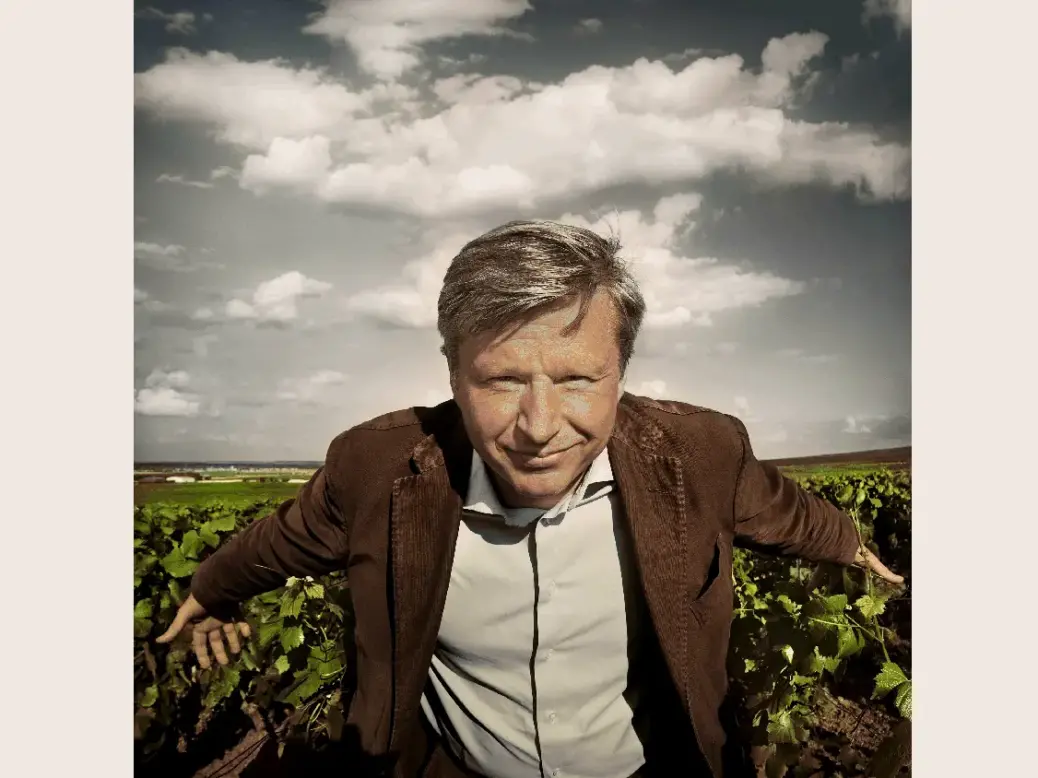
Simon Field MW is dazzled by fine wine and words as he joins chef de cave Jean-Baptiste Lécaillon at two launches of the Louis Roederer 2025 releases.
The opportunity to taste through the Louis Roederer 2025 launches in two capital cities is a privilege, as far as it is possible to be from being Down and Out in Paris and London. The more so because the presenter, Jean-Baptiste Lécaillon, is almost as good a public speaker as he is a chef de cave. We are guided through the latest additions to the range: the latest Collection, Cristal, and Coteaux Champenois releases, as well asa brace of Starck Brut Nature wines.
The vintages are very different (2018 and 2021, for example, are polar opposites) and underline Lécaillon’s focus on the need to adapt constantly in the face of climate change. The presentation is as engaging and informative as ever. Inhis introduction, Frédéric Rouzaud, representing the seventh generation of the owning family, praises his winemaker as “half poet and half scientist.” Warming to the theme, he describes the family’s 250ha (620 acres) as the Stradivarius of Champagne holdings, revealing that 135ha (334 acres) are now organically certified, with the others well on their way.
Jean-Baptiste is quick to pick up the thread, describing the three focal points of the Roederer vineyards: Verzenay, which he compares to Chambertin; Aÿ, which he compares to Musigny; and Avize, which he extolls with such panache that it proves to be beyond a specific Burgundian comparison. Anyway, the focus is on a constant striving to manage the complexity gifted by nature. “Every plot is asingle ecosystem with its own resilience and versatility,” he maintains, advocating adherence to the system of permaculture, whereby all facets of an environment—from hedgesand bees, to cover crops and biodynamic fertilizer—interplay as part of a virtuous circle of natural progression, benevolence, and growth. “We take care of the earth,”he concludes, adding that since 2002, Roederer has developed its own nursery to facilitate plant propagation, rootstock research, and the like. Lécaillon takes inspiration from the Roederer journals from the 1830s and earlier, to demonstrate the ongoing familial efforts to address climate changes. The logical extension is more and more focus on specific sites—a thread that runs through the whole range, including the Collection series. He cites the contrast between the difficult 2024 harvest and the ongoing “magical” 2025 cycle as a further example of the contrasts in play. 2025, it seems, will be a quality rather than a quantity vintage. There was no frost, no mildew, and rain just when it was required—“Easy!” says Monsieur.
Related

Work in the winery is as important as ever but may now be seen rather more as a mechanic of fine-tuning. There are, of course, many variables in play, and most can be manipulated as a direct responseto climate change and the effect that it has had on ripeness, harvest date, yield, and the texture and extract evidenced in the resulting wine. Consequently, use of oak fermentation has risen (from under 10% to over 15%); the dosage has come down across the range (7g/l now the benchmark for the Collection series); the malolactic fermentation has been suppressed, wholly or partially; and there has been more focus on reserve wines, including the Perpetual Reserve. Finally, there has been a voteof confidence for Chardonnay, which has now overtaken the Pinots in the latest Collection, 246, where it makes up 54% of the blend. This is an interesting development for a Reims-based house and one long associated with great Pinot Noir villages such as Verzenay and Aÿ.
Tasting

67 Pall Mall, London, and Le Grand Palais, Paris
Collection
Content from our partners
Following the vagaries of nature is key, clearly, and was the origin of the gestation of the Collection series, which is designated a Multi-Viintage rather than a Non-Vintage cuvée, a subtle distinction that is more than mere linguistic sophistry, emphasizing, as it does, the importance of elements that have not come from the “base” year and underlining a multiplicity of provenance. The current manifestation, 246, has 2021 as its base year but comprises 200 different wines from 50 crus and 10 vintages. The human factor is increasingly focused on “playing with the fruit”—serious playing, I might add—whereas for the previous Collection entry, Brut Premier, it was more a case, per JBL, of “manipulation of winemaking tools.” Each wine is different, and each release is numbered. After a series of trials, the first Collection, 242, was based on the (difficult) 2017 vintage. The latest iteration is built on the equally tricky 2021 vintage and contains 45% of reserve wine. The secret of the selection of this numerical series can be explained by the fact that in 2026 the house will be celebrating its 250th anniversary.
Collection 246 (54% C, 35% PN, 11% M; dosage 7g/l; disgorged spring 2025)
The challenging juxtaposition of 45% reserve wine, a part of which dates from 2012, with the fruits of the difficult 2021 vintage, has bequeathed a wine that is soft, chiseled, and poised. Less intense than either C243 or C245, but redeemed by a chalky purity, a beguiling weave from the mousse, and a pleasing fruit character, with lemongrass and nectarine to the fore, then a finish that is more reductive, with smoke and flint evidenced and a bittersweet grapefruit grip. | 92–93
Brut Nature
“It is not addition; it is subtraction,” says Jean-Baptiste, somewhat whimsically, describing the fifth outing (the third for the rosé) of the Brut Nature cuvée, fashioned in conjunction with the self-styled “democratic designer” Philippe Starck, he of citrus juicers, frighteningly angular furniture, and electric bikes, inter alia. This may well not have been one of his more demanding projects: “Brut Nature,” he tells us at the Palais Royal launch in Paris, “is so honest, so minimal, that I didn’t want to add anything to it.” So, the label has been jettisoned in favor of etched lettering, the collar has been pared back, and the presentation box is suitably stark, for want of a better word.
Behind the “less is more” platitude, however, can be identified a far more interesting paradox. The fruit is sourced from a single 10ha (25-acre) plot in the premier cru village of Cumières, a warm enclave comprising three distinct lieux-dits that overlooks the River Marne and that is markedby dark clay topsoil and a 2-yard (2m) dig before one gets down to the chalk. The crop here consistently yields some of the ripest fruit overthe 240ha (600 acres) of the group’s property.The most austere cuvée in the range is therefore made from the ripest fruit, and thus provides a bellwether to the flux of climate change. Furthermore, it is only released in the warmest of years, each, thus far, three years apart.
The winemaking for the Brut Nature is described by Jean-Baptiste as a “veritable laboratory,” backed up with vineyard experimentation that touches upon key aspects of the viticultural canon, including cover crops, vine sculpting, and biodynamic treatments. The Champagne grape varieties are also challenged, since there is, for the first time, a little massal-selected Pinot Blanc included in the 2018 blend, with both Arbane and Petit Meslier in the pipeline for future iterations from 2022. The field blend was all picked over four hours in the morning (on September 2), offering what Jean-Baptiste describes as a “resilience” to the resulting wine. A veritable melting pot, too, vintage after vintage, this Champagne “charts a path to reflect the transformations reshaping our region and our craft.” And what’s more, there is no opportunity to hide behind either dosage or vintage variation, or, for that matter, the leavening balm of differing provenance. A test of mettle, therefore, the putative austerity teasingly challenged by Lécaillon’s statement that “everything is amplified in this wine”—apart, it would seem, from the pressure, because this cuvée is bottled at 5 (rather than 6) atmospheres in order, per JB, to enhance a creaminess to balance the acidity. “You can taste the climate change” is his pithy conclusion.
2018 Louis Roederer Brut Nature(55% PN, 25% M, 20% C, a touch of Pinot Blanc; dosage 0g/l; disgorged early 2025)
Soft-burnished silver with a decorous mousse. The nose recalls mirabelle plums, petrichor, and a hint of verbena, the ripeness of the vintage held in check by steely intent. The palate is juicy, more playful than expected, with notes of clove and Sichuan pepper pleasingly juxtaposed with guava and mandarin, with poached pear and sourdough also detected. A vibrant, sapid finish ensues. | 94
2018 Louis Roederer Brut Nature Rosé (64% PN, 20% M, 16% C, a touch of Pinot Blanc; dosage 0g/l; disgorged early 2025)
A pretty, soft, coral color, with hints of onion skin. An initially reticent nose, gradually ceding rosehips and other more delicate red fruits (strawberry, maybe), pepper, and spice in support. A robust, phenolic, youthful palate, rejoicing in a sunny disposition but aware of the need for restraint and recalling its lack of sugar; poised and somewhat statuesque on the finish. Giacometti has been sharing a glimpse of Botero, but ultimately, and with no lack of dignity, he holds court. | 93
Cristal
The world had to wait another century before Czar Alexander II inspired the creation of Cristal, which Jean-Baptiste describes as his “child of chalk.” The 2016 was sourced from 32 of the 45 “contender” vineyards, all grand cru, of course, all marked by a very high chalk content, and all vinified separately. JB compares the 2016 to both 2012 and 2013, the former following an earlier cycle, the latter a later one, with 2016, stylistically speaking, somewhere in the middle, but with all three affected by early-season mildew and thus modest of crop. All the relevant vineyards were fully organic by 2012; and by 2016, according to JB, everyone “knew what they were doing.” He rates the vintage very highly indeed and is equally optimistic about Cristal’s future manifestations, which are to be 2018, 2019, 2020, and 2022. Released at the same time is the 2015 Cristal Rosé, which is made from a completely different blend, its fruit mainly sourced from five chalky plots climbing up from the road as one travels from Aÿ to Dizy. JB praises the “delicacy” of the wine, advising that it is a high calcium content in the soil that has facilitated this lightness of touch in such a warm year. The maceration has been delicate and is described in terms of an “infusion.” Superb wines both, especially the 2016 Brut, which promises extravagantly but gives an awful lot already. Even 20 years ago, such early generosity of spirit would not have been evidenced. How this will influence the aging process is hard to say, but JB does not want for confidence on this topic.
2016 Cristal (58% PN, 42% C; dosage 7g/l; disgorged autumn 2024)
Salt, licorice, lavender, chamomile, macaroon, wild strawberries—one could go on. Complex, in short. 50% sun, 50% soil, per JB, focusing Pinot Noir generosity for the former and Chardonnay sapidity for the latter. Verzenay Pinot fruit stands out for its power and generosity. As a result, the wine is more forward than the Cristals of yore, with savory, almost nutty, characteristics already challenging the articulate red-fruit grip. Only the stentorian, stony finish underlines precocity and, in so doing, underscores the supreme quality of the base fruit, which dares to be so eloquent so soon. | 97–98
2015 Cristal Rosé (56% PN, 44% C;dosage 7g/l; disgorged autumn 2024)
A soft, rose-petal color, with a persistent mousse and sensuous aromas of yellow fruit and soft spice. Behind that, crushed raspberry, iodine, and damp chalk. Almond, pine nuts, and quince are also evidenced, alongside a mellifluous voice from a warm Mediterranean orange grove. Complex, undoubtedly, but also edgy and gently tense (if such a thing can be). A pleasing, satiny texture greets the tongue, with red fruit in the ascendant, offering phenolic weight and earthy majesty—“freshness from the soil,” as JB describes it. A touch of sea salt enlivens the finish. | 94–95
Coteaux Champenois
And so to the latest string to the burnished Roederer bow, the Coteaux Champenois, a style that had previously featured in the range but was discontinued in 1996, possibly—dare one presume?—due to a lack of popularity. Or maybe because it was too wet and too cold. The vines in question have to display different characteristics to reflect different stylistic aspirations; there is, for example, not the same need for a high level of malic acid, but there is a definite need for low yields of small, concentrated grapes. Canopy management must thus be orchestrated differently, with the requirement of aeration and sunshine, and a focus on greater phenolic maturity. The plots identified have a little more clay in their makeup, leading to lower yields and higher levels of extract. “It is a completely different philosophy,” per Jean-Baptiste, but one that chimes with the focus on the single vineyard and on nuance,à la Bourgogne—though he is adamant thathis wines are not aspiring to emulate Burgundy. He is optimistic, however, that over the next few years the Coteaux Champenois offering will be developed, with perhaps two whites and five or six reds in the range, each in small batches of between 1,200 and 2,000 bottles. A significant dissemination of terroir, in other words, and one that has never been possible through the veil of fermented bubbles. “We should not be too excited too quickly,” he maintains, though clearly he is enthusiastic about this development, perhaps with legacy in mind. It may be seen as a mere distraction, but it may also be seen as a complementary discipline that will inspire us to reconsider our understanding of what Champagne (in its broadest definition) can offer.
2022 Hommage à Camille Volibarts (100% C)
This is green-gold and bright, the aroma ripe and generous, with hints of mango and honeysuckle garlanding the citric core, fulsome in deference to a very sunny year. The palate is mealy, creamy, and rich, the combination of élevage in sandstone and predominantly new barrels forging an impressive structure, which will need a little more time to settle. The region has ensured, however, that there is plentiful acidity and a rich, chalky substratum that will underwrite the quality ofthe evolution. | 92
2022 Hommage à Camille Charmont (100% PN)
Bright ruby, with crimson tints. The nose is pure yet generous, offering notes of crushed raspberry, black tea, and a lick of white pepper. Behind, one can detect both cocoa and vanillin, courtesy of 16 months in barrels, one third of which are new. A precocious, slightly mentholated palate, salty maybe; deft fine-grained tannins in support, and an elegant pavonine finish. Not remotely in the mold of Burgundy, says JB (the white may be), but an honest, pensive child of Aÿ terroir, with notes of umami and dried fruits adding textural depth tothe pellucid charm of the fruit. | 93