I strode across the valley from the Bürgenstock Resort to a grassy mountain slope overlooking Lake Lucerne where, observed only by the cattle, I had my Sound of Music moment. Although it was really the sound of cow bells with which these hills were alive.
But let’s start at the very beginning. I embarked on a tour from Lausanne, via Bern, to Lucerne, traveling by rail, staying at the Bürgenstock Collection, a group of hotels with long and illustrious histories. Hoovered into the Katara Hospitality portfolio in 2008, the Bürgenstock hotels benefited from substantial investment, which has given them a new and glamorous lease of life. I had been invited to experience their five-star luxury… but what has this got to do with wine?
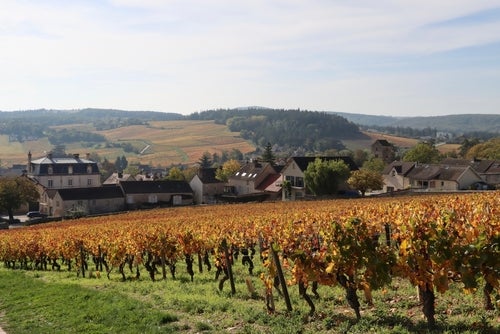
Well, it’s a hop and a skip along the shore of Lake Geneva from the Hotel Royal Savoy in Lausanne to the vineyards of Dézaley, a 54ha (134-acre) grand cru. There are only two AOC grand cru vineyards in Switzerland—Dézaley and neighboring Calamin—which were ratified in 2013.
I became curious about Dézaley when researching the Via Francigena, a pilgrimage route recorded by Archbishop Sigeric, who traveled from Canterbury to Rome to collect his pallium in the 10th century. The route passes through Lavaux in the Vaud, a region that stretches between Lausanne and the Château de Chillon. This beautiful area, home to the Chasselas grape, became a UNESCO World Heritage site for its cultural heritage—the interaction of the people and their environment. This began with the Cistercian monks who created the vineyard terraces on the steep slopes in the 12th century. I imagine they gave shelter to pilgrims.
Related


My abode was far removed from Cistercian simplicity. The Hotel Royal Savoy Lausanne is pristine after a five-year renovation. From my window I could see the French Alps across the lake. It was a very good place to start. I know the musical was set in Austria, not Switzerland, but the lake view and mountain air were intoxicating. I wanted to spin and sing.
Instead, I went to bed… After a super-comfy night, I jogged along the shore to the pretty village of Pully. As the sun rose over the lake, ghosty sails emerged from the mist, and I found I was not alone. The Swiss are such healthy people—walking, running, sailing, swimming, and immersing themselves in spa experiences. I was keen to fit in, so I took a quick dip in the hotel’s indoor/outdoor hydrotherapy pool—a swim in the lake was a step too far—before leaving to visit Domaine Louis Bovard, the most renowned producer of Dézaley.
I met with Louis-Philippe, the tenth generation of this winemaking family, who is now well into his 90s. After taking a look at the precipitous vineyard—which rises from 1,230ft (375m) above sea level on the lake shore, to 1,800ft (550m), on a slope that reaches 100% grade in some places—we repaired to the winery to taste some Dézaley.
Content from our partners
Ninety percent of this grand cru is planted to Chasselas, Switzerland’s most popular grape variety. This tends to produce wafting, floral, light-bodied white wines, often served as an apéritif. Without much personality of its own, it’s easily terroir driven. And Chasselas from Dézaley is not light and airy, but rich and generous.
The south–southwest orientation makes Dézaley a warm vineyard, whereas the neighboring grand cru vineyard of Calamin tips toward the southeast. Louis-Philippe spoke of the three suns here, which include the reflection from the lake and the radiation from the stone walls that support the terraces. The soil here is rich in limestone.
Domaine Louis Bovard calls its Dézaley “Médinette” for the Luxor temple, and the distinctive label, designed a century ago, carries the image of Bacchus. The 2022 Dézaley Médinette is creamy, rounded, and ripely citrusy, with waxy, leesy notes. It’s aged for ten months in foudres and receives regular bâtonnage. “As it ages, it reminds me of an older Viognier,” said Louis-Philippe, who went off to find a 2011, which was remarkably youthful. The crème pâtissière and buttery richness contrast with salty savory notes on both nose and palate. This will certainly continue to evolve and demonstrates the aging capacity of Dézaley in the right hands.
Not content with making Dézaley, in the 1990s Louis-Philippe introduced new varieties into Lavaux. A Sauvignon Blanc from Epesses called Buxus and a Chenin Blanc called Salix, in the Collection Louis-Philippe Bovard, are both good and worth trying. The Hotel Royal Savoy can organize visits to Bovard and other local producers.
I was also keen to try some of Switzerland’s indigenous varieties from the neighboring region of the Valais. Lying east of the Vaud, this Alpine terroir stretches along the upper course of the Rhône, north of Italy’s Aosta Valley. So, I headed back to the Royal Savoy to taste with French sommelier Johan Strazzeri, who is knowledgeable and enthusiastic about Swiss wine. We perused the wine list in the Sky Lounge, the recently launched rooftop terrace restaurant, sitting outside with a wonderful view of Lake Geneva. It’s a lovely spot in the summer, when the restaurant serves sharing plates of Mediterranean-style fare. From November to March, fondue is on the menu.

Swiss wine is well represented on the Royal Savoy’s wine list, and I was pleased to find Petite Arvine from Marie-Thérèse Chappaz and Cornalin from Denis Mercier. These producers champion Alpine varieties, and I was intrigued to try their wines.
Marie-Thérèse Chappaz farms (biodynamically) 11ha (27 acres) above her house in Fully, planted to a wide range of grape varieties. Her Grain Arvine de Fully 2022 has a musk-rose aroma and an equally fragrant orange-blossom palate, which is quite soft, with a slightly salty and lanolin note to finish. Later in my trip, I tried her five-varietal blend, Grain Cinq 2020, which also has the orange-blossom note, with a touch of citrus and spice, but is creamier, fuller, and richer. What an interesting producer.
Cornalin has its roots in the Aosta Valley and is easily confused with Cornalin d’Aoste, which is produced from a variety the Swiss call Humagne Rouge. Go figure. The spicy and sweaty-sock aroma of Denis Mercier’s Cornalin 2021 was arresting, and the palate was a bit funky, too, full-bodied and earthy, with savory, smoky tobacco and leather notes. A slightly bitter stemminess provides some freshness and edge. I warmed to its hearty character. It was less robust than I expected, with chunky but softish tannins. I was curious to see how it evolved, so I took the bottle with me, for it was time to board a train for the picturesque ride to Bern and the Hotel Schweizerhof.
Jack’s Brasserie: trump card
Built in the 19th-century tradition of the grand station hotel, the Schweizerhof is right beside the railway terminus. Not the most salubrious location these days, but this five-star hotel (one of only two in Bern) has a trump card: the famous Jack’s Brasserie. It is necessary to book a table in advance any and every day of the year at this Bernese institution. Famous diners are honored with brass plaques on the banquette seats, but the place is equally beloved by locals, one of whom is reported to have taken the same table for lunch every day for more than 45 years. It has a nostalgic, warm-hearted feel, and it serves classic French cuisine with a modern twist. The focus is on quality, locally sourced ingredients. There are no fireworks – just well-executed dishes. I dined well.
I was impressed with Soren Jerslev, the young Danish head sommelier who, since 2017, has built an exciting list including 21 wines by the glass. Yes, it’s strong on the classics—replete with top Burgundian producers but augmented by well-chosen, affordable Burgundy, and there’s no shortage of wine from Bordeaux, as befits the brasserie’s French character. But of more interest to me were the Swiss producers, of which there are 50 on the list.

Soren is very passionate about sustainability in wine production—from vine, to cork—and this includes supporting local producers. He was fun to taste with—the best sort of sommelier, who will infect diners with his enthusiasm. When I arrived in the afternoon, he had a lineup of Swiss wines for me to try, into which we tossed a few Burgundies for comparison, and from which I have selected some highlights.
My favorite white was an unassuming Chasselas from Domaine La Colombe, Mont-Sur-Rolle Petit Clos Grand Cru 2022, made by Laura and Raymond Paccot, from clay soils in the canton of La Côte in the Vaud, a stunning landscape of vineyards that I had seen from the train traveling from Geneva to Lausanne. At 12.5% ABV, this Chasselas is floral and stony, with a fresh almond note, straight and neat; light and refreshing. Simple and very drinkable—even with chocolate. Yes, truly.
In Switzerland, I simply had to sample chocolate as well as wine, so I asked if we might experiment with some chocolate- and-wine pairings after the initial tasting. The chocolate was elegantly wafter thin, made by the hotel’s pastry chef, and most of the wines were dry, of course. An unusual pairing, perhaps, but with surprisingly good results. Paccot’s “grand cru” made the best match with white chocolate dusted with bitter cocoa powder.
It’s worth mentioning that grand cru on the label may not be quite what you imagine. Dézaley and Calamin are the only grand cru AOCs in Switzerland, denoting specific vineyards. But the term is also widely used on labels simply to distinguish a producer’s best wine.
Staying with Chasselas, some lees aging fills out the straight palate with nutty richness. A good example is La Maison Carrée Auvernier Chasselas Sur Lie 2022, which is matured in large, old barrels. It’s likely the lees are also responsible for an attractive light bitterness.
I also liked the zesty Rosé du Vully Cru de L’Hopital 2022 from Domaine de la Bourgeoisie, which has a hint of orange peel and is bright and breezy. This comes from a southwest-facing sandy slope in the Three Lakes region, where the blend of Pinot Noir, Gamay, and Malbec is not considered unusual. It went surprisingly well with a sliver of sweet caramel chocolate.
We tackled Pinot Noir from Swiss producers Fromm and Obrecht, well known for their wines from this fickle variety. I wasn’t very excited by the rather weedy Obrecht Trocla Nera 2021. Weingut Fromm Michel Pinot Noir 2022 is brightly fruity, with crisp acidity and snappy tannins, but it was surpassed by Domaine Mia Mercurey Les Caudroyes 2020. My favorite Swiss contender was Christian Hermann Fläscher Pinot Noir 2022, for its fine tannin and ripe summer fruit. This producer previously took a more extractive approach but has clearly changed direction. Hermann’s Pinot paired rather well with dark chocolate with roasted hazelnuts.
I have to mention Merlot from the area of Ticino, on the southern slopes of the Alps, where light and sprightly reds are produced. The following week I was in Bolgheri, where much of the Merlot is becoming flabby and alcoholic, but from Ticino, chilled down on a summer’s day, Merlot is spot on, and we tried a good example from Theilervini.
All the wines I have mentioned are listed by the glass in Jack’s Brasserie, where the customers clearly appreciate the wide range of options, for they represent 40% of turnover.
During the summer there is also a restaurant on the roof |at Hotel Schweizerhof—a pop-up affair that this year has a Japanese theme. After the wine tasting I opted for a bottle of Jack’s Beer, the house brew, which was light, slightly creamy, and refreshing. The rooftop is a wonderfully chilled space for lounging. The beehives up there supply the hotel with honey (intense and tangy orange), not only for eating, but for spa treatments, too. The bees feed on flowers that spill from the numerous window boxes that make the old town so colorful.
I came with no expectation of Switzerland’s capital city and seat of parliament, but Bern is a gem. Compact, beautiful, and easy to walk around—dodging the trams and bicycles—it is buzzy and full of youthful energy, but chilled as people of all ages sit outside sipping coffee and apéritifs.
The medieval city was founded on a peninsula hemmed by the swift-flowing Aare River. It was rebuilt in the 15th century following a fire in 1405, then given a Baroque facelift in the 17th century, but it still feels very medieval. Don’t miss the 13th-century Zytglogge Clock Tower. Hotel Schweizerhof can arrange a walking tour with the knowledgeable Ornella Bieri. This includes a special visit to the astronomical clock designed by master clockmaker Kaspar Brunner.
I had a chat with Hotel Schweizerhof’s marketing manager Johanna Schmude, who follows the local custom of commuting home on the river with her clothes in a dry sack. The fast-flowing current that powered three city-owned water mills in the 14th century was too strong for me, so I crossed the Aare on a well-engineered iron bridge and jogged along the far side of the river. Do take this path if you go, as it gives a dramatic perspective of the city perched above.
Bern seems to be off the tourist radar. Were the readership of The World of Fine Wine not so discerning, I wouldn’t let you in on the secret.
Bürgenstock Resort: breathtaking
Time to board a train to Lucerne, from where we caught a hybrid catamaran across the lake and disembarked for the funicular ride up to Bürgenstock Resort.
Take a breath.
This spa hotel was beloved by Hollywood stars in the 1960s. Frequent guest and hotel poster girl Audrey Hepburn got married in the white chapel, where you can still tie the knot. When the resort was taken over by Katara Hospitality, it was closed for nine years while they invested a cool CHF 550 million creating a splendid new resort. The historic building was renovated together with the Hollywood pool and Bull’s Eye Bar, which appear in the opening scene of the Bond movie Goldfinger.
In the gallery dedicated to the history of the former Bürgenstock Resort there are photographs of celebrity guests from showbiz, politics, business, and culture, as well as fascinating memorabilia, but make no mistake—this spa resort is bang up to date. The sleek contemporary block includes a 10,000-sq-m spa and wellness center, said to be the largest in Europe, with several swimming pools, including an infinity pool heated to 95°F (35°C), which overlooks the lake with mesmerizing views. It was hard to drag myself out.

But my bath was nearly as big, and with views almost as good. Somewhere to enjoy a pre-dinner glass of Pinot Noir from Domaines Rouvinez, which was among the welcome gifts in my room. I enjoyed this pleasant fruity wine from the Valais, although not as much as the expensive face creams and eye gels from 111SKIN. Wine tasting takes its toll.
The bathroom goodies from the Acqua di Parma collection had my nose tingling with appreciation, but there were plenty of other smells over which to cogitate, not least those at Sepp Bircher-von Atzigen’s dairy farm, a short walk down a grassy slope from the hotel. This cheese-producing family has supplied the Bürgenstock Resort since 1903. The traditional, dry-aged cheese here is called Sbrinz, and it tastes somewhere between Parmesan and Comté. It had been a long time since I last tasted cheese with a producer (at Cîteaux Abbey, with a robed cheese-making monk), and I’d love to go into more detail about Sepp’s many wet- and dry-aged cheeses, but I must focus on the wine.
On that note, I should mention that ten years ago Bürgenstock Resort planted a pocket handkerchief of Solaris vines on a south-facing slope. You will pass it on the way down to Sepp’s farm. It’s next to the beehives. This vineyard produces a rounded, soft, and spicy wine (labeled Château Palace) that partners well with Sepp’s Five Star cheese, which is made exclusively for the hotel.
Everything is either historic and interesting, or modern and impossibly lavish. There is an indoor tennis court, and the two golf courses are among the oldest in Switzerland. The Hammetschwand Lift is the highest exterior lift in the world. Completed in 1905 with an iron framework similar to the Eiffel Tower, this triumph of Swiss engineering whisks guests at 10.3ft/s (3.15m/s) up the 500ft (150m) shaft. There’s a famous photo of Jawaharlal Nehru and Indira Gandhi taken in 1953 at the viewpoint, which is at an altitude of 3,700ft (1,130m). I recommend the walk down through the forest.
The landscape is Walt Disney picture-perfect, and there are numerous walking and biking trails, on which you can be accompanied by a guide, should you wish, or just head off on your own. The great outdoors around Lake Lucerne is irresistible, which is fortunate given the meals we were consuming. But you can indulge or be super-healthy in the restaurants. Breakfast is à la carte and the vitality option is very tasty. The kitchen and waiting staff are on top of every food allergy, intolerance, and preference, and dishes are tailored accordingly.
On the first evening we dined at the main restaurant, Spices Kitchen & Terrace, which seems to hover in the air in an awe-inspiring cantilever. This restaurant brings together cuisines and chefs from Japan, India, Thailand, and China, and the open kitchen, all fire and brimstone, provides great theater but looked hellish busy for the chefs.
Head sommelier Andrea Tozzi is spread a bit little thin across the resort’s several restaurants, but when we caught his attention I asked for a well-defined, straight, and fresh wine for my sashimi, and he recommended Weingut Besson-Strasser Räuschling vom Rheinfall. This light wine, at only 11.5% ABV, made a rapier cut through the salmon, but I wouldn’t recommend the Cholfirst Pinot Noir from the same producer. The food-and-wine pairing was a bit hit and miss, but I’d snuck in Denis Mercier’s Cornalin which, after 36 hours, had mellowed, and it smoothly accompanied the Indian lamb chops and spicy dal, among the many delicious dishes on the table.
At lunch—posh burgers by the Hollywood pool—I was undeterred by the staff’s lack of wine knowledge, having spotted a wine made from the rare grape variety Humagne Blanche on the list. So, we tried Le Vin de l’A Le Vin de L’Accouchée Humagne Blanc 2022. This delicate wine has white floral aromas and a contrast of slightly pithy notes and silky lemon and white peach on the palate. Quite simple, but very pleasing.

On the following evening, we dined at Parisa restaurant. The understanding, subtle use, and layering of spices in both restaurants are excellent. It took a while to locate Andrea Tozzi, who recommended a Pinot Noir 2020 from Fröhlich. This fragrant, soft, and generously fruity Pinot Noir formed an easygoing relationship with the Persian meze.
Overall, the wine experience didn’t quite measure up to the excellence of the Bürgenstock Resort in every other respect. On the wine list I found plenty of top-notch producers represented— from Burgundy, Piedmont, and Bordeaux, as should be expected—but drew a blank with Pinot Noir from high-profile Swiss producers such as Domaine de la Rochette, Gantenbein, or Irene Grunenfelder. These domaines make very small quantities and are certainly much in demand, but given the range of Domaine de la Romanée-Conti on the list, I was surprised by their absence and felt that the wine list was not quite as lovingly curated as Hotel Schweizerhof’s. The choice of Moët & Chandon as the Champagne by the glass was not very imaginative… but the cocktails were.
I was fortunate to have tried such a variety of Swiss wines at the Bürgenstock Collection. Only 1% of Swiss wine is exported, so you may just have to visit to discover them yourself… which is no hardship, believe me. It felt very civilized traveling by rail, on trains that ran with typical Swiss efficiency.
Although the Bürgenstock Collection is part of a much larger group, the hotels have great individuality, drawing on their heritage while also being thoroughly modern. My favorite? Well, Hotel Schweizerhof has Jack’s Brasserie, ideal for those who take wine seriously… But for pure enjoyment, indulgence, and the breathtaking lake and mountain setting, without question the Bürgenstock Resort. It was very hard to say “so long, farewell, auf Wiedersehen, adieu” to this glamorous hotel.