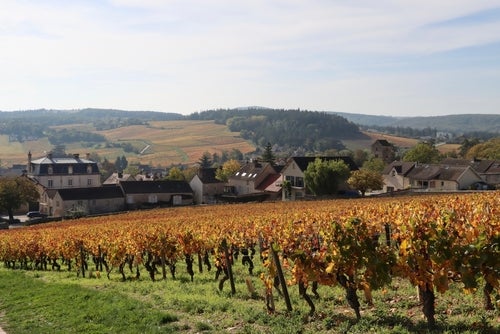
Sarah Marsh MW takes a tour of Mercurey’s vineyards with Amaury Devillard, president of the Mercurey Growers’ Association.
Over the past decade the quality of Mercurey has improved incrementally thanks to investment in the vineyards and a shift in focus from volume to quality. The high percentage of limestone in Mercurey’s soil needs careful handling to conjure wines of elegant austerity, rather than rusticity. As more producers have refined their winemaking approach and use of oak, in recent years I have increasingly included Mercurey in my vintage reports, lured by juicy reds with a more refined tannin profile than in the past. Indeed I was so impressed with 2024, a tricky vintage for reds, I started a small separate report reviewing 20 producers’ wines.
There is palpable energy in the village. This is partly fuelled by a younger generation with aspirations for once-underperforming climats, but even well-regarded domaines, among them Michel Juillot and Tupinier-Bautista, benefit from a fresh perspective. And there is new blood. I like the wines of Laurent Dufouleur, Gouffier, and ex-Faiveley winemaker Julien Bordet (La Grange aux Source). Some Côte d’Or négociants have contributed favorably to Mercurey’s image, notably Faiveley, which has long been at the forefront of investing in vineyards and promoting Mercurey, and Albert Bichot with Domaine Adélie’s elegant Champs Martins. Recently Chanson has invested in some Clos L’Évêque.
Mercurey: A rough bowl shape
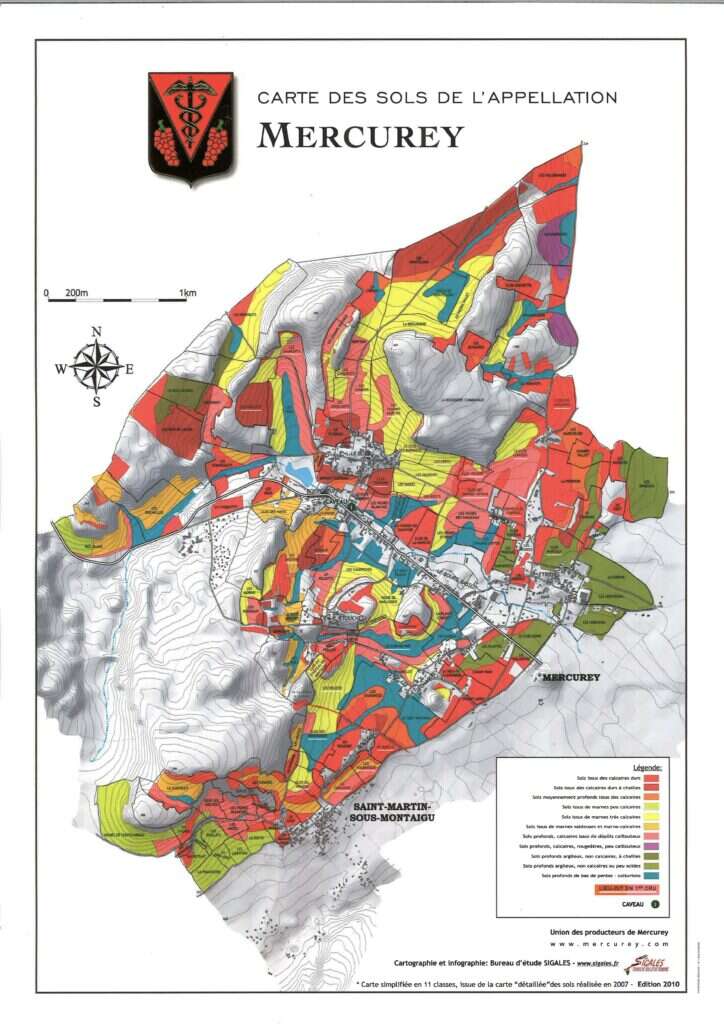
Mercurey centers around a village, named after the Roman god, of 1,200 inhabitants, forming a rough bowl shape with wings stretching up to the northerly village parcels and south/west to the village of St-Martin-sous-Montaigu; while on the southeast side, Mercurey opens to the plain. Within this there are small valleys and hills, offering different exposures and levels of protection from the wind. It is the prevailing westerly wind that makes the microclimate marginally cooler in the Côte Chalonnais (an advantage in warmer summers), than the somewhat more protected Côte d’Or from which it continues, albeit on a line of hills slightly further to the east.
Related


The altitude of Mercurey’s vineyards is similar to the Côte d’Or at around 220–340m (720–1,115ft), as are the soils, which are generally Jurassic with the typical mix of limestones with clay, as well some gravel. “It’s a patchwork of terroir, but if you come in winter you’ll be surprised to see the vineyards are almost laid out on a grid,” remarks Amaury Devillard, president of the Mercurey Growers’ Association, whose family have lived here since the 12th century. “My grandfather was the first to bottle back in 1934. He believed in the terroir in Mercurey and replanted the vineyards.” Château de Chamirey now has 37ha (92 acres) including five premier cru.
Mercurey is a larger commune than Gevrey-Chambertin with 846ha (2,090 acres) designated, of which 650ha (1,610 acres) are under vine. Chardonnay takes up 15% of the planted surface area, an increase of 5% during the past 15 years. Jean-Philippe Archambaud, Director of Philippe-Le-Hardi, the largest producer of Mercurey blanc, is a staunch advocate of white Mercurey. “It’s always been seen as a red wine-producing village, but it can make very good whites.” Premier Cru La Mission is a wholly Chardonnay vineyard, but there are other stony, limestone parcels brilliantly suited to Chardonnay, notably in En Sazenay, Champs Martins, and Les Crêts, which turn out cracking premier cru whites with savory personality. And there’s a touch of co-planting in old vineyards which no doubt helps with freshness.
Amaury and I set off southwards from Château de Chamirey, where he has converted the old winery into an elegant cellar door shop, towards the village of St-Martin-sous-Montaigu through a clutch of premiers crus which face south/east above the D155. The vineyards drape across a staggered slope like a double-bump children’s slide. On the lower part you pass through Les Ruelles, Les Fourneaux, and La Chassière ending up in Clos du Paradis which stretches higher up the slope. Les Velley (aka “Les Veleys” or “Les Vellées”), À la Serve, and Les Montaigus cloak the upper part reaching 390m (1,280ft)—quite high for premier cru and where you might expect less clay, but Amaury tells me there is a lot up here. “The soil across Mercurey is very varied. The top soil changes within a few yards from red clay to super stony with a high percentage of limestone everywhere.”
Content from our partners
It’s probably the clay that makes these premiers crus fullish and rounded. I confess it’s difficult to pinpoint the terroir expression of individual climats within this southerly clutch. Pleasant wines, but not top-drawer Mercurey. They can be quite burly and robust or more fruit-driven. Domaine Raquillet has a straight and neatly woven Les Veleys 2024, quite different from Bautista’s muscular Vellées (same climat). Manuel Bautista is a rugby player and it shows, although his nephew is injecting greater charm and forward expression.
The Land Rover chugged reluctantly up to Chatelet, a lofty village parcel at Mercurey’s southern extreme with a great view down the valley which is strewn with regional vineyards. More regional vineyards cloak the cool north-facing slope opposite where, over the substantial hill, you’re in Givry. Amaury makes a comparison. “Givry is an amphitheater with all the vineyards on a warm face,” he says. “They ripen quickly and at the same time. You have to be quick at harvest or risk overmaturity, while Mercurey’s bowl has many varied aspects.”
There are 32 premiers crus in Mercurey, ranging from 1.17ha (2.89 acres) to Clos l’Évêque at 16.2ha – some more distinctive and distinguished than others. A fine duo of premier cru are located south of the village itself, but roughly in the middle of the appellation and more sheltered than the southern group. With 10.6ha Le Clos du Roi/Roy is the second largest premier cru which Amaury describes “like a propeller with four sections, sloped and flatter with varied soils, delivering different levels of phenolic intensity.” Hence he makes four cuvées before blending. The expression of Clos du Roi is showy, full-bodied, firmly structured with ripe fruit and bold tannins. It’s made by about six producers including Domaine Faiveley. Abutting Clos du Roi is La Mission à Chamirey, monopole of 1.9ha (4.7 acres), historically owned by the family, initially planted in 1985 with substantial re-planting in progress when I visited. It faces southeast at about 380m (1,250ft) elevation. Located right by a wood, Amaury can lose the equivalent of four barrels worth of grapes to foraging deer. Three separate parcels are picked and aged separately, since some of the soil is very stony and another part quite sandy. It was this white Mercurey which caught my eye when Amaury sent me bottles of 2019 during lockdown. A white Mercurey punching well above its weight and age worthy.
We drove on to the pretty hamlet of Touches, where the beautifully restored church is open every day. From this vantage point it’s easy to see how the vineyards north of the village wrap around the hill opposite. Moving on to En Sazenay (7.44ha [11.38acres]) and La Bondue, looking eastwards you see the village opening in a wide mouth onto the plain. La Bondue by the woods has grip from the iron in the soil and a wilder feel. By contrast Sazenay produces taut whites and crisp, nervy reds. I love the cool restraint and mineral quiver of Sazenay, among the most distinctive of Mercury’s premier cru. My sort of wine. Facing south-southeast on light stony soils, partly on a plateau, there’s an abundance of limestone and many producers make both colours. (There’s a lovely example from Meursault producer Génot-Boulanger, whose historic vineyards lie in Mercurey.)
On the north side of the village, we made a quick dip to Les Saumonts on a south-southwest slope with a touch more clay further down, but rising steeply to 350m (1,150ft) where the hard limestone is terraced. Génot-Boulanger makes a pretty, raspberry-bright wine from young vines. Lying adjacent, Les Puillets is east-facing. Philippe le Hardi produces a snappy crunchy Les Puillets which contrasts with a supple, silky ripe red from Les Croichots which lies on the warmer face of the combe that divides this hill from the principal hill and the style reflects the more southerly exposure.
The northern wing of village parcels
Follow the road up the combe between Les Croichots and Les Combins you’ll reach that northern wing of village parcels I mentioned earlier. From north-facing La Brigadière the style of Jeanne et François Raquillet’s light, bright, and zesty red is typical. Philippe le Hardi have replanted with Chardonnay, which despite the aspect ripens early and was quite exotic in 2023.
On either side of the principal hill lie two widely known premier crus. The expansive Clos L’Évêque is made by many producers. Almost flat, tilting eastwards, its light, gravelly clay turns out fruit-forward, quite light, fresh, and sometimes spicy reds with easy tannins. The much steeper Champs Martins moves from west- to south-facing and the wine leans into an elegant style in both colors with more refined reds, almost graceful, illustrated by Gouffier and Domaine Adélie. The thin marly soils at the top—about 15% of the total— is favored for Chardonnay.
In the south-facing, steepish upper-middle section of the hill lie four premiers crus which produce some of Mercurey’s most distinguished premier cru wines—mineral whites and compact reds. Naugues is probably the most firmly structured. Moving west to east, Les Clos des Barraults makes an L shape around a statue of a virgin. The stony soils with plenty of limestone produce compact, tense, and lightly austere reds; adeptly illustrated by Michel Juillot, while Laurent Dufouleur’s version is crisp, straight, and salty. Les Crêts reds have similar nervy reserve. There’s a significant percentage of Chardonnay to which its light stony soil is well suited.
The red clay in Les Naugues, which lies mid-slope under Crêts, provides greater body and muscle. Les Naugues produces vigorous, punchy reds which benefit from ageing. Handsomely expressed by Jeanne et François Raquillet and Paul et Marie Jacqueson based in Rully.
The wine profile is also fuller bodied from Clos des Grands Voyens, a monopole of Jeannin-Naltet. This has become a good address since engineer Benoît Eschard took the the helm of his wife’s family domaine in 2012. Benoit remarks. “There’s much more clay here. It typically has more tannin and structure than Clos L’Évêque, but less than Les Naugues.”
Mercurey recently celebrated the 100th anniversary of its delimitation in 1923, but the history is much longer, and somewhat chequered. Revered for its wine in the late middle ages, fame and fortune dwindled, but Mercurey is finally back on track. Moreover, as quality improves, prices remain relatively stable, offering an attractive price/quality ratio.
At the Caveau Divin in the village you can sample wines from 80% of the producers, with 64 stored under gas. Bottles are sold at cellar door prices and it’s open all summer, seven days a week.