Longyu 12 is the flagship brand of Changyu Longyu Estate, the grandiose facsimile of a Bordeaux château built in 2013. Sitting in the foothills of the Helan Mountain range, the château is a 30-minute drive from Yinchuan City, the capital of Ningxia province, in central western China on the fringes of the Gobi Desert. Set in landscaped gardens with fountains and luxuriant flower-beds, the château is a tourist’s dream, while the interior trumpets the Changyu story with giant backlit color tableaux and pictorial representations, along with its own museum and cellar door. With 40,000 visitors a year, it’s all about the experience.
Changyu was created by Cheong Fatt Tze, a Chinese diplomat, in Yantai in 1892 as Zhang Yu Wine Company and became the first commercial winery in China. He imported 500,000 vines from the US and Europe, including Carmenère from France. Thanks to its Austrian technical adviser, August Wilhelm Baron von Babo, whose father founded Kloster Neuburg, the Carmenère was known as Cabernet Gernischt (gernischt being a corruption of gemischt, “mixed”). The most widely held view is that it was given this name because Babo thought, incorrectly, the grape was a crossing of Cabernets Sauvignon and Franc.
Lenz Moser V first visited China in 2005 to find a Chinese importer for his Grüner Veltliner, and he soon found himself in partnership with Changyu. The château was inaugurated on August 18, 2013, and rebranded Changyu Longyu Estate, with the joint project officially launched in 2015. Long stands for dragon, yu for decree—so, “the dragon’s decree.”
A blank canvas
In 2006, Changyu planted 373ha (922 acres) in the three subregions of the Helan Mountain East Foothill zone, which runs from north to south. The main varieties planted were Cabernet Sauvignon, Merlot, and Syrah, along with Chardonnay and Riesling for the white wines. The plantings were made sourcing old clones 106 and 107 from France, which yield some of the smallest Cabernet Sauvignon berries in the world.
Related
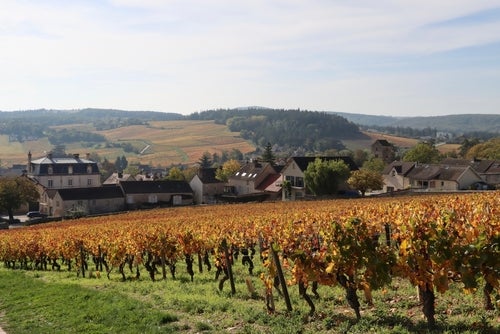


It was a blank canvas for Changyu. According to Xinming Zhou, Changyu Longyu’s plantings specialist and vineyard manager since 2007, “We planted these grapes as an experiment, since we didn’t know what was best for the Helan Mountain region. There were no parcels or clos; we just made the wine, and then we tried to figure out which parcels gave the best results.”
Today, says Lenz Moser, “We have identified, together with the vineyard manager, about 250ha [618 acres] from which we take the grapes. We now have five parcels in five areas outside the château (which itself has 60ha [148 acres]) in the subregions of Qingtongxia, Yong Ning, and Yin Chuan.” Most of the grapes come from Qingtongxia, within which the Ganchengzi zone is a source of some of the best grapes for phenolic ripeness.

Soils vary in composition, with the most southerly region, Qingtongxia, on sandy, alluvial soils; the Yong Ning region in the middle on sandy, gravelly soils; and in the north, the Yinchuan subregion’s sandy soils and cooler climate help with acid retention. In Ningxia’s continental climate, there is plenty of sunshine and warmth at altitudes of 3,600–4,300ft (1,100–1,300m), complemented by cool nights.
Content from our partners

Annual rainfall is low, at 8in (200mm), and the Yellow River, whose source is in the clean and natural Tibetan Plateau, provides irrigation where necessary. There is considerable diurnal variation, with swings of between 18° and 45°F (10–25°C) in the spring and autumn, and closer to 18°F (10°C) day–night differences during the warm summer months. Growing degree days are high, at around 2,600—3,000.
According to Mr Zhou, the vineyard work was very labor-intensive when he first arrived. Gradually, they have moved to more mechanization and information-based technology. Drones are used in the vineyard, along with AI to bring greater traceability of parcels and mechanize entire lines of production, with a QR code on barrels and everything traceable back to the vineyard.
In the vineyard, the density of the vine varies from 3,300, to 4,000 per hectare, and the trellis is the so-called inclined horizontal dragon trellis, with the vine trunk tilting at 45 degrees and one or two buds left for the following year when pruning. A drip-irrigation system is used throughout the growing season, and sprays using copper sulfate are kept to a minimum. The problem of a lack of sufficient organic matter in the soils means using animal compost and pruning waste, bit by bit, to increase fertility, with the objective of converting all the vineyards, in due course, to organic certification.
Burying the vines in winter is a necessary but time-consuming business, starting in November for one to two weeks, with the unearthing at the end of March over a similar period. The average winter temperature is –4°F (–20°C), with the lowest since 2019 being –18°F (–28°C). The problems are not just low temperature but dryness and wind chill throughout the winter. In Xinjiang, by contrast, it isn’t necessary to bury the vines because heavy snow serves as protection, whereas in Ningxia the heaviest snows are only 1–2in (3–5cm) in depth, which is no help.
Climate-change challenges
According to Mr Zhou, three main factors determine the quality of the grapes. First, very low rainfall results in tiny berries weighing around 0.05 oz (1 g). Then strong winds from the northeast blowing through a channel in the mountains throughout the year lead to loose bunches and low yields—a form of natural selection. There is little disease, thanks to this natural ventilation, while the bunch weights of only around 3 oz (80 g) and a yield of just 3 tons/ha mean that the ratio of skin to juice is high. Finally, the high altitude leads to a long growing season, resulting in good phenolic ripeness.
Climate change is a challenge. According to Mr Zhou, things have become increasingly apparent and severe since 2019. Where previously they were getting 230–240g of sugar per liter, today it’s more like 270–280g/l. With a jump in sugar ripeness and correspondingly lower acidity, he is now pushing to harvest earlier, but it all has to be done within the framework of physiological ripeness, “so it’s quite tricky.” To meet the challenge, he is aiming to increase the height of the vine and the cordon, doing little or no leaf-plucking or hedging to redirect energy into leaves rather than the berries, and increasing irrigation to slow down the accumulation of sugar.
Harvest starts in mid-September and runs to the second week in October. Before the harvest, the first selection is made for Longyu 12 in the vineyard. Mr Zhou prides himself on the selection criteria, which he calls “the highest in China.” The grapes are entirely hand-picked, and all pickers are trained to understand how to pick, so the first sorting starts with the picking. A selection follows on a sorting table, as well as by an optical machine sorter.
The bunches are destemmed and crushed before the must is run into stainless-steel tanks of 10-, 20-, and 50-ton capacity. There is a general pre-fermentation cold soak of between three days and a week, depending on the grapes and the style, with a cold soak of around three days for Longyu 12 itself. Once the must is at room temperature, yeast is added, and this includes Longyu’s own proprietorial yeast.

Fermentation goes on for 10–12 days, with pumping over twice a day. There is another stage during the fermentation that involves separating the solids and the liquids at night in order to avoid excessive tannin extraction, and the liquids are then returned to the solids on the following day. At the end of the fermentation, the free run is separated and the solids pressed twice for a softer and harsher press, followed by malolactic fermentation. Only the free run is used for Lonygu 12.
The wine then goes into a variety of 100% new French Tronçais 225- and 500-liter barriques. Longyu 12 spends 18 months before blending, reduced from 24 months since 2021. Two large casks of 5,000 liters are used for blending, then the wine is returned to barrel for three months before bottling. Tannins are not added, because “the phenolics are good,” and adding back water is illegal in China. They will, however, correct for acidity before fermentation where necessary, so as to adjust the pH (normally in the 3.7–3.9 range) and maintain color.
According to Moser, “Acidification is a tool in the armory to be used if necessary, but if we do everything right in the vineyard, it’s not necessary. I don’t really like it. I’m a hands-off winemaker; I want to take the best fruit, and with double sorting—which we use every year—that’s the main thing.”
Throughout his ten years of involvement in making wine at Changyu Longyu Estate, he has had regular discussions with Dr Li, Changyu’s overall head of winemaking. One of the recurring topics of conversation is the challenge of alcohol and how to reduce it in the white wines, in particular. “It’s about using several measures in the vineyard and the cellar,” says Moser. “It’s water-management, it’s fertilization, and earlier harvesting, and in the cellar using native yeast instead of the modern aggressive yeasts. This debate is not over yet.”
Moser is an integral part of the tasting team, which includes Longyu’s head winemaker Wenguang Jiang, as well as Yu Jie Xie—or Grace to her English-speaking friends—one of a team of four winemakers, who is from Yintai in Shandong. She completed her master’s in viticulture and enology at Adelaide University in 2019 and came to Changyu in 2024 after working previously at Changyu in Yantai.
What do Chinese consumers really want?
Changyu’s icon red Longyu 12 is 100% Cabernet Sauvignon; it is branded Longyu M12 for overseas markets. A Longyu 8 is picked earlier, generally for fresher, more vivid fruit, with 30% new oak; and the Longyu 9 spends 22 months in oak. The name Changyu Longyu Estate is retained mainly for the European market, for which there is also a mid-tier Moser Family Cabernet Sauvignon and two entry-level wines, a red and a Helan Mountain Cabernet Sauvignon Blanc de Noir white. The winery’s total production stands at some 1 million bottles, with Longyu 12 at between 120,000 and 160,000 bottles.
On Moser’s trips to China, he and his assistant always carry a variety of bottles for benchmarking. “We like to compare these wines to Bordeaux and other regions,” says Zhou. “So, we have tasted the likes of Château Montrose and Lascombes from Bordeaux, Penfolds 407 from Australia, and Ningxia Cabernet. We also taste wines of different vintages every year, and in June we compared wines from 2016, 2023, and 2024.”
“We don’t always agree, but we fight it out,” says Moser. “Technically, they are very good and have an advantage over me, because I’m not technical, but what I do bring is my knowledge and experience of blending and also of knowing what the consumer wants. They trust me. One of the things I want to do is reduce the influence of wood, in order to bring out the vibrant and beautiful fruit from these uniquely small berries.” Zhou feels that the style tends to be fuller-bodied for the Chinese market, because “Chinese people […] prefer more tannins, soft texture, and heavier body.”
Moser is not as convinced about what the Chinese really like, because he thinks their general knowledge of wine is next to zero. “There is no such thing as the Chinese wine consumer. When they say they know what the consumer wants, I always doubt this. I feel that historically the Chinese consumer, if it exists, used to go with Bordeaux as a status symbol; then came the Australian phase, and Penfolds was very successful because it gave the Chinese a softer style, and it went better with food.

“I lean more toward the Australian style, because I think the Chinese like the softer style. Our big debate is to bring the alcohol down, because it’s pretty heavy. China is still an emerging market, leaning now more toward whites than reds, following the global white-wine trend. We have 90% red in the market, and that is changing. I think it will follow the global trend and go with more modern wines with lower alcohol.”
Changyu’s second icon wine is Purple Air Comes from the East, which is designated for overseas markets. “Purple Air Comes from the East is close to my heart,” says Moser. “I had been planning to make it since 2015, but 2015 wasn’t a good enough vintage, so the first vintage released was 2016, and it got very good ratings.” Both wines use 100% new oak. “Longyu is more fruit-driven,” Moser says, “while Purple Air is more classic, with more coffee, more chocolate flavors, more wood influence. You don’t taste it, but it has more toasty oak, with a special toast by Chinese coopers at the château for the style I really like.”
Tasting

2019 Longyu 12 Cabernet Sauvignon Dry Red Wine (15% ABV)
Deep, youthful ruby hue, shading to garnet. Attractive, sweet-smelling fragrance, incorporating blackcurrant, blackberry, and subtle cedary oak aromas, as well as a distinct minty/capsicum note, something even savory and balsamic. Nicely textured, distinctively Cabernet, with flavors of cassis tinged with mint and capsicum and subtle oak layering, all leaving an impression of power, yet thankfully underpinned by a firm backbone of acidity and a light gamey note of evolution. | 91
2020 Longyu 12 Cabernet Sauvignon Dry Red Wine (15% ABV)
A more youthful ruby color; a hint of garnet at the rim. Fine aromatic quality, in Margaux-meets-Chile style, with plenty of sweetly ripe cassis and cedary oak and just a hint of mintiness, but not as much as in the 2019. This is full-flavored, opulent, and rich, with powerful cassis fruit flavors, a veneer of stylish vanilla oak, and bittersweet chocolaty notes underpinned by firm acidity and extremely supple, ripe tannins, almost juicy, and again that powerful ABV feel on the finish—not burning as such, but with plenty of power. | 91
2021 Longyu 12 Cabernet Sauvignon Dry Red Wine (15% ABV)
A more youthful ruby in color. Bright, fresh, and highly aromatic. Inviting, certainly—perhaps more a cross of Napa Cab and Australian Cab than Bordeaux, thanks to a veneer of vanilla oak combining with cassis notes and a brush stroke of signature Cabernet mintiness, plus a hint of pyrazine. Plush-textured, with obvious concentration of cassis fruit and serious opulence (very New World), all in a supple framework of gentle tannins, which are more evident than in the 2020 and 2019. Good acidity and still a tad chewy, hitting the buffers of a slightly dry finish, the oak the most likely culprit. | 92
2022 Longyu 12 Cabernet Sauvignon Dry Red Wine (15% ABV)
Still in barrel before bottling, and bottle aged for around 3–6 months, this is a deep youthful ruby, bright and inviting, yet still sweetly cassisy and slightly minty, with licorice spiciness to boot (Margaret River? Chile?). As yet showing a little more aromatic restraint than the 2021. Opulent, concentrated fruit, with a strong cassis middle, tinged with mint, and a firm structure in which supple tannins and a good acid spine combine to show a decade’s potential longevity, underpinning the entire enterprise. | 92–94
2019 Purple Air Comes from the East (14.5% ABV)
Good, deep youthful ruby color. Attractively aromatic, still fresh and with just a hint of maturity, a touch of smoky oak over typical ripe Cabernet aromas, with licorice and clove spice from the oak. Rich and opulent mid-palate, with distinctive dark-berry Cabernet flavors, a hint of leafiness, and a lack of mid-palate concentration. The sweet turns quickly to savory, with slightly bitter tannins on a drying finish. Lacking harmony. | 89
2023 Longyu Cabernet Sauvignon Blanc de Noir (14% ABV)
Pale gold in color. Oaked but not too obviously; a feeling of richness, even decadence, a sweet-fruit fragrance. Complex, with stone-fruit richness in the middle; nice texture, veering toward a slightly savory and bitter finish, with dry tannins from fruit or oak or possibly both. A wannabe Chardonnay, this is unique technically but not tasting-wise—a creative way of using Cabernet Sauvignon to make an enjoyably drinkable dry white. | 89