Joanna Simon’s series on wine country food and wine takes her to Argentinian Patagonia, as she explains the history and preparation of the colonial-era beef and vegetable stew, carbonada criolla—and finds the best wines to drink with it.
Argentina has two stews that vie for national treasure status: locro, which is a national dish in many variations in several countries crossed by the Andes; and carbonada criolla, which is most strongly associated with Patagonia. Of the two, locro, with its Andean Quechua origins, can claim superiority of age, but it is carbonada criolla, a dish of Argentina’s colonial period (mid 1530s to 1810), that has its place in the cultural identity-defining gaucho poetry, featuring as it does in the famous epic poem El Gaucho Martín Fierro.
Martín Fierro was written by the Argentinian José Hernandez in two parts, La Ida (The Departure) in 1872 and, more than twice as long at nearly 4,900 lines, La Vuelta (The Return) in 1879. It’s seen as the apogee of gaucho literature, is thought never to have been out of print, and has been translated into scores of languages.
Carbonada makes its appearance early on, coming in the second song (Canto II) of La Ida. Martín Fierro is recalling gaucho life in earlier, happier times before press gangs and persecution. La sabrosa carbonada (the tasty carbonada), is mentioned alongside carne con cuero (meat with its hide on, meaning beef for cooking in the traditional asado way), mazamorra, a hominy corn dessert, los pasteles (which could have been savory, but were probably sweet here) and el buen vino (no need to translate that).
Related
How to make carbonada criolla
Whereas locro is a thick, creamy soup-style stew based on indigenous produce, above all hominy and white beans, with the addition of squash and various meats (beef, pork, bacon, chorizo, and often offal/organ meats), carbonada criolla is a creole dish—a fusion of indigenous ingredients, such as pumpkin, potatoes, and corn, with Spanish elements and influences, in particular, dried fruit and meaty stews. The result is a chunky beef and vegetable stew with a distinctive sweet note from the dried fruit, as well as the pumpkin, sweet potato, and corn. The pure Spanish descendants of the original settlers were the criollo people; hence the criolla of the dish’s name. Carbonnade flamande, Belgium’s beef and dark ale stew, is sometimes cited as the inspiration for carbonada criolla, but there seems to be no real foundation for this.
Traditionally, the stew is cooked and served in a hollowed-out pumpkin, the whole thing cooked over hot coals or in wood embers or ashes, asado-style. These give the dish the carbonada part of its name: carbón is the Spanish for coal, carbonizada is the word for charred, and the carboneros were the late 19th and early 20th-century charcoal-burners during European land clearance and colonization, especially in Patagonia, the region with which the dish is most closely linked.
The other common name for the dish is carbonada en zapallo—zapallo being the Spanish for pumpkin. Nowadays, the cooking is often done in an oven and the pumpkin and stew may be cooked separately and then united before serving (less maneuvering about of a large cooked pumpkin filled with hot stew).
Content from our partners
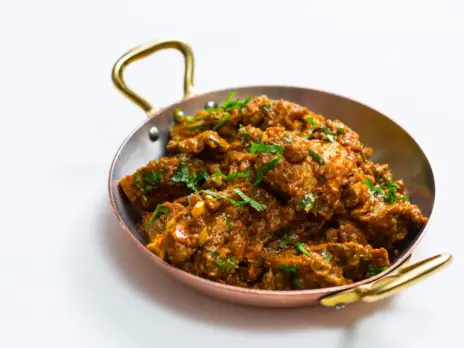

The essential ingredients are a round pumpkin (such as kabocha, red kuri, or crown prince), stewing beef, sweet and white potatoes, onion, green pepper, corn (usually corn on the cob), garlic, beef stock (broth), and dried fruit. Most commonly the fruit is dried peaches and/or apricots, but sometimes raisins or prunes are included, and sometimes fresh fruit, too, such as grapes, peaches, or pears—there’s a lot of latitude. Other ingredients frequently used are tomatoes, carrots, wine, bay leaves, oregano, and paprika.
The savory-sweet combination of a meaty stew with fruit appears in many countries, but often there’s a tart element as well, as in Georgia’s chakapuli (lamb or veal with sour plums), Greece’s kydonato (lamb with quince and pomegranate molasses), Australia’s lamb with verjuice, apricots, and green peppercorns, and, although it’s a baked dish, not a stew, South Africa’s bobotie. You can find versions of carbonada criolla with a little sharpness, provided by grapes, wine, tomato, or even vinegar, but they aren’t the most traditional.
The best wines to pair with carbonada criolla
The sweetness shouldn’t outweigh the savory meatiness of the stew, but it inevitably influences the choice of accompanying wine. Almost as inevitably with a beef stew, white wine is not the first port of call, although a full-bodied white, especially Chardonnay or Semillon with some oak sweetness, can work with a carbonada that is not too beef-heavy. Amber/orange wines are also possible—not those at the extreme end of the tannin and dryness spectrum but an approachable, qvevri-fermented Georgian wine such as Tbilvino Qvevris Rkatsiteli 2022.
When it comes to red wines, it’s hard to avoid Argentine Malbec—and there’s no reason to. It has the fruit in most cases to take on the sweetness in the dish. I would avoid the oakiest wines, but then I would as a rule anyway. More reluctantly, I would think twice about some of the more mineral, elegant Malbecs from extreme terroirs, which can taste too austere with carbonada (I’m thinking of wines such as the lovely Buscado Vivo o Muerto La Verdad Malbec 2019 from 1,450m up in San Pablo in the Uco Valley). Wines that toe the middle ground successfully include Zuccardi Q Malbec, Bodega Colomé Estate Malbec, Domaine Bousquet Gaia Malbec, and Bodega Piedra Negra Reserve Malbec. From Patagonia, my choice would be the complex, refined, old-vine Bodega Noemía J Alberto 2022, as long as I was sure that the carbonada was not too sweet.
The Malbec doesn’t have to be from Argentina. These days, Cahors has plenty to offer, with many wines delivering expressive, rich, pure fruit, fresh, mineral definition, and polished tannins. Château de Chambert (currently on the 2017 vintage), Château de la Pineraie L’Authentique, Château de la Marjolière, which I tasted for the first time recently, and Château de Haut-Serre are all good starting points.
And it certainly doesn’t have to be Malbec. Cabernet Sauvignon and Merlot with plush fruit and soft tannins, in blends or solo, and the lush Pinot Noir fruit you can find in Central Otago are all possible, but even better I think are Grenache-based reds. There is plenty to choose from in the southern Rhône, from Châteauneuf-du-Pape outwards, but also further south again in Roussillon, notably Collioure. Domaine de la Rectorie Collioure Coté Montagne 2022 hits the spot for me.