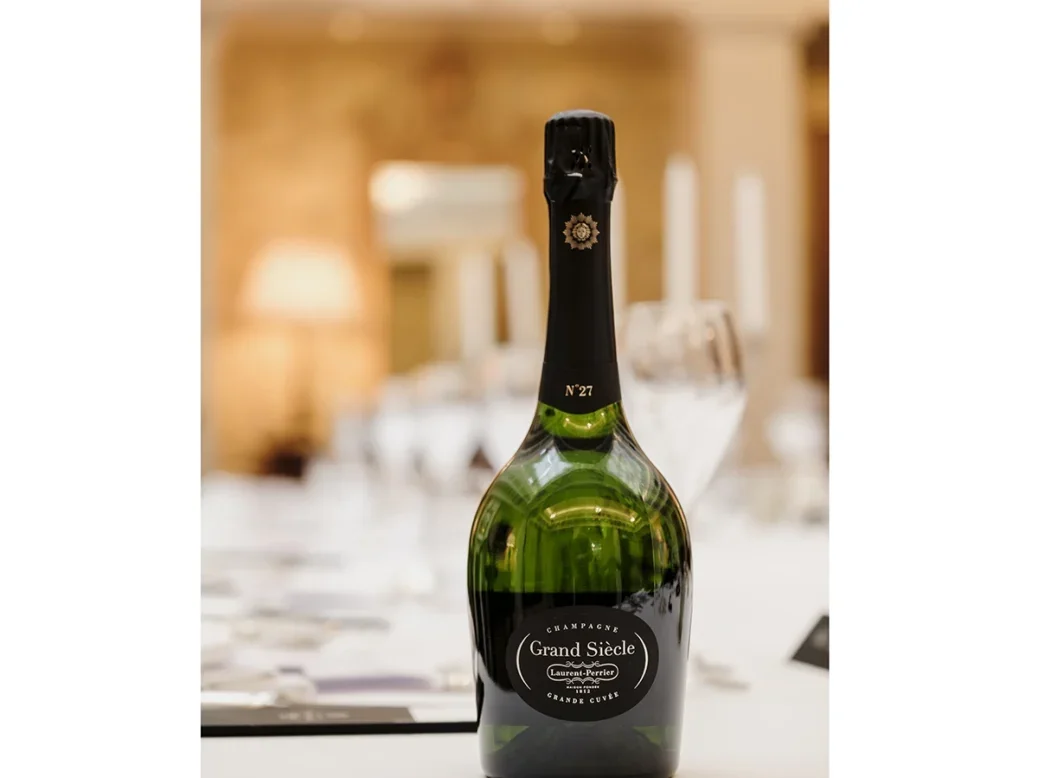
Simon Field MW joins chef de cave Olivier Vigneron over lunch at London’s Lanesborough Hotel to taste Laurent-Perrier 2018 and Grand Siècle Iteration 27.
Laurent-Perrier is one of the five largest producers in Champagne, and yet it differs subtly but essentially from the corporate lattices of LVMH or Lanson BCC, say, or from the postmodern cooperative web that is Nicolas Feuillatte. Laurent-Perrier is the only one that remains family-owned and the only one that brings only one brand to the marketplace. The cultural differences are nuanced but telling and can neatly be encapsulated by the fact that my conversation with chef de cave Olivier Vigneron is conducted in French rather than in English.
Vigneron, who has worked at LP since 2004, threads a clear line of succession from the equally Francophone Michel Fauconnet, the man who displayed a near-Hitchcockian relish in his apparent reluctance to retire. Putative successors, including the highly influential Dominique Demarville, came and went, but it turned out that the dauphin, unassuming and capable, had been in situ in Tours-sur-Marne all along, hiding in plain sight. With a name like his, nominative determinism writ large in Gallic script, the line of succession appears to be secure. Reporting to two generations of the de Nonancourt family (Alexandra and Stéphanie the éminences grises these days, with Alexandra’s daughter Lucie de Pereyre de Nonancourt the Grand Siècle ambassador), Vigneron aspires to bolster a legacy that has been quietly revolutionary. Laurent-Perrier, after all, was first off the blocks with its zero-dosage offering (Ultra Brut), had a huge influence on the evolution of the macerated rosé style, and was also the pioneer of the Multi-Vintage deluxe cuvée with Grand Siècle. In an age when rosé sales continue to climb and when the nuanced implication of Multi-Vintage is also in ascendancy, Laurent-Perrier has many reasons to be proud of its quietly influential heritage.
Pride is now focused on the early 2026 releases: the 2018 Vintage and Grand Siècle Iteration 27. Olivier has come to London to launch this brace and, with thanks to the chefs at the Lanesborough Hotel, to illustrate their gastronomic potential. He is accompanied by multilingual Laurent-Perrier enologist Constance Delaire, who is able to step in when the finer points of Vigneron’s Gallic elegance are momentarily misplaced. This is a formidable team, in other words, less obviously “corporate” than some, but passionate and inspiring. What could be better?
Related

Harbinger of a famous trilogy
Our first wine is the 2018 Vintage, celebrating a year that turned out to be the harbinger of a famous trilogy. A wet winter had followed the far-from-auspicious 2017 harvest and served as a counterpoint to the ensuing intensity of heat, the latter every bit as fierce as in 2003, the former holding the edifice together far more successfully than 15 years previously. A short cycle and early harvest (started in the third week of August) did not jeopardize structural potential or physiological ripeness. Olivier concedes that malic acid levels were low (between 5.6 and 6g/l) but maintains that they have in no way compromised the structure of the wines and their capacity to mature. The 2018 is only the 32nd Vintage released by Laurent-Perrier—an appreciably lower ratio than for most houses and a statement of confidence in its potential. As usual, the Chardonnay just edges the Pinot Noir (58% to 42%), and as usual there is no oak and a full malolactic fermentation, despite the heat of the year. Olivier maintains that “purity, finesse, and structure,” LP leitmotifs one and all, are all evidenced in this youthful Champagne, which he praises for its vivacité naturelle, the “strict” Chardonnay from villages such as grand cru Le Mesnil-sur-Oger and Avize demonstrably harnessing the powerful potential of the Pinots from key LP landmarks such as Tour-sur-Marne, which hosts the winery, and Louvois, location of the elegant familial seat. Interestingly, Vigneron maintains that he feels that the Pinot Noir from the celebrated grand cru village of Aÿ is just “too expressive” for the Grand Siècle but is ideal for the Vintage wine, where it acts as a key component. There has, of course, been a great deal of blending in play, even for the wine of a single vintage—this is Champagne, after all.
As a brief interlude before the Grand Siècle, Olivier reminds me of the “new” (as in latest) cuvée, the Héritage, which was introduced a couple of years ago to serve as a stepping stone in the range and, most importantly, to underline the attention paid to reserve wines. “We have more than 300 large vats of reserve wine,” Olivier advises, stressing that their importance is such to merit greater attention. The Héritage is therefore made up entirely of reserve wines, sourced from four different vintages over 40 different crus and serves as a further illustration of the virtues of assemblage. “I want to stress,” Olivier continues, “that the reserve wines are so much more than un rapport d’unité et de sécurité”—more than a means to an end, in other words, but in themselves the lifeblood of fine Champagne. The Héritage cuvée illustrates this fact eloquently, and it will be fascinating to assess how it evolves with its second release.
No need to wait for the new Grand Siècle, however. The Iteration collection, which clearly segregates releases, was introduced as late as 2019. The greater transparency thereby achieved was deemed essential in fostering expertise and, by extension, collectability, in this, one of the most influential of all the deluxe wines. The bottles enjoy their 27th outing and the magnums, deliberately some way behind, their 24th. The subtly controversial dictate of founder Bernard de Nonancourt—namely, that there can never be perfection in nature but that one can get a little closer with the intervention of man over an extended period—has crystallized with a wine comprising three complementary vintages, with Chardonnay always marginally in the ascendant, with only 11 of Champagne’s 17 grand cru villages permitted as sources, with no oak, and with a minimum of ten years of lees-aging. Fairly straightforward stipulations, it would seem, but somewhat controversial in 1959. “The whole will always be greater than the sum of the parts,” echoes Olivier, describing an “aromatic voyage” as the metamorphosis of perception yields “a tactile and emotional experience,” his poetic side emerging at last.
Content from our partners
What also emerges is the sheer quality of the I27, including wines from 2015 (60%), 2013 (20%), and 2012 (also 20%)—all the more fascinating in that none of these is a “star” year in the mold of 2008 or 2002, say. They pull together very well, however, Olivier adamant that the temptation to include some 2008 (I26 was 65% 2012, 25% 2008, and 10% 2007) was specifically rejected on the grounds of the need to maintain a crystalline purity of attack. We know the proportion of the three components overall, but there is no further information to describe, for example, how the 2012 component may differ—in terms of vat or even structural breakdown—from the 2012 contribution to the I26. As usual, the Champenois are generous in mining the detail—far more than previously, for sure—but will only go so far. The enigma persists, and one never dares to request the overall production figures, which are never released. Less than Dom Pérignon, one surmises… What we do know is that eight key villages have been selected from Bernard’s original grand cru shortlist: Le Mesnil-sur-Oger, Avize, Cramant, and Oger in the Côte des Blancs, and Tours-sur-Marne, Ambonnay, Verzy, and Bouzy in the Montagne de Reims—class acts, one and all.
The wine impresses immediately, its purity and elegance resounding. Its components are fascinating. 2015, the majority shareholder, was another warm, quite challenging year, certainly tilting toward Pinot Noir (while LP generally favors Chardonnay). 2013, for its part, was an “old-school” vintage, marked by a conspicuously late growing cycle and by musts and wines that focused primarily on length and precision, an idea complementary to both 2015 and 2012, the latter a year of early viticultural challenges, lowish yields, and some robust, foursquare wines. Quite a contrasting triptych, in other words, and yet the resulting Grand Siècle I27 allures. Olivier maintains that the I26 is “monumental” in style, with the I27 more “lively” and “energetic.” Modesty prevents him from going too far by way of explanation of his preference for the younger wine. Be that as it may, a side-by-side tasting with the 2018 Vintage certainly underlines the value to be gained from this cross-vintage blend, entirely at one with the values enunciated all those years ago by M de Nonancourt.
Today’s vintages, per Olivier, are more unpredictable and more unstable; there is increasing need for water retention but also for good drainage, for deep root penetration, and for a respect for a sustainable agenda. Olivier attributes the success of this impressive wine to “an innovative spirit, which marks out this house above any other, […] the willingness of messrs de Nonancourt and Fauconnet to go further to seek a precision of aromas, itself born from a precision in the identification of terroir,” to ensure that, when it comes to the prestidigitation in the winery and the magic of the assemblage, the very best raw materials have been selected. The fact that such a long-standing aspiration, honored in the practice, now seems obvious, once again underlines its significance in shaping these great wines.
Tasting
2018 Laurent-Perrier (52% C, 48% PN; disgorged July 2025; dosage 8g/l)
Bright, soft green-gold, with an energetic mousse: pinpointed, precise, promising. The aromatic takes us to the lemon grove at dawn, spring flowers garlanding its walls, hints of macadamia, almond, and acacia. A youthful sensation, white peach and pink pearl apple in support. The palate is lively, zesty, clean, and true; sourdough and the most modest hint of the Viennese bakery are as close as one gets to the fractious midsummer heat of the year in question. Most impressive—and all the more so in that there has been no recourse to repressing the malolactic intervention or even a reduction of dosage in the name of a tense, linear structure. There is no need, for it is there anyway, buttressing the fruit with ease. Lots more to give here, as one would expect. | 92–94
Laurent-Perrier Grand Siècle Iteration 27 (60% C, 40% PN; 60% 2015, 20% 2013,
20% 2012; disgorged May 2025; dosage 7g/l)
An alluring luminosity, the bead tightly regimented, persistent. Honeysuckle, almond, and dried apricot, then acacia, Amalfi lemon, and hints of petrichor and flintstone, the darker Pinot character hitherto kept in check. The palate defers a little more to the dark grape, with small red berries neatly entwined, a deft counterpoint to the citric backbone and to unmistakable if shy murmurs of hazelnut and sloe. The integration between such different vintages has been seamless, the ensemble confident, firm of voice, and set fair for a happy evolution. | 94–96