In 1838, Prussian wine merchant William Deutz settled in Champagne, choosing the influential village of Aÿ, just as his compatriot Joseph Bollinger had done a decade earlier. Etymology betrays the influence of Aÿ at the time (Avenay and even Epernay were named topographically for their respective locations in relation to Aÿ), and both geology and aspect confirm its significance as one of the greatest of the Pinot Noir grands crus. Indeed, the village, exceptionally, also has grand cru status for its Chardonnay.
Deutz has never moved from 16 Rue Jeanson, and it now produces more than 2.5 million bottles a year. It is still under family ownership, even if the family in question is the Rouzaud dynasty, which also owns, inter alia, Louis Roederer, Ramos Pinto, and Delas Frères. Within this matrix of excellence, Deutz is afforded autonomy, both technically and commercially.
We are so advised by chef de cave Caroline Latrive, one of a new generation of increasingly mobile enologists. We have met her before at Bollinger and, more recently, as chef de cave at Ayala. She is presenting a brace of grand cru Pinot Noirs from Aÿ, one a little more exuberant, the other deliciously reticent, their differences thus obediently highlighted in a demonstration of the complex terroir in play. This difference is thrown into even sharper focus when we are told that the sites are a mere 220 yards (200m) apart. Shades of Burgundy, carefully nuanced and eloquently sketched for us in London’s Peninsula Hotel. Caroline is reasonably fluent in English but decides to speak in French, which is refreshing, as are some of her introductory statements. She describes her “vocation of pleasure” and her role in fashioning the different cuvées as “an exercise in liberty,” which sounds even better in French.
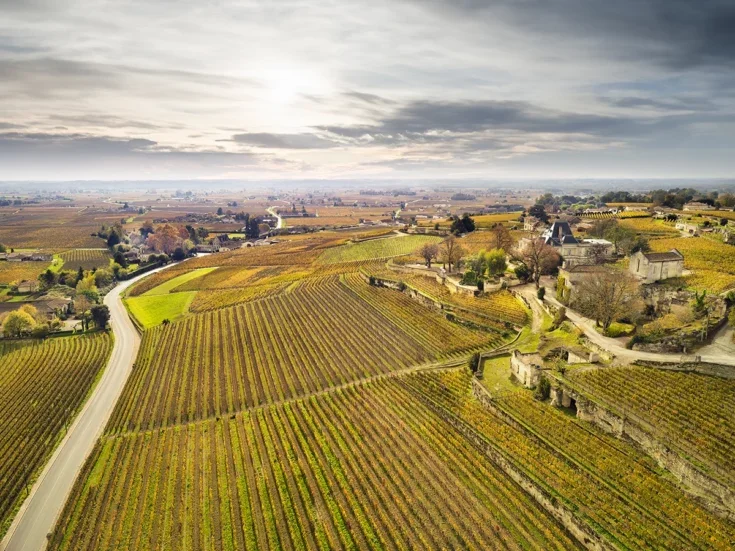
Liberty to showcase exceptional Pinot Noir. Both sites, La Côte Glacière and Meurtet, are stalwarts in the regular Hommage à William Deutz cuvée. In 2012, 2015, and now 2018, however, conditions favored the showcasing of the individual vineyards, the east-facing 2.4ha (5.9 acres) of Meurtet and the 1.9ha (4.7 acres) of La Côte Glacière, its chilly name belying the warm south-facing vines. Meurtet has deeper soils and, according to Caroline, less vintage variation. (What she describes poetically as the bascule aromatique comes a little later.) Glacière benefits from older vines (planted in 1967) and shallow soils, with the solid chalk substratum a mere 28in (70cm) from the surface. It is a little steeper than Meurtet (25% versus 15%) and is usually harvested earlier, in 2018 from August 25 to 27, compared to September 3–5 for Meurtet. Deutz generally cleaves to a “later harvest” policy; clearly this was somewhat compromised after the long hot summer of 2018, a year that was consistently generous, without ever slipping into hydric crisis. Indeed, Caroline describes the vintage as a “benediction,” especially after the frosty challenges of 2017.
Related

Caroline’s overall assessment of the two wines is pithy and memorable: Meurtet is “restrained and delicate, the incarnation of great precision,” whereas La Côte Glacière is a “majestic expression of opulent Aÿ Pinot Noir.” The differences are the work of nature rather than the vigneron, with winemaking identical in all but the dosage, which is 7g/l for the Côte and 5.6g/l for Meurtet, a difference that may underline the expressive ripe character of the former to a greater degree. Caroline brushes off such speculation, maintaining that the dosage was only finalized after extensive “blind” trials and was deemed to suit the robust and capacious structure of the wine. The wines are thus conspicuously different yet both reassuringly Pinot, so they offer a nice contrast with the Blanc de Blancs style of the Amour de Deutz. Both of the wines were disgorged in the spring of 2025, and both underwent a full malolactic fermentation.
Mission accomplished, then—and accomplished with no lack of aplomb. The tasting on the fifth floor of The Peninsula shows off the difference well; better still would be to taste the wine in situ in Aÿ, preferably in Deutz’s ornate Second Empire drawing room, known as the Salon des Oiseaux. One only has to open the French windows to find out why: Miraculously, as the tasting goes on, the birdsong becomes ever more mellifluous, in quiet celebration of the founder of the house. One mystery remains, however: Why was this entrepreneurial expatriate Prussian called William rather than Wilhelm or even Guillaume? No one seems to know the answer.
Tasting
2018 Deutz Hommage à William Deutz Meurtet
(100% Pinot Noir; disgorged April 2025; dosage 5.6g/l)
Content from our partners

Pale gold, limpid. The nose is discreet, gentle, eventually conceding apricot, lemongrass, and wild strawberry, the last subtly underwriting Pinot Noir credentials and latent power. The palate adds textural generosity, a silky seam of elegant composure, a resting place for the soft red fruit. Hints of peach, white flowers, and even more tropical descriptors (mango, soft pineapple) are detected with aeration, the latter essential to liberate this relatively timid child. The finish is already quite expressive, however, with a noble bitterness, described by Caroline in terms of “Aÿ salinity,” evidenced. Pleasure is both granted and deferred. | 94
Deutz Hommage à William Deutz La Côte Glacière
(100% Pinot Noir; disgorged April 2025; dosage 7g/l)
A slightly deeper gold, with a strong persistent mousse and an assonant aromatic that defers immediately to small-berried red fruit, such as blackcurrant and rosehip. There is verbena, too, mango and honeysuckle—in short, a generous fruit basket is laid out before us, behind which one also discovers soft spice and a whiff of black chocolate, each betraying both the quality and the intensity of the Pinot fruit. The ripe, exuberant personality is held in check by a velvety textural blanket, with the natural acidity and innate length conspiring to add gravitas by way of counterpoint. The 7g/l of sugar has been deftly integrated and in no way compromises the stony precision of the finish, which is both charming and elegantly sculpted. | 95