Joanna Simon explores the origins, history, and preparation of jambon au Chablis, and finds the best wines, including a certain local white, to pair with the Burgundian dish.
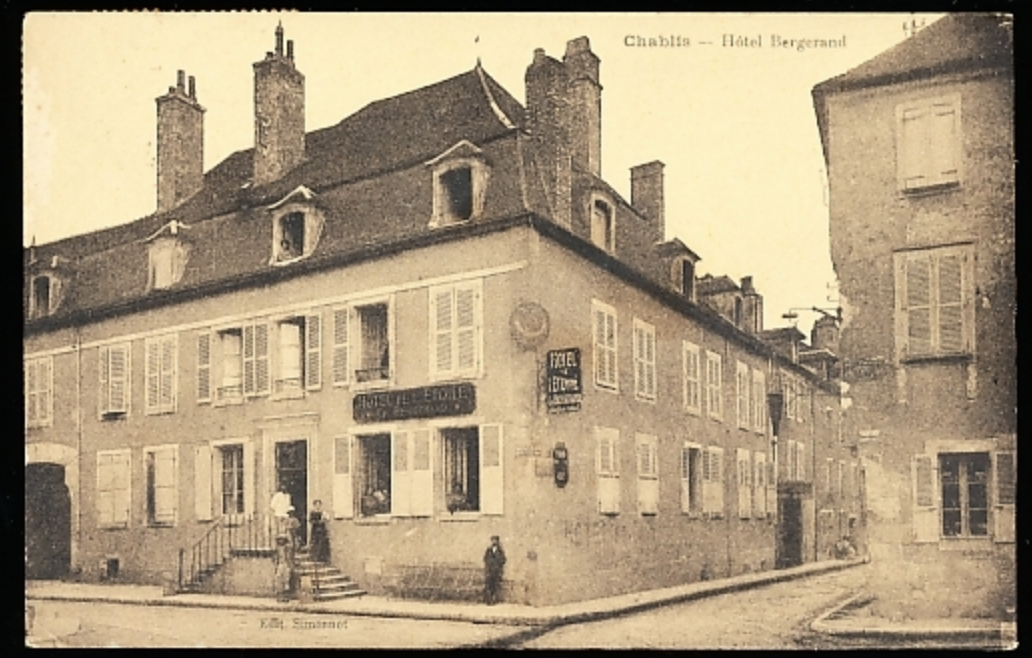
In its heyday in the first half of the 20th century, the Hôtel de L’Étoile in the historic heart of the town of Chablis was one of the great staging posts on the gastronomic map of France. The rollcall of famous patrons included distinguished men of letters, actors, statesmen, and royalty, among them Aristide Briand, Jean Cocteau, André Gide, Sacha Guitry, Pierre Fresnay, Raimu, the French President Gaston Doumergue (the son of a vigneron in the Gard, incidentally), and Alphonse XIII king of Spain.
The hotel, which won the Touring Club of France’s prestigious “bon hotelier” first prize in 1913, boasted a garage, central heating, and hot and cold running water, and its image featured on many postcards, but it was the restaurant above all that drew people from far and wide. Specifically, it was the dishes of chef-owner Charles Bergerand (sometimes referred to as Charles-Louis to distinguish him from his father Charles).
The hotel had been founded in 1866 as La Maison Bergerand by his grandfather Théodore Bergerand, former sauce chef to King Louis Philippe at the Tuileries. In time, he was succeeded by his son Charles and then his grandson Charles(-Louis), who was born in 1879 and rejoined the family business in 1906 after apprenticeships in Beaune, first as a pastry chef then a chef, followed by positions at prestigious restaurants in Paris and Monaco. It was he who built the reputation of the restaurant and who is also credited with increasing the renown of Chablis’ wines, thanks to their heavy presence in the restaurant.
Related

Of all Charles Bergerand’s celebrated dishes —les écrevisses à la chablisienne, les escargots de Bourgogne, la fondue de poulet à la crème and le soufflé aux oranges among them—the ne plus ultra was jambon à la mode d’ici, later named jambon à la chablisienne, (and sometimes called jambon au chablis), which remains a popular staple today not just of the Yonne but across Burgundy.
The prestige of the hotel-restaurant did not endure, although the building, the façade of which dates to 1778 and other parts of which date to the 16th century (miraculously, it escaped the June 15, 1940, bombardment), still stands at 4 rue des Moulins, on the corner with rue du Maréchal Leclerc. Charles died in 1954, without children and having already passed the reins to his great-nephew André Roy. After Roy, it went through several hands, gradually declining until November 2022 when, according to Chablis, Terre d’histoire, an association founded to study, preserve, and promote the historic patrimony of Chablis, it was sold to a Chablis wine domaine-owning couple. After extensive renovation work, due to start in 2023, the legendary hotel-restaurant’s star would shine again, the association reported. To date, it has not reopened and there has been no further news. (Perhaps there is an investment opportunity here for a WFW reader…)
Back to jambon à la chablisienne. The original dish is usually said to have started with cooking a whole ham on the bone in Chablis wine and various seasonings and aromatics. The poaching liquid, after reduction, then formed the basis of a typically Burgundian, rich, but relatively simple sauce, with finely sliced shallots, tomato concentrate, crème double (double or heavy cream rather than the crème fraîche that is the common currency in France today), and butter. This was poured over thick slices of the ham.
Content from our partners
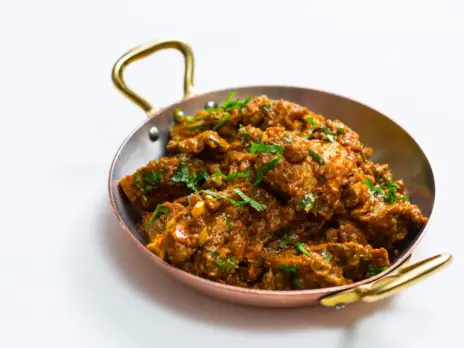
There’s no reason to doubt that Charles Bergerand used whole hams—it would have been expected in a high-class restaurant—but the recipe for Jambon mode d’ici, in a small collection that he published to give to good customers, is for the sauce only, the final instructions being to “Saucer sur le jambon chaud découpé en tranches” (pour it over the hot ham cut in slices). And then “Servir très chaud.” (Serve very hot.)
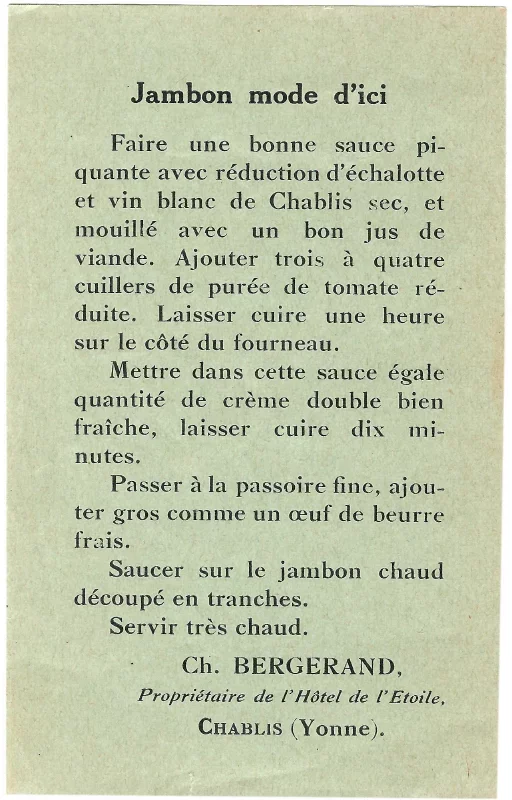
Today, most domestic and many restaurant versions dispense with cooking a whole ham and use thick slices of jambon de Paris or jambon blanc, cut off the bone rather than ready sliced (it makes all the difference). Chablis, not needed for poaching, is the main liquid of the sauce, reduced with a smaller amount of chicken stock. The other difference from Charles Bergerand’s recipe (which is believed to date from the 1930s or ‘40s) is that fresh tarragon usually features today, although it shouldn’t dominate. I don’t know when it became the norm, but I always include it.
The best wines to pair with Jambon au Chablis
The other role of Chablis is as accompanying wine—the wine it is assumed Charles Bergerand had in mind when he created the dish. Certainly, the right Chablis goes very well with a dish that combines saltiness (ham), richness (cream), sharpness (wine and tomato), and sweetness (shallot and tomato concentrate). Young village Chablis is often recommended, but I find the greater intensity and weight of a premier cru Chablis is better suited, unless it’s a notably expressive village Chablis, such as Samuel Billaud’s Les Grand Terroirs, a blend of three village parcels. Domaine Samuel Billaud would also be one of my go-to premier cru choices, as would, among other domaines (indeed, many others), François Raveneau, William Fèvre, and any of the three Dampt domaines, Daniel, Vincent, or Sébastien. As for vintage, I would suggest 2022 as the youngest and you could go back a long way.
As good a pairing as it is, Chablis is far from being the only possibility, as one might imagine from the simplicity and balance of the ingredients in the finished dish. Other white wines to keep in mind (wines with good structure, intensity, acidity, and, often, some minerality) include Soave Classico, ideally Imama Vigneto di Foscarino or Pieropan La Rocca Soave Classico (or the Calvarino, if you prefer the more mineral single-vineyard wine); Piedmont’s Timorasso, preferably at least five years old and from the Derthona DOC; Austrian Grüner from, for example, Emmerich Knoll, Brundlmayer, or Schloss Gobelsburg; Godello, especially from Bodegas Rafael Palacios; and dry Alsace Pinot Gris (producers such as Zind-Humbrecht, Albert Mann, Domaine Ostertag).
There are some very good red wine matches for Jambon à la Chablisienne, too, particularly Pinot Noir and Grenache. And I do mean Pinot Noir rather than Burgundy, because it’s a dish that tends to emphasize red Burgundy’s dryness and any tannins. It can work—with wines from the Côte de Beaune more than Nuits—but you are on surer ground with Pinot Noirs from, especially, Central Otago, from producers such as Felton Road, Two Paddocks, and Akitu, and with a few years’ bottle age. An Akitu A2 2020 vintage was a seamlessly enjoyable pairing recently.
The southern hemisphere also comes into play with Grenache, although I would be happy with a fragrant, elegant Rasteau from Domaine Élodie Balme. Old vines and bush vines in the Barossa Valley bring together the perfume, vibrancy, and savory notes to suit the dish, although you need to steer away from the more powerful, oaky, and tannic styles in favour of wines such as Turkey Flat Vineyards Grenache and Yangarra Estate Vineyard Old Vine Grenache. And this wouldn’t be At the Table, if I didn’t mention Beaujolais crus. With their perfume, fruit, liveliness, minerality, and low-profile tannins, I’m sure you can see why they merit their latest appearance.