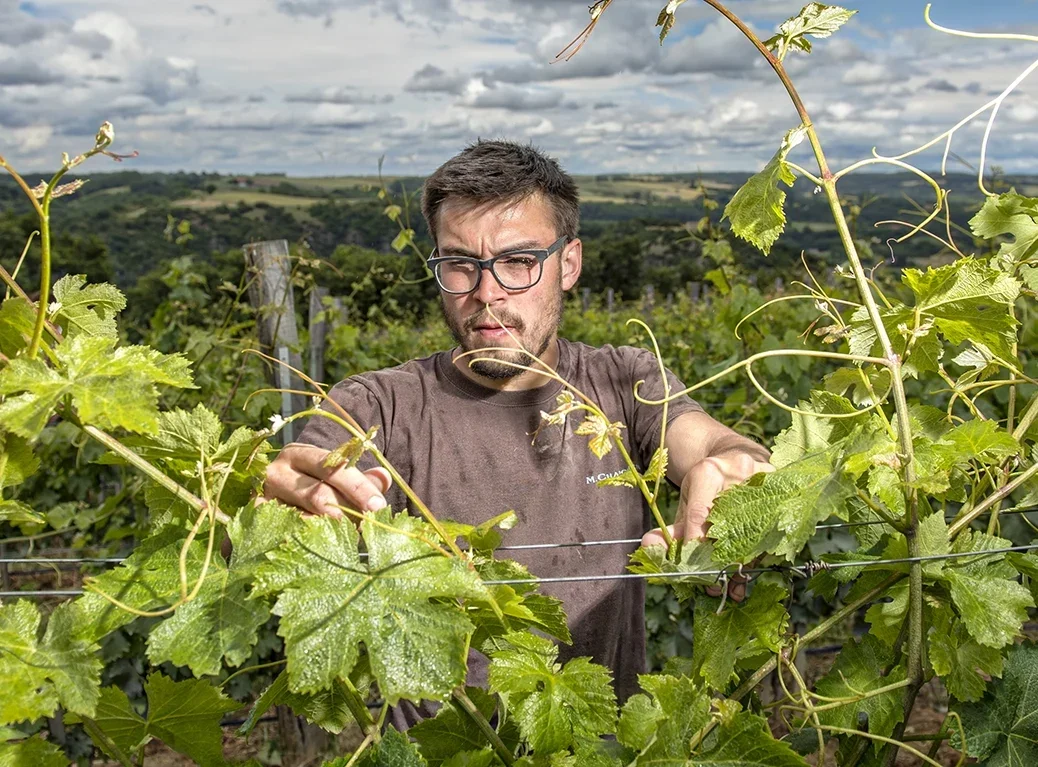
Simon Field MW reviews M Chapoutier 2024 Sélections Parcellaires.
There are no grands crus on the Hill of Hermitage. It might be argued that all of its stark granitic 136ha (336 acres) are de facto grand cru; it’s not that much bigger than Clos de Vougeot, after all, and its history and reputation, peppered by anecdotes of Gaspard de Stérimberg the hermit and Thomas Jefferson the admirer, is far from inauspicious. The largest landowner is Michel Chapoutier; many of his 31ha (77 acres), indeed, are located around the famous chapel, that beautifully stark symbol of austere quality and single-minded devotion, which has served the House of Jaboulet so well over the years. Michel is not known for an immodest temperament and might advise that it is his family that has identified the putative grands crus, now known as Sélections Parcellaires, and that it is these wines that should sit at the top of the appellation. Les Bessards may well be the lieu-dit, he would maintain, but it is De L’Orée and Le Pavillon, the single plots, that best stand up to grand cru scrutiny. Twenty years ago, Robert Parker, with an almost unprecedented slew of 100-point awards, worked hard to revitalize the legend, and the marketplace has done the rest. Chapoutier has become rich and the Hill of Hermitage has regained its luster.
The Sélections have expanded over the years and now encompass Alsace and Roussillon, not to mention other Northern Rhône appellations and Châteauneuf-du-Pape in the south. Theirs is a qualitative message, bolstered by the biodynamic principles that Michel has pursued, with some rigor, since 1989, when he assumed control of the company from his father, in what may, without too much by way of over-dramatization, be described as a familial coup d’état. Thereafter he has been tirelessly proselyting about the significance of site-specific microbial activity and on the need for roots to be nurtured naturally and patiently in order for the wines to assume an autonomous identity. For this reason, Le Méal and L’Ermite, but a matter of meters apart, taste so different. “You have to know how to listen to the vines and how not to interfere,” is Michel’s pithy summary. His pilgrimage has been tireless and, at times, frenetic; I recall hearing him described as lunatique—not because of a mental indisposition, but rather because of his ceaseless and energetic pursuit of perfection, in itself guided by the cycles of the moon (la lune). The French language can, it seems, be so much kinder.
Things have moved on, however, and the paterfamilias has handed over day-to-day control to his children, Mathilde, who looks after “commerce,” and Maxime, who is more technically minded. Traditionally, it may be recalled, all of the Chapoutiers must have a Christian name beginning with the letter M. I forget why, other than genealogical pride, but muse that Max Schubert himself, the godfather of Shiraz, would surely have been welcomed to the Chapoutier Court in Tain. Maxime, for his part, has been schooled vinously in Australia and England, and appears (how could he not) to be a little more relaxed than his father. As is the nature of dynastic succession, the dauphin seems keen to make his own statements, most of which focus on the winery. Whenever I met Michel, it was always in the vineyard and usually involved me running after him. With Maxime there is an early focus on the winery; we have more (modish) whole-bunch fermentation (more for grapes grown on alluvial soils); we have extended lees-aging for the whites, more “controlled oxidation,” shorter maceration for the reds (down to three weeks), and lower fermentation temperatures. The 1,200-liter muid is today’s maturation vessel of choice, doubling up on tradition’s demi-muid, and presumably fine-tuning the rate of aging. Maxime, who has also been tutored in the fine arts of distillation and beer making, inter alia, does not wish for anything else, at this stage, other than to invest “energy and precision” in the range. Not an onerous task, given the extant quality.
Related

An inspiring selection
2024 is not a bad vintage in which to implement such a philosophy. It is not a bad vintage, per se, albeit a far-from-great one, blighted by frost, humidity, mildew, and coulure, among other challenges, with the sunshine, when it finally visited, somewhat unpredictable and never especially warm. Low yields have ensued, and musts with relatively low pH levels, the character of the wines also shaped by the inclusion of a proportion of stems, lending shape, grip, and what Maxime identifies as a “floral precision.” No bad thing if one is seeking to highlight stylistic variety in a matrix where most of the other variables (including grape varieties) are stable, and probably easier than the (some may say) excessively warm vintages of 2020 and 2022. Such conditions have certainly helped to shape the distinct characteristics of a fabulous family of white wines, always one of Chapoutier’s strengths. Michel has long understood the potential of great old-vine Marsanne. And the Syrah is impressive, too!
An inspiring selection from 2024, then. The glory days of Michel in his pomp and Parker at his most generous may have passed, but the message, punctuated by hard-earned and well-respected environmental credentials, is persuasive. I have always been rather amused by the family motto (Fac et spera), which might facetiously be translated as “Get on with it and hope for the best.” A more pantheistic interpretation would surely focus on the value of good works and the fully justifiable hope that nature will respond to them with benevolence and grace.
Tasting M Chapoutier 2024 Sélections Parcellaires
November 25, Vinoteca City, London
Content from our partners
All the reds are 100% Syrah; whites, 100% Marsanne (except the Condrieu, 100% Viognier).
Coteau de Chery AOP Condrieu
Offering one of the most appealing panoramic views of the Rhône, Chery is a steep vineyard, its Viognier struggling with degraded biotite and mica-schist terroir, both proving ideal nurseries to harness salty acidity to balance a classically unctuous texture, its musky boudoir aroma of linden and honeyed soapstone ceding to apricots and plum, its finish assured and benevolent. | 93
Les Granits Blancs AOP St-Joseph
Near-centenarian Marsanne grapes climb the hillside behind Tournon in a highly photogenic manner, their granitic cloak chalky white with minimal topsoil. Earthy, viscous, and urgent, this is an appealing example, harnessing the refreshing virtues of a cooler year (no longer anathema) and buttressing classic almond paste, verbena, and guava notes from this noble variety. | 93
De L’Orée AOP Ermitage
From the east end of Hermitage, where the granite has given ground to alluvial clay; the bend in the river assures its south-facing disposition, however, and these 70-year-old Marsanne vines were perfectly ripe and ready before the end of August in 2024. The result is a potent, low-yielding L’Orée, the most reticent of the big three Ermitage whites, as usual, but not lacking for citric definition, a filigreed brocade of floral tribute, and a silky, softly persuasive texture. Quietly beguiling. | 93
Le Méal Blanc AOP Ermitage
On the hillside, with distinctive heat-retaining pebbles, some quite large, Le Méal, even in a cooler year such as 2024, is generously textured and richly layered, with distinctive aromatics of celery, fried butter, cashew, and acacia, its oaky upbringing lending a creamy backdrop to the palate, complementing the crystalized citric-lime character and a chalky, cerebral finish. It is always fascinating to track the life of a wine such as this. | 94–95
L’Ermite Blanc AOP Ermitage
Straw-gold, limpid, bright. The nose marries vanillin and dried apricot, crushed stone and honeysuckle; symphonic and rich. The baton does not fall to rest when focus turns to the palate, which is energetic, lingering, and profound. Notes of pear and guava, then white pepper and tilleul; ineffably complex, not lacking for depth in this cooler vintage, but adamantine of focus and pure of intent. The sine qua non of Marsanne, surely. | 95–96
Les Varonniers AOP Crozes-Ermitage
A very particular terroir here, located at the bottom of the granitic hillside, and touching on the more alluvial soil of the plain of Chassis. This harmonious bond is captured by aromas of blackberry and olive, with lavender and briary thereafter. Silk of texture, with soft, chalky tannins and a finely tapered finish. | 93
La Mordorée AOP Côte Rôtie
It is not clear to me if this is actually from one parcel or several that are near-contiguous, given that it is said to be sourced from both the Côte Blonde and the Côte Brune. Be that as it may, the former lends lifted blueberry and rosemary aromatics, the latter a richly satisfying tapenade depth, thereby capturing the lingering ethereal elegance of a great Côte Rôtie. | 93–94
Neve AOP Côte Rôtie
A relatively recent addition to the canon (surely the name does not mean “snow”) and a very specific 1.5ha (3.7-acre) site, Neve is very much a child of Côte Brune mica-schist, therefore of a dense, satiny color and texture, with a nose of bacon rind, raspberry compote, and distant bonfires, then a warming, generous palate, currently enrobed by sophisticated but not overbearing tannins, courtesy the 30% of new oak used during the 18 months of élevage. | 90–92
Les Granits Rouge AOP St-Joseph
Another blend of parcels, this one from the east-facing Montagnon site and south-facing eponymous St-Jospeh lieu-dit. A beautifully aromatic wine, with seductive notes of cloves, jasmine, and blackberry, and a distinctively peppery undertow. The palate is energetic, slightly lifted, the tannins chalky in obeisance, the line of acidity firm and supportive. There is an almost Burgundian charm here. | 93
Saint-Pierre AOP Cornas
Overlooking the village and its ancient spire, the Saint-Pierre lieu-dit is located on a precipitous slab of decomposed white granite and has offered the Chapoutiers an excellent opportunity to demonstrate an aptitude to tame the famously robust inclination of this small, sun-soaked appellation. The demonstration is masterly indeed, from the fulsome aromatics of dark cherry, sous-bois, and charcoal, through to a palate that is texturally magisterial, entwining, as it does, edgy, assertive tannins with layers of dark fruit, black pepper, and savory indulgence. | 92–94
Le Pavillon AOP Ermitage
Sixty-five-year-old Syrah from the famous Bessard lieu-dit, high up on the western side of the appellation. A deep evanescence, almost aubergine, but with very pure dark fruit on the nose, blueberry and boysenberry then hints of tapenade and bitter chocolate. The tannic grip is persuasive but not overwhelming, the bright supporting acidity lifting the finish with no lack of charm. | 94–95
Le Méal Rouge AOP Ermitage
This steep 0.6ha (1.5-acre) plot is the sunniest in Hermitage, although today the wine is quite stern of disposition; granitic of temperament beyond an unyielding obsidian hue. A little time in the glass betrays complexity and allows the finely grained tannins to yield a little; a lot more time in the bottle will pay dividends, as it so often does with this enigmatic cuvée. | 92–94
L’Ermite Rouge AOP Ermitage
A stark, monumental contrast to the somewhat reticent Méal, this, as so often, is a richly expressive, almost gregarious Ermite, from its bright, deep-sea reflections through to an aromatic dominated by herbs from the garrigue, gunpowder, black tea; no shortage of dark fruit either; Morello cherry, loganberry, and cassis to the fore. All redoubled on the palate, which is dense but silky, the generous if darkly stained cornucopia of fruit underscored by a sturdy balustrade of dignified old-vine tannins and bright acidity. | 95–96