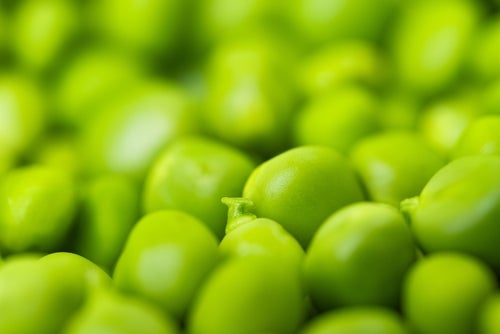
Joanna Simon on the simple charm of risi e bisi, a northeastern Italian dish of rice and peas that sits somewhere between a risotto and a soup.
If you happen to be in the Veneto in the last week of May, you could visit the Festa dei Bisi, the festival of peas in Peseggia di Scorzè northwest of Venice, an annual week-long gastronomic festival of more than 50 years’ standing that takes place at the end of the new pea season.
You could, but why would you? Perhaps not for the inter-regional tug-of-war championship and other entertainments on offer, but to see how seriously peas are taken in the region, or, rather, what a cause for celebration and joy the sweet new-season’s peas are. And you would almost certainly eat the most famous dish, the time-honored risi e bisi, although you could have been eating this hybrid of risotto and soup throughout the Veneto anytime from April onwards when the new peas come in.
How to make risi e bisi
I say hybrid because it is not made in the same way as risotto. The stock/broth is not stirred into the pot in increments and no wine is used. Risi e bisi is more liquid, but it’s thicker than a normal soup. Some writers say it should be eaten with a fork (including Elizabeth David in Italian Food, 1954). Others say it requires a spoon (among them, Marcella Hazan in The Classic Italian Cookbook, 1973). Probably wisely, Katie Caldesi, in The Italian Cookery Course (2009), says “provide spoons as well as forks.”
Related
Translated as rice and peas, risi e bisi sounds somewhat mundane, and it is an undeniably simple dish of inexpensive ingredients—rice, peas, stock (broth), and not much else—but it was enjoyed by the rich as well as the commoner. Indeed, not least by the rich and privileged. Risi e bisi, or rixi e bixi in Venetian dialect, was the first dish traditionally served at the Ducal Palace at the Doge’s banquet in Venice on April 25, the feast of St Mark, the city’s patron saint.
It may well have its inspiration further back in the Byzantine Empire, with which Venice traded extensively, and it’s likely that it originated not in Venice itself but inland in the city of Vicenza, spreading east to Venice and west to Verona. When it became a tradition of the Doges’ St Mark’s day feast isn’t known, but the 16th century is often cited, rice cultivation having begun in Venice in the second half of the 15th century and become more widespread and cheaper in the next century (not that any Doge would have been concerned about the cost). An 18th-century report of one of the banquets in the state archive in Venice is said to describe two versions of rixi e bixi.
In the same century, the dish made it into literature and the theater when the acclaimed Venetian playwright and librettist Carlo Goldoni referred to it in his comedy Sior Todero Brontolon, which was first performed in 1762. And the 19th century saw “risi e bisi e fragole”—rice, peas, and strawberries representing the white, green, and red of the Italian flag—become a popular motto against the Austrian occupation of Venice. To bring us up to the present, contemporary fans include Barack and Michelle Obama, for whom risi e bisi has been cooked by one of their favourite chefs, the award-winning Chicago-based Tony Mantuano.
Content from our partners
Apart from the three staples (rice, peas, stock), the other ingredients are sautéed onion (generally in olive oil) and, stirred in at the end, Parmesan and butter (in fact, butter doesn’t feature in every recipe, but I recommend it). The traditional regional rice is Grumolo delle Abbadesse, a type of vialone nano from the Colli Berici south of Vicenza, and the favored local peas are those from Lumignano, also in the Berici Hills. These, though, were not the new peas sent to the Doges. Instead, the young peas came from Strunjan in what is today Slovenian Istria, where the same dish, in this bilingual coastal village, is called rizi e bizi and is just as popular.
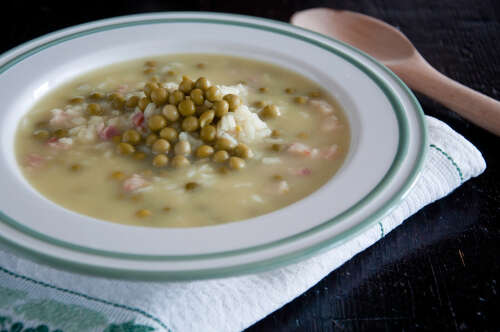
The main variations to the recipe are the inclusion of prosciutto crudo (dry-cured ham), which is the tradition in Vicenza, and the type of stock/broth. It can be a vegetable stock using a pea purée made from some of the cooked pea pods, or a chicken or veal stock (I usually use a homemade chicken stock). It’s well worth using vialone nano rice; carnaroli, the alternative, will give a less creamy result. As for the peas, I use fresh young peas or those I have frozen during their brief UK season. Commercial frozen peas or petits pois don’t give quite the same result. In Marcella Hazan’s words, frozen peas give a “tolerable but slightly blurred copy of the original.”
In terms of method, some chefs do cook risi e bisi in the same way as risotto, stirring in liquid in successive stages, but traditionally the liquid is added in one go and the mixture stirred only occasionally (and not at all by some).
The best wines to pair with risi e bisi
A safe, if unimaginative, traditional British approach to pairing wine and food was that the finer the wine the simpler the accompanying dish. This would make risi e bisi a candidate for very fine wine. As it happens, it is, although it can also find its match in simpler bottles. Either way, the fresh, green sweetness of the dish tends to suit younger wines with purity of flavour, rather than flashy fruit and showy flesh and texture or notably old wines. And, unsurprisingly, it favours white wines. I shall focus on those but, if you do want a red, think in terms of lighter, fresher styles with minimal tannin and oak, such as good Bardolino (a rare beast but try Monte del Fra or Cantina Menegotti), Cabernet Francs from the Loire or northeast Italy, Sicily’s Frappato and other red wines hailing from volcanic or granitic soils.
If ever there was a case of “what grows together goes together” it is risi e bisi and northeast Italian white wines. You could see out spring’s risi e bisi season drinking nothing else without feeling you were missing out. From Bianco di Custoza, Lugana, and Soave Classico around Verona to the Alpine Alto Adige in the far north and across to Colli Orientali and Collio on the Slovenian border in the east, there is a wealth of different wines made in the requisite, purity-focused style from an array of grape varieties. The Veronese trio excepted, many, conveniently, are labelled by grape variety.
Two things to bear in mind when deciding on grape variety or denominazione are the type of stock/broth and whether there is prosciutto. With a pea-pod broth, giving a slightly greener, more vegetal emphasis than a chicken or meat-based one, you could consider a racy Alto Adige Sauvignon Blanc, Riesling, or Sylvaner, a Collio Orientali Friulano, or a Collio or Alto Adige Pinot Grigio (Elena Walch Pinot Grigio, for example). And, taking a small detour for a moment, Mosel Riesling Kabinett can also work when the sweetness and vibrant acidity are in step with the peas, as they are with Weingut Vollenweider Wolfer Goldgrube 2023. But it’s a balancing act. Other Kabinetts I have tried have been too sweet.
Risi e bisi made with chicken/meat stock and including prosciutto is often better paired with the Garganega and Trebbiano di Soave (aka Trebbiano di Lugana) varieties of Soave and Lugana and also with Alto Adige Chardonnay. I would happily drink Zenato Villa Flora Lugana or Ca dei Frati I Frati Lugana, Anselmi’s Capitel Foscarino (IGT Veneto), or Soave from, among others, Gini, Suavia, or Coffele (especially the latter’s Ca’ Visco).
But the grape variety I think works best across the board is Pinot Bianco, especially from Alto Adige with its signature vitality, blossomy creaminess, orchard fruit, almond and minerality. Here again, Elena Walch is a notable producer. But the one I would go furthest for is Cantina Terlano. Its Vorberg Riserva and Rarity Pinot Bianco are breathtaking wines: exceptionally multifaceted, refined and elegant. Its Pinot Bianco-led blends Grand Cuvée Primo and Nova Domus (both with Chardonnay and a little Sauvignon Blanc) also pair very well.
Finally, a few more suggestions for life after Italy: Pierre Trimbach Alsace Pinot Blanc, Austrian Grüner Veltliner, delicate cool-climate Chardonnay, and Sauvignon Blancs that are neither overwhelmingly fruity nor pungently verdant or mineral.