

Originally from Northern Ireland, the Barton family have weathered many ups and downs during their 200-year association with Château Léoville Barton in St-Julien. But the wine itself has always been a model of a certain kind of Bordeaux classicism, says Raymond Blake.
When is a château not a château? When it is Château Léoville Barton, the St-Julien second growth that celebrates two centuries of Barton family ownership this year. Bordeaux’s Médoc may be home to many splendid, turreted, and castellated châteaux whose Disneyesque facades prompt a photo frenzy whenever a visiting group passes, but no such edifice is described by the term “Château Léoville Barton.” In this case, the “château” refers to the wine and the land whence it comes—and that wine has been written about and sometimes eulogized by greater pens than mine for nigh on a century.
Oz Clarke, wrote in 2020, “The 2000? This one is just beginning to emerge in all its classic beauty, with a memorable flavor of dry blackcurrant, chewy ripe black olive and haunting cedarwood scent.” Maurice Healy, from Claret and the White Wines of Bordeaux, 1934: “I would place a Léoville Poyferré 1875, drunk at Château Pontet Canet in 1929, as my ne plus ultra of that decade; but the proxime accessit came very near indeed when Eustace Hoare produced a Léoville Barton 1874 last April.”
My own effort to capture a great Léoville Barton in words was prompted by a sense that contemporary trends in the world of wine may not all be for the good, recently writing, “The easy categories of old are no longer clearly defined. White wine is now orange, red is black, rosé is everywhere. The classics are being pushed to the margins. Or are they? I was leaning, reluctantly, toward this opinion when a bottle of Château Léoville Barton 2005 brought me up short. It was like a pure, clear voice in a sea of babble: balanced, harmonious, and elegant. Class will always out.”
Related
I will leave the last, most succinct word to possibly the most experienced Bordeaux taster of all, Michael Broadbent MW. Writing of the 1985 in Vintage Wine, 2002, he delivered a ringing endorsement: “For me, the perfect claret.”
Putting Barton on the Bordeaux map
To tell the full story of the Barton family’s association with France, we need to go back over three centuries to 1722, when 27-year-old Thomas Barton arrived in France from his native County Fermanagh in what is now Northern Ireland. He settled briefly in Montpellier and then Marseilles before moving to Bordeaux in 1725. His family had strong trading links with France, but a career in the wine business was not preordained. Nevertheless, he quickly developed an interest in wine and established himself in the trade, soon gaining a reputation as an astute businessman, in the process building a considerable fortune, with Ireland as a key export market thanks to his family links. Thomas wanted his only son, William, to join him in the business, but while Thomas could be difficult to deal with at times, William was cussed all the time, and the pair had a fractious relationship.
By the time he died, at the age of 85 in 1780, Thomas owned considerable land and property in Ireland, and these estates eventually passed to William’s older sons, while his fourth son, Hugh, inherited the wine business in Bordeaux, though not before William’s quarrelsome nature had made life difficult for all who encountered him. Hugh had joined the business aged 20 in 1786 and, if anything, displayed greater business acumen than his grandfather, Thomas. His career was not without great challenges, however, for he and his wife Anna were imprisoned in October 1793 during the French Revolution, before being surprisingly released at Christmas, after which they made their way first to England and eventually back to Ireland. From there, Hugh continued to manage the business with such success that he was able to purchase Langoa in 1821 and Léoville in 1826, literally putting the Barton name on the map. A little later, he purchased land in County Kildare, where he built Straffan House, Anthony Barton’s 1930 birthplace.
Content from our partners
In many respects, the recent history of Léoville Barton is the story of Anthony’s involvement over a period of seven decades, from the time he arrived in Bordeaux in 1951. In the immediate post-World War II years, despite some stellar vintages such as 1947, the golden era of a century earlier was a fading memory. Anthony’s own prospects were next to nil. After years of struggle, including demolishing some of the house, his father Derrick had sold Straffan for a knockdown price in 1949. As a younger son, Anthony had no hope of inheritance, though there was little for his older brother Christopher either. (Christopher was a distinguished oarsman, winning an Olympic silver medal in 1948 before eventually settling in New Zealand, from where he had minimal contact with the family, though much more recently his grandson Thomas Russell, who rows for the Kiwis, has connected with Anthony’s grandson Damien and has visited St-Julien.)
Anthony’s arrival in Bordeaux was hardly propitious, his uncle Ronald, who had served in the British army during World War II, acting as a liaison officer with the Free French in West Asia, was struggling to keep the châteaux afloat, especially after the dismal 1951 vintage. In addition, it was assumed that Ronald would marry and have children of his own, and they would inherit Langoa and Léoville. That did not come to pass, though Ronald remained in charge for another three decades before ceding control to Anthony, who made his mark quickly with the storied 1985 vintage. He made his mark in other ways, too, establishing a reputation for fair-minded pricing, while many around him abandoned common sense, attaching price tags to their wines that were frankly ludicrous. (Thus were sown the seeds of today’s market and its lukewarm reception to more ambitious release prices for yet another “vintage of the century.”)
Anthony Barton’s tall, commanding presence, wry wit, and salty sense of humor—“When I was a young man, I had a broad mind and a narrow waist. Now they’ve swapped”—endeared him to all, so that by the time of his death in 2022, he was a revered and popular figure in the Bordeaux firmament. His life was not without heartache, for his son Thomas died in a car accident in 1990, which immediately threw a much greater weight of responsibility onto Lilian, Anthony’s daughter.
Lilian’s demeanor is gracious but grounded, mindful that while recent decades could be regarded as a golden era for Bordeaux, she only has to think back to her early years to remember a bleaker period that sits in stark contrast to the prosperity of today. While much of her interaction with consumers in the markets she visits is taken up with extolling the qualities of Léoville and the other Barton wines, she is never slow to remind today’s generation of wine lovers of the straitened times she remembers from the 1960s and ’70s. The vineyard and winery workers’ circumstances of 50 or 60 years ago are scarcely believable today: “Accommodation was basic and the workers were paid a pittance, perhaps supplemented by milk and some meat when a lamb or pig was slaughtered […]. I continue to tell people of those times.”
This state of affairs was not unique to Léoville; it was emblematic of the region as a whole and was memorably captured by Jean-Michel Cazes of Lynch-Bages in his autobiography From Bordeaux to the Stars, when describing living conditions in the early 1970s: “Almost all of our staff were housed free of charge in dilapidated houses in and around the village of Bages. Most of the houses lacked the most basic comfort. Long periods of crisis and economic difficulties had meant almost no maintenance work had been carried out, and there was no sewage system. Even running water had only recently become available.”
Walking the walk
Lilian and her son Damien visited Dublin earlier this year, principally to host a celebratory lunch marking the bicentenary, but duly cognizant of their Irish heritage, it was a joint celebration with Château de Fieuzal, celebrating 25 years in the ownership of the Quinn family. The standout wine from a host of magnums served was the Léoville Barton 2006, matched to braised short rib of beef, with jalapeño and potato rosti. Though not a generally lauded vintage, this bottle had shed the asperity of youth, with the still-firm tannins benefiting from the richness of the dish, to yield a hand-in-glove pairing. At the conclusion of the meal, which was light on techno-speak and long on conviviality, Damien commented, “I don’t come often enough to Ireland. Mummy takes most of these trips, and now I understand why.”
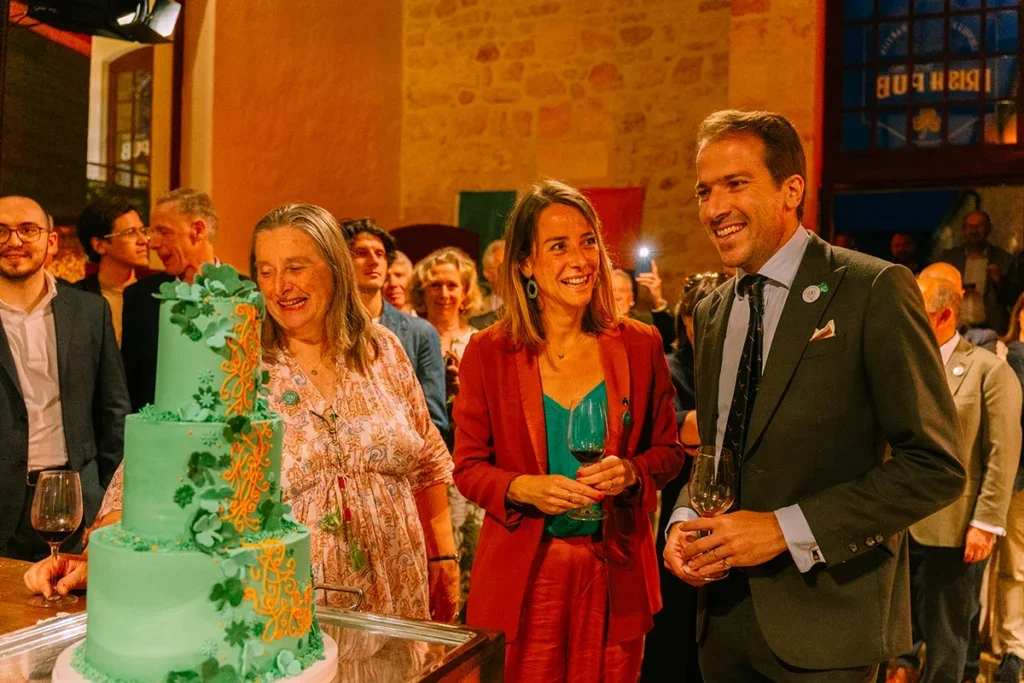
Nor was the visit an easy lap of honor for Lilian, an opportunity to revel in the 200th anniversary. She had only recently returned from presenting her wines in Belgrade, and her Dublin itinerary included various trade visits, meetings with importers, and appointments in off- and on-trade outlets, followed by a return to the ancestral home of Straffan House, now the K Club, where the 2006 Ryder Cup golf tournament was held. The club is fully aware of the Barton connection, marked most recently by the opening of the Barton Grill as its premier dining option.
Mother and son share an office, with Damien gradually taking over more management responsibility as Lilian approaches retirement. While Lilian is not slow to remind people of the tough times that the classed growths endured in living memory, Damien draws attention to the contemporary story of hardship that is to be seen in Entre-Deux-Mers, barely 30 miles (50km) from St-Julien. There, many producers are having to sell their wines at a below-cost pittance if they can sell them at all. While the patrician châteaux of the Médoc and elsewhere may not be enduring such challenging times, the knowledge that this is happening just down the road helps keep feet on the ground.
There is little chance of Damien’s feet leaving the ground, for even though his elaboration of the current difficulties in Entre-Deux-Mers does not refer specifically to Léoville Barton and may seem a little out of place in a piece designed to celebrate a bicentenary, it speaks of an engaged frame of mind and an awareness that, as the Bartons’ third century at Léoville begins, there is no room for complacency. His conversation abounds in references to the need for a sense of social responsibility—by way of proper remuneration and incentivization for employees—and a care for the environment through sustainable practices.
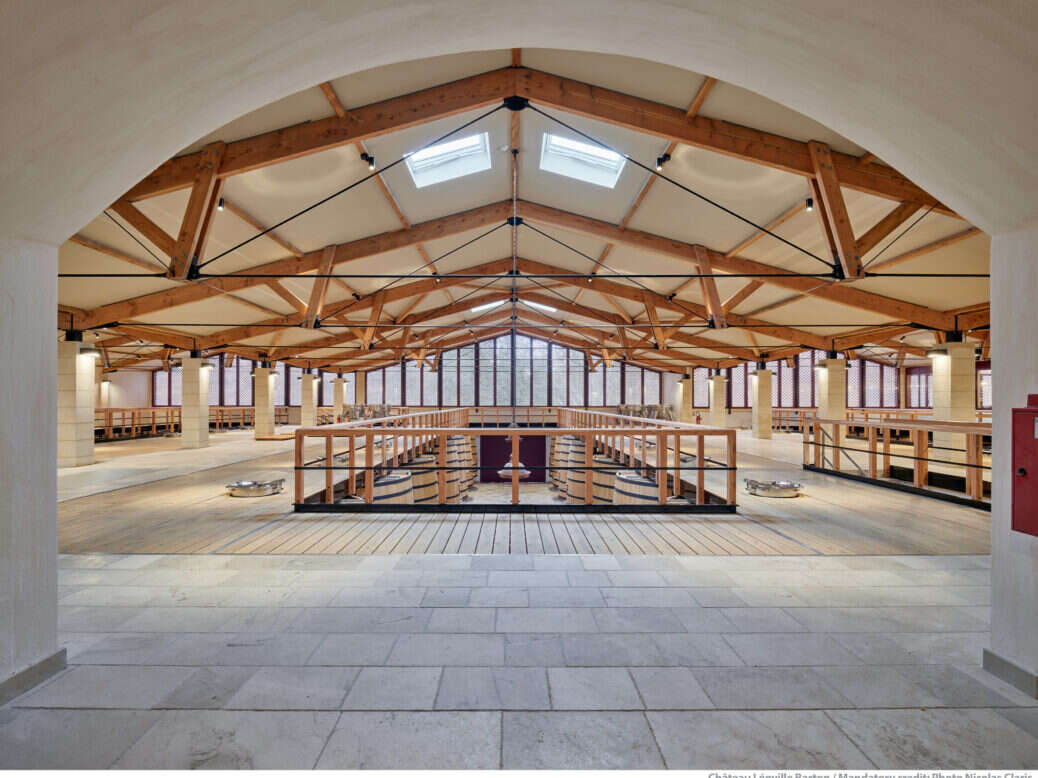
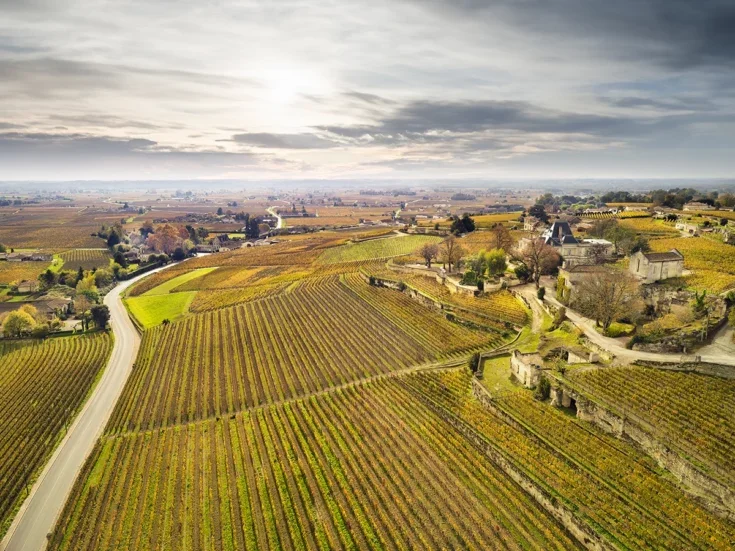
Talking such talk is all very fine, but they also walk the walk at Léoville Barton, most visibly in the new winery that saw its first vintage in 2021. It was built as ecologically friendly as possible—reduction in wastewater being a priority, for example. It is also equipped with a series of vats that reflect the vineyard holdings, allowing for each vineyard parcel to be harvested at the optimum moment. Those vineyards cover some 50ha (125 acres) in three principal blocks, the majority of which are planted to Cabernet Sauvignon (77%), while the remainder comprises Merlot (20%) and Cabernet Franc (3%). Vine density sits between 9,000 and 10,000 per hectare, and yield usually hovers around 40hl/ha, though that can drop to 30 in challenging vintages. The crop is entirely hand-harvested.
These are the vineyards that were acquired by Hugh Barton in 1826, and they comprised roughly one quarter of the original Léoville estate. Five years previously, he had bought third-growth Langoa Barton, which had its own château and winemaking facilities, so he simply set about making both wines at Langoa, a practice that continues to this day. Consequently, there is no château at Léoville Barton—but just to confuse the newcomer to claret, the beautifully proportioned building depicted on the label of Léoville Barton is actually Château Langoa Barton.
It would be difficult to overstate Hugh Barton’s dynamism and business acumen for, decades before his vineyard purchases, he had founded the négociant business of Barton & Guestier along with his partner Daniel Guestier. This business eventually passed out of family ownership in the 1960s, saddling the current generation of Bartons with a minor problem, likely unforeseen at the time. Unlike many Bordeaux châteaux that have a library of old vintages stretching back a century or more, usually seen through locked and bolted wrought-iron gates, the wine library at Léoville is more modest, thanks to the fact that old stock was held by Barton & Guestier rather than at the château. This omission is gradually being rectified, and since 1993 up to 1,000 bottles of each vintage are held back for tastings and other events. Might some bottles of the 2026 vintage, for which a specially designed label will be commissioned, make it all the way to 2126 for the tercentenary?
Well equipped for the third Barton century
Claret. It is tempting to think that the term was coined with Château Léoville Barton in mind, for its compact enunciation seems to echo the qualities that hallmark the wine: balanced and harmonious, elegant and long, supple yet strong. Michael Broadbent called it correctly for the 1985, and it seems fair to predict that future wine scribes may cast similar judgment on vintages yet to come, for Léoville is well equipped for its third Barton century, in terms of both facilities and personnel. Lilian’s daughter Mélanie, a trained enologist, is currently fully taken up with her duties at Château Mauvesin Barton, which the family bought in 2011, but will in time assume enological responsibilities at Léoville and Langoa. Her young son Valentin already shows an enthusiasm for exploring the winery and, together with Damien’s son, belongs to the 11th generation. And his name? Hugh.


