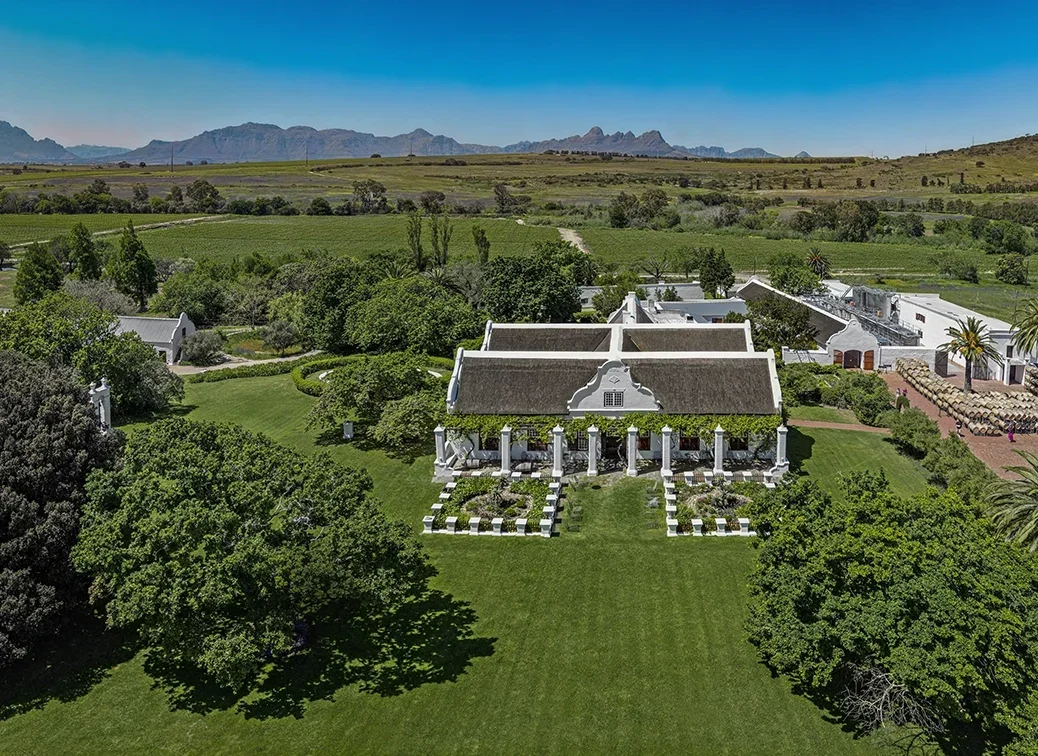
Meerlust has been a leader in South Africa’s development as a fine-wine producer and fully deserves its icon status, says Anthony Rose after a rare vertical tasting.
I am no champion of the word “icon,” because it is more honored in the breach than the observance. Yet it’s impossible to think of South Africa’s Meerlust without reaching for the I-word. Meerlust is not only a 17th-century National Monument but also one of the Cape’s most historically important estates, combining deep heritage with decades of consistent quality. Above all, it is responsible for the pioneering Bordeaux-style blend Rubicon, a wine that reshaped South African fine wine. With its flagship blend of Cabernet Sauvignon, Cabernet Franc, and Merlot, and first produced from the 1980 vintage, Rubicon became a benchmark that many Cape estates would follow.
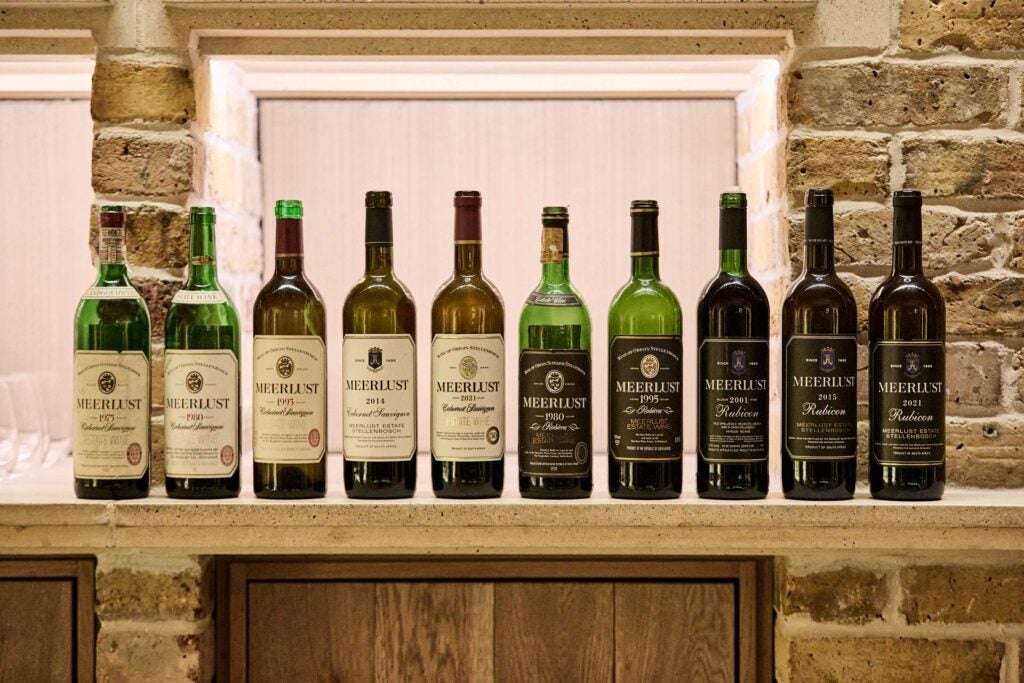
Five years earlier, in 1975, Nico Myburgh produced the first Meerlust-labeled Cabernet Sauvignon. It is therefore fitting that his son Hannes should choose to celebrate that milestone with a Beyond the Rubicon 50th-anniversary tour, spanning Johannesburg, London, and New York, culminating at the estate. In London, at Berry Bros & Rudd in St James’s, Hannes and cellar master Wim Truter presented a rare retrospective tasting: Cabernet Sauvignon from 2021 back to the inaugural 1975 vintage, alongside Rubicon from 2021 back to its first vintage in 1980.
History and heritage
Hannes Myburgh began by reflecting on his tenure, which started in 1988 when he succeeded his father. Thirty-seven years may seem lengthy today, but it’s brief compared to Meerlust’s history. Following the Dutch colonization of the Cape in 1652, the farm was granted in 1693 to German immigrant Henning Huising, who named it Meerlust—“Pleasure of the Sea”—in reference to its location just 3 miles (5km) from False Bay. The property was purchased by a Myburgh ancestor in 1756, who built the iconic Cape Dutch manor house and cellar in 1776. Meerlust has remained in the family ever since.
Related

The modern era began in 1959, when Nico Myburgh inherited the estate. Passionate about both farming and heritage, he restored the historic buildings, replanted vineyards, and supplied grapes to cooperatives before focusing on estate bottling. The Cape Dutch cellar was restored in 1974, and the following year he produced Meerlust’s first estate Cabernet Sauvignon, released in 1978.
The birth of Rubicon
Hannes recounted how a holiday in Bordeaux in 1967 inspired his father to replant the estate. Recognizing similarities between Bordeaux and the Eerste River Valley, Nico replaced older plantings of Chenin Blanc, Cinsaut, and Semillon with Cabernet Sauvignon, Merlot, and Cabernet Franc. Cabernet Sauvignon was already present on the farm; Cabernet Franc was planted in 1972 and Merlot in 1974, making Meerlust the first estate to cultivate commercially both varieties in South Africa.
In 1978, Italian winemaker Giorgio Dalla Cia arrived for a single season—but he remained for 25 years. Together with Nico Myburgh, he envisaged a Cape blend capable of competing internationally. Early experiments used roughly 70% Cabernet Sauvignon, 20% Merlot, and 10% Cabernet Franc. A disastrous 1979 vintage forced the entire crop to be discarded, but the 1980 harvest delivered both quality and quantity.
Content from our partners

Although the vines were young, the team produced a Médoc-style blend without yet having a name. Stellenbosch University professor Dirk Opperman proposed Rubicon—the point of no return—and the first vintage (1980) was released in 1984. Despite early skepticism, Rubicon’s success encouraged widespread planting of Bordeaux varieties in the Cape.
Nico Myburgh later added Pinot Noir in 1980 and Chardonnay in 1995. Achieving international recognition during Apartheid proved difficult; as Nico famously said, it felt like boxing with one hand tied behind your back. Yet as Hannes noted, “perseverance and a relentless commitment to quality is the reason Meerlust has remained unique—from underdog in the 1980s to where we are today has been a thrilling exercise.”
Terroir, climate, and viticulture
Truter then went on to discuss Meerlust’s identity, particularly Rubicon’s stylistic evolution. The estate’s proximity to the ocean brings cooling southeasterly breezes and mists, lowering peak temperatures by almost 14.5°F (8°C). Compared with other Stellenbosch wards, Meerlust spends the least time above the critical 95°F (35°C) threshold at which vine shutdown begins. Average temperatures are slightly higher than in cooler areas such as Simonsberg and Polkadraai, however, resulting in elevated growing degree days.
Harvest typically occurs about two weeks earlier than the regional average, allowing phenological ripeness before the late-March rains. While climate change has not fundamentally altered the estate’s trajectory, increased weather variability is evident: Severe droughts and very wet seasons are more common (2021 was notably cool, 2022 very warm). Notably, no Rubicon was produced in 1985, 1990, 2002, 2011, or 2019.
Meerlust has largely avoided vineyard virus issues thanks to a proactive replacement program initiated after Chris Williams succeeded Dalla Cia. Recent investments have focused on replanting premium sites for Rubicon. Annual multispecies cover crops are used, soil probes monitor vineyard conditions, and leaf analysis tracks water stress and nutrient needs. In an increasingly unpredictable climate, Truter emphasized that water management is central to resilience.
Vineyards and winemaking
Fruit is sourced from four distinct terroir units—Lowlands, Quarry, River Terraces, and Compagniesdrift—encompassing 45 individual blocks. Lowlands’ clay-rich soils ripen earliest; Quarry’s rocky terrain contributes energy and length; and River Terraces’ Dundee soils of sand and river stones yield aromatic, lighter-textured components useful in blending; while the Cabernet Sauvignon in Compagniesdrift’s north-facing decomposed granite (40ha [100 acres]) gets the first pick to form the backbone of Rubicon.
Meerlust currently has 65ha (160 acres) in production, with an additional 20ha (50 acres) going on-stream in the coming years. Some 25ha (62 acres) have been replanted recently, and each block is vinified separately. Investments include a dedicated Rubicon cellar allowing parcel-by-parcel vinification. Grapes are hand-picked and fermented in stainless-steel and concrete tanks, with basket pressing and fraction blending according to extraction levels. Oak usage has evolved over time: Chris Williams reduced new oak from 100% when he began in 2004, to more restrained levels. Today, Truter employs roughly 50% new French oak. Blending occurs after six months of malolactic fermentation, followed by 10–12 months’ aging in 300-liter barrels. From the 2021 vintage, new cooperages and refined grain and toast selections aim to enhance structure and polish.
Meerlust’s trajectory over the past half-century has been one of vision matched by discipline—from pioneering Bordeaux varieties in the Cape and the creation of Rubicon, to maintaining a clear-eyed commitment to quality throughout the challenges of political isolation and climatic change. A seamless generational transition, the reinvestment in vineyards, refinement in winemaking, and an evolving understanding of its terroir have all given Meerlust the tools it needs to carry its legacy forward with quiet confidence as it shapes up to become a significant chapter in the ongoing development of South African fine wine.
Tasting
Meerlust Cabernet Sauvignon
1975 Cabernet Sauvignon (ABV n/a)
Only large foudres were used; smaller oak and greater extraction were introduced from 1978 onward. Surprisingly deep in color, with smoky aromatics, coffee hints, and gamey complexity. Silky texture, fully resolved tannins, and a savory, bone-dry finish; fruit fully mature but not oxidized. | 89
1980 Cabernet Sauvignon (ABV n/a)
Cool conditions, extended skin contact, and 18–25 months in smaller barrels. Garnet and evolved; subtle nose of oak and leather. Supple entry, with lingering vigor, fresh acidity, and a savory, gamey, drying finish. | 88
1993 Cabernet Sauvignon (12% ABV)
Garnet rim with youthful ruby core. Fragrant bouquet with vanilla oak; classic Cabernet blackcurrant fruit and cedar. Supple tannins, with persistent grip and a savory finish, approaching its peak but still going strong. | 91
2014 Cabernet Sauvignon (14% ABV)
Large crop, cool, wet season, with extended hang-time and new clonal material. Deep, youthful ruby, opulent and vigorous cassis fruit, sturdy structure, and firm tannic grip, supported by bright acidity. | 92
2021 Cabernet Sauvignon (13.7% ABV)
An outstanding Stellenbosch vintage, with extended ripening. Vibrant cedar and vanilla aromatics, concentrated cassis fruit, and pronounced freshness. Youthfully muscular tannins are balanced by firm acidity and a saline nuance. Excellent aging potential. | 93
Meerlust Rubicon
1980 Rubicon
(70% Cabernet Sauvignon, 20% Merlot, 10% Cabernet Franc; 11.8% ABV)
This first blend yielded a wine of classical structure. Garnet-tinged. Smoky, gamey aromatics and graceful evolution. A sweet, red-fruit core, with gentle tannins and lively acidity, gamey and dry. Slowly and gracefully evolving, this would beat many a 1980 Bordeaux—and look at that alcohol level. | 91
1995 Rubicon
(68% Cabernet Sauvignon, 20% Merlot, 12% Cabernet Franc; 12.8% ABV)
From a warm, dry year, showing youthful color, ripe plum-cherry fruit, and a veneer of subtle, smoky, vanilla oak. An opulent, juicy cassis core is framed by evolving tannins and a savory, gamey finish. | 93
2001 Rubicon
(70% Cabernet Sauvignon, 15% Merlot, 15% Cabernet Franc; 13.5% ABV)
From a warm, dry year, considered a great vintage, this is dark and youthful in color, with brooding aromatic depth of background black fruits and oak spice. Concentrated dark fruit is enveloped by firm tannins and vibrant acidity, and as it evolves toward a seamlessly juicy, supple, savory, and even saline finish, this wouldn’t disgrace a top Bordeaux cru classé. | 94
2015 Rubicon
(61% Cabernet Sauvignon, 23% Merlot, 16% Cabernet Franc and Petit Verdot;14% ABV)
From a dry, cool year and a highly regarded vintage, this blend is deeply colored and almost primary still in its vivid aromas, with opulent, dark fruit, firm extraction, and bracing acidity. Its sinewy finish is now beginning to soften. | 93
2021 Rubicon
(48% Cabernet Sauvignon, 46% Merlot, 5% Cabernet Franc, 1% Petit Verdot; 14.2% ABV)
From a cool vintage, producing elegant reds following late-season ripening. The aromatics are cedary, the flavors rich in concentrated primary fruit and firm tannins, supported by refreshing sea-breeze acidity. While the structure is evident, it’s an elegant red, approachable soon yet capable of at least 10–15 years’ aging. | 95