Joanna Simon explains the history and preparation of ànec rostit amb peres, aka pato con peras or duck with pears, and tries to settle on the best wines to drink with the typically sweet-savory dish.
Catalan cuisine has a personality of its own that has been maintained even with the passing of the years or centuries, or with the advent of new products or with the vagaries of fashion. Part of this personality stems from the excellent quality of the products of its soil or shore […] Part […] stems from culinary techniques that have changed little over the centuries, such as the soffritto [and…] picada… [and part] stems from the genius of its people.”
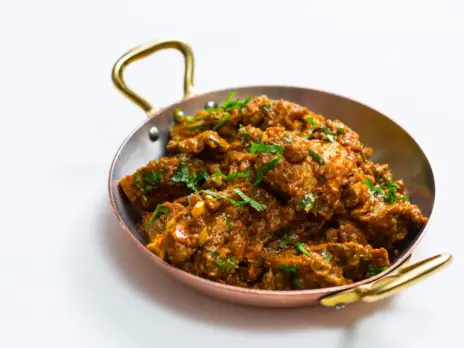
A lot has happened since food historian Rudolf Grewe wrote those words for the Oxford Symposium in 1981, not least the tornado of culinary innovation wrought by chef Ferran Adrià and his disciples, followed by, in reaction to it, the creation in 1996 of the Fundació Institut Català de la Cuina to research the history of Catalan cooking and to create an archive of traditional recipes, the Corpus de la Cuina Catalana, before they were lost forever. Among them is ànec rostit amb peres, duck with pears, or pato con peras in Spanish.
The richest, most complicated and sophisticated cuisine in Spain
Yes, a lot has happened, yet what Grewe observed more than 44 years ago is still fundamentally true, or perhaps one should say, true once again after the 1980s–1990s avant-gardist wobble. As Claudia Roden puts it in her opening sentence on Catalonia in The Food of Spain (2012): “Catalan cuisine is the richest, most complicated and sophisticated of Spain.”
Related
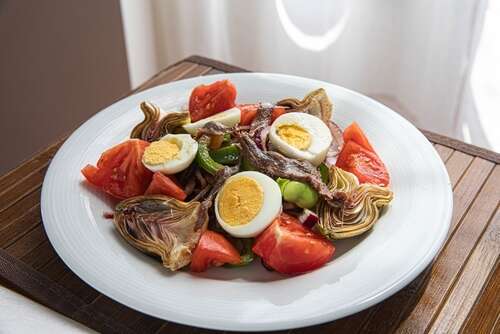
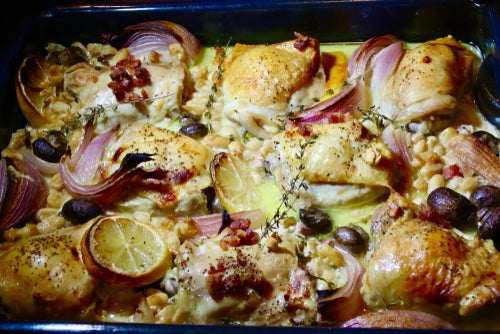
It is rich not only in its ingredients, styles, techniques, and flavors, but also in history. The foundations of Catalan cuisine were set in Roman times, when the three staples, wine, olive oil, and bread, were established, together with the practice of preserving fish from the coastal waters and meat and poultry from the interior. The Moors in the Middle Ages were pivotal in bringing ingredients such as rice, citrus, and dried fruits, sugar, aubergines, spinach, and an array of spices and in combining sweet and sour, savoury and sweet, and fruit with meat and poultry—elements that are so characteristic of Catalan cuisine.
From the early 16th century, the conquest of the Americas introduced a smorgasbord of vegetables, fruit and other foods to the Catalan repertoire, from tomatoes, peppers, potatoes, pumpkins, pineapples, and papayas to maize and chocolate—chocolate being used as much in savory as in sweet dishes. In the following centuries it was French culinary influences that were added to the melting point, with Bourbon rule from 1714 and the French Revolution bringing fleeing nobles, their cooks and haute cuisine at the end of the century. Béchamel sauce, sometimes Hispanicized with wine, Sherry or tomato, features in Catalan dishes of fish and seafood and aubergine and cheese, for example.
Another fascinating aspect of Catalunya’s culinary history is its cookbooks, which are some of the earliest anywhere. The handwritten Llibre de Sent Soví, author unknown, is believed to date from 1325, while Llibre del Coch, by Mestre Robert, chef to King Ferdinand I of Naples, is the first printed cookbook in Catalan. A copy in the Biblioteca de Catalunya, printed in 1520, is the oldest known copy, but the book is thought to have been written around 30 years earlier, because King Ferdinand I, to whom Mestre Robert (aka Ruperto de Nola) dedicated the book, died in 1494 and because the Catholic Church’s Lenten ban on eggs and milk was lifted in 1491, but eggs and milk are absent from the lengthy section of recipes for Lent. In addition, no foods from the New World are included.
Content from our partners
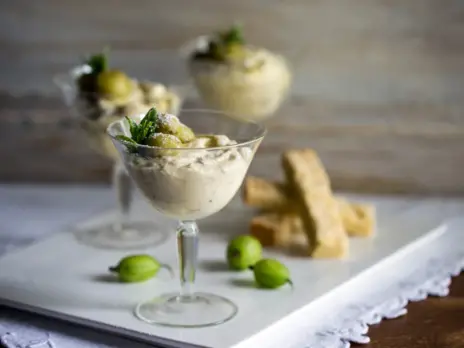

Llibre del Coch is partly based on Llibre de Sent Soví, but it also includes some recipes of Arabic, Italian and French origin and more sugar and spices are used. Tellingly, neither book includes any Castilian recipes. It is a measure of the standing of Catalan cuisine that, despite having no Spanish recipes, Llibre del Coch was translated into Castilian in 1525 and published in, probably, ten editions in the next half century.
Fast forward to today and ànec amb peres, a classic savoury dish with fruit in a sauce thickened with another cornerstone of Calalan cooking, a picada, a paste of pounded nuts, garlic and other flavourings. In the case of Claudia Roden’s recipe (which I use with one minor addition, a cinnamon stick with the pears when poaching them in dry white wine), the picada is made from almonds (toasted), garlic and brandy.
On the Cuina Catalana website, there are also recipes for duck with figs, peaches, cherries, orange, raisins and prunes. I chose pears because not only is there evidence of pear growing as far back as the 13th century in Catalunya but the province of Lleida has a PDO for three of its pear varieties (Limonera, Blanquilla, and Conference).
And when it comes to wine pairings, pears have the advantage of being less assertively sharp and sweet than some other fruits, so it’s a versatile dish and one that has the benefit of simplicity, while tasting of more than the sum of its parts. As the duck roasts, you poach the pears and make the sauce, starting with another pillar of Catalonian cooking, a sofregit (sofrito in Spanish) of onion, tomato, and a little sugar sautéd in olive oil until jammy. You add stock, thyme, bay leaf, the pear poaching liquid, and the duck juices, stir in the picada, cook for about ten minutes, cut up the duck and serve in or with the sauce and pears.
The best wines to pair with duck with pears
Pinot Noir is often a good place to start with duck, whether it’s a plump, milder-tasting Pekin, a denser, more flavorsome Barbary, a gamy wild mallard (which needs more careful cooking if it’s not to be tough), a slower growing free-range duck, or a Gressingham. I buy the latter, which is a Pekin x wild mallard crossing that has flavor of the wild duck with the succulence of the domestic.
While the type of duck has an impact on the style of Pinot Noir (a fuller-bodied, more savory wine with Barbary duck; more fragrant and lifted with Pekin)—and indeed on any accompanying wine—the sauce is at least as important, if not more. The sofrito contributes sweetness and richness; the pears and their wine poaching liquid lend mellow sweetness and acidity.
Ten years ago, I would probably have advised caution before opening a fine Burgundy, but the harmonious ripeness and succulence of recent vintages (particularly the run from 2017 to 2020 and then 2022) has changed that—provided, that is, you have a flavorsome duck, not just a flavorsome sauce. With a Barbary duck I wouldn’t be afraid to head north to Gevrey-Chambertin, Fixin or Marsannay. With a Gressingham, I range through both Côtes de Beaune and Nuits, alighting happily on, say, Domaine Jessiaume Santenay Premier Cru Gravières (rouge).
Beyond Burgundy, if you steer a path between the most savory, Burgundian style Pinot Noirs (such as the great Hamilton Russell Vineyards) and those in which the sweetness of the fruit and oak dominate, the choices are many. Illustrative wines include Creation The Art of Pinot Noir 2023, Walker Bay (Creation Reserve shows its oak too much for this dish), Seresin Estate Rachel 2023 (Marlborough), Marimar Estate Cristina Don Miguel Vineyard (Russian River Valley), and Ponzi Vineyards Laurelwood Pinot Noir (Wiillamette Valley). Sancerre Rouge, specifically from the 2022 vintage, is another.
Pinot may be a good place to set off, but there are other reds, including Rioja Crianza and Reserva mature enough for the fruit and oak to be seamlessly entwined; Spain’s new wave but old-vine Garnachas from the Sierra de Gredos and, in Catalunya, Montsant (the wines of Joan d’Anguera, among others), and Terra Alta; Beaujolais Crus such as Moulin-à-Vent, Morgon and Côte de Brouilly from the 2022 vintage; and Châteauneuf-du-Pape with venerable gracefulness. I can give the example of Vieux Télégraphe 1998.
White wines also have a place. You might expect, with the fruit and white wine, that duck with pears would offer opportunities for youngish whites, but there is a depth to this dish and a richness to duck that I find is better partnered by a mature wine, even one that has a degree of oxidation beyond that intended by the producer. I say this having recently paired it with a Caiarossa Bianco 2016 (a Tuscan blend of Chardonnay and Viognier) and Crystallum The Agnes Chardonnay 2011. Well cellared (the Crystallum for most of its life in a particularly cold humid cellar), both wines still had acidity, together with a honeyed edge and many-layered textural richness.
Although oak-fermented Chardonnay was a common theme, it was not the key. It was the complexity of maturity and concentration, together with balance. I am sure the same success could be found with top-notch, mature Loire or South African Chenin Blanc (with some residual sugar or without), old-vine dry Semillon, Jurançon Sec, and perhaps Riesling. I’m not suggesting that younger wines won’t work, but it is a dish worthy of mature whites. If you’ll excuse me now, I’m off to the cellar.