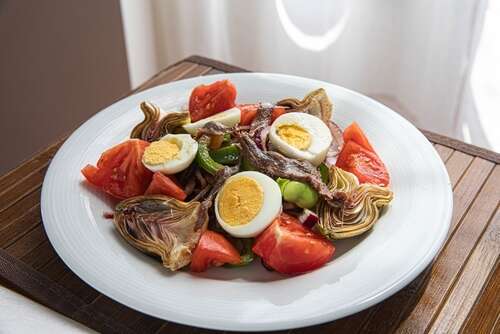
Salade niçoise as a summer subject for a series on classic wine-country dishes seemed a safe choice. It’s seasonal, its origins are firmly in a wine region—the tiny, historic Bellet appellation within the larger Provence region—and it’s the first dish I have done from Provence. It’s also unquestionably one of the best known salads in the world, alongside the likes of Caesar, Greek, Caprese, Cobb, and Waldorf.
But that’s its problem. Familiarity has bred contempt and its frequent concomitant, controversy. It’s not the contempt of the average diner, who seems happy enough with all sorts of variations and qualities of salad under the niçoise name. It’s the contempt of the self-appointed guardians of what they regard as the true recipe for versions of the dish that don’t conform. In May 2016, there was outrage on Facebook when the chef Hélène Darroze—two Michelin stars at the time, three now—posted a recipe that deviated from tradition.
What surprised me as I dug ever deeper was that these defenders of the salade niçoise faith were not confined to the great French chefs and cookery writers (we’ll come to those). Battalions of British celebrity cooks and chefs have pitched in this century, among them, Nigel Slater early on (2001), Delia Smith, Gordon Ramsay, Rowley Leigh, Nigella Lawson, and Simon Hopkinson. And renowned American writers, too.
What also surprised me was how—dare I say, uncharacteristically?—flexible Elizabeth David had been half a century or so earlier. In Summer Cooking (1955), she starts by saying: “There is no precise recipe for a salade niçoise. It usually contains lettuce hearts, black olives, hard-boiled eggs, anchovies and sometimes tunny fish.” Her only diktat is: “There should be garlic in the dressing.” She then describes the recipe in La Cuisine à Nice (first published in 1909) by H. Heyraud (whom she refers to incorrectly as Lucien; he was Henri). His starting point is young globe artichokes cut in quarters.
Related
Five years later, in French Provincial Cooking, she is still taking an inclusive approach, giving versions ascribed to Escoffier, Heyraud, and Escudier (La Véritable Cuisine Provençale et Niçoise, by Jean-Noël Escudier, 1953), as well as her own, and saying “the ingredients depend on the season and what is available”. She gives the “pretty well constant elements in what should be a rough country salad rather than a fussy chef’s concoction” as hard-boiled eggs, anchovy fillets, black olives, and, conspicuous by their absence from her Summer Cooking, tomatoes. Other ingredients to choose from are capers, tunny fish, cooked French beans, raw sliced red peppers, beetroot (beetroot!), potatoes, and artichokes. Strikingly, neither Escoffier’s nor Heyraud’s recipes include egg. Even in Escudier’s, slices of hard-boiled egg are no more than an option for decorating the border of the dish.
Of all recipes, it is one from the high priest of French cuisine, chef and cookbook author Auguste Escoffier, that has most incensed the French defenders of “la vraie recette”. It’s not the version Elizabeth David quotes, or the one I have in Escoffier’s Ma Cuisine of 1934, but the much more widely disseminated and copied recipe from Escoffier’s first book, the seminal Le Guide Culinaire of 1903. This was popularized in America by Julia Child via the bestselling and hugely influential Mastering the Art of French Cookery (1961) and her 1970 television show, The French Chef, and by Modern Culinary Art, the 1966 translation of Henri-Paul Pellaprat’s L’Art Culinaire Moderne (1936).
The august Escoffier’s offending recipe begins: “Take equal quantities of diced French beans and boiled potatoes.” It’s not just that these are rogue ingredients according to the guardians of the putative authentic recipe but that they are cooked.
Content from our partners
“What crimes have been committed in the name of this pure, fresh salad based on tomatoes and consisting entirely of raw ingredients with the exception of hard-boiled eggs,” wrote Jacques Médicin in his highly regarded Cuisine du Comté de NIce (1972) which was translated into English as Cuisine Niçoise in 1983. The former mayor of Nice and far-right politician was himself less highly regarded once he had been jailed for fraud in the 1990s, but the reputation of his book is undiminished.
It is Médecin’s recipe for La (vraie) salade niçoise—La salada nissarda in dialect—that is used by the Cercle de la Capelina d’Or, an association in Nice devoted to preserving traditional Niçoise cuisine by certifying restaurants in Nice, running courses and competitions, and lobbying for the original recipe to be protected by UNESCO.
In addition to railing against incorporating any boiled vegetable or any potato, Médecin says that there should be no vinegar, the tomatoes must be salted three times, and anchovies and tuna must never be used in the same salad. It’s one or the other and anchovies are traditional because, when the recipe was created (towards the end of the 19th century, it is assumed), tuna was too expensive to be used except on the most important occasions.
The ingredients, therefore, are tomatoes, cucumber, green bell peppers, baby fava beans or baby artichokes when in season, tinned anchovy fillets (or tuna), hard-boiled eggs, small onions, basil leaves, Niçoise olives, a garlic clove, olive oil, salt, and pepper. The Cercle de Capelina d’Or also includes a handful of salad leaves, a stick of celery (but omits it from the recipe itself), and radishes. For the record, I don’t include any of these, but I do dress the salad with a simple vinaigrette, rather than just oil, I use very finely sliced salad onions, which are milder than small onions, and sometimes, criminally, when I can’t get fresh baby fava, a handful of very lightly cooked French beans.
The best wines to pair with salade niçoise
These are quite assertive tastes and textures for wine, including pungent, fresh, green notes, saltiness, crunch, and the contrasting rich texture of egg yolk. In Nice, I would go all out to drink a local, vanishingly rare Bellet with salade niçoise. It could be white, rosé, or even red, but my first choice would be a white, which would be made predominantly or wholly from Rolle. It’s a variety (known as Vermentino in Italy) that brings crisp acidity for the tomatoes, the raw vegetables and the saltiness of the anchovies, a slight oiliness of texture for the anchovies and eggs and which combines fruit, saline minerality, and a suggestion of herbs in a way that stops it being too fruity for the umami character of the dish.
In the absence of Bellet (and it is largely absent outside the environs of Nice), I would be happy with another Rolle or Rolle-based Provence white, or a Vermentino from along the Mediterranean coast in Liguria, from coastal Tuscany, or from Sardinia, where there are many more to choose from. Both Domaine de l’Île Porquerolle Côtes de Provence Blanc 2023 and Tenuta Campo di Sasso Occhione 2025 (Toscana) were completely at ease with the salad. Among other Tuscan whites, I would happily drink it with Poggio al Tesoro Solosole and Tenuta di Ghizzano Mimes.
Provence rosé is clearly a “when in Rome…” choice. And it can work well, but salade niçoise can over-emphasise fruit, especially in younger, simpler wines. What is needed is a wine with good structure and minerality. Bandol rosés are notable for holding their own (and standards are generally high), as is Château Simone from the tiny Palette appellation. Try Château Simone Blanc, too, if you have the opportunity. Another successful rosé pairing was with Campo di Sasso Rissoa Toscana Rosato 2025, which has the structure as well as a good streak of salinity.
If it were not for the egg, I would be comfortable drinking Sauvignon Blanc or a white Bordeaux blend with salade niçoise. But my dislike of the combination of Sauvignon and egg could be a personal quirk. If you don’t mind it, I would recommend a Bordeaux Sauvignon or blend.
I find Chardonnay and egg more companionable, but for Chardonnay to work with the raw vegetables, the anchovies and the olives, it needs to be a wine with good acidity and minimal apparent oak—sinewy rather than well-upholstered, younger rather than older, and quite likely to be from limestone. High-elevation or coastal cool-climate vineyards in Argentina, Chile, South Africa, and northeast Italy are good sources, as is Chablis. And one final suggestion if you are going egg-free: mineral-focused South African Chenin Blancs from producers such as Alheit Vineyards, Mullineux, and David & Nadia.