

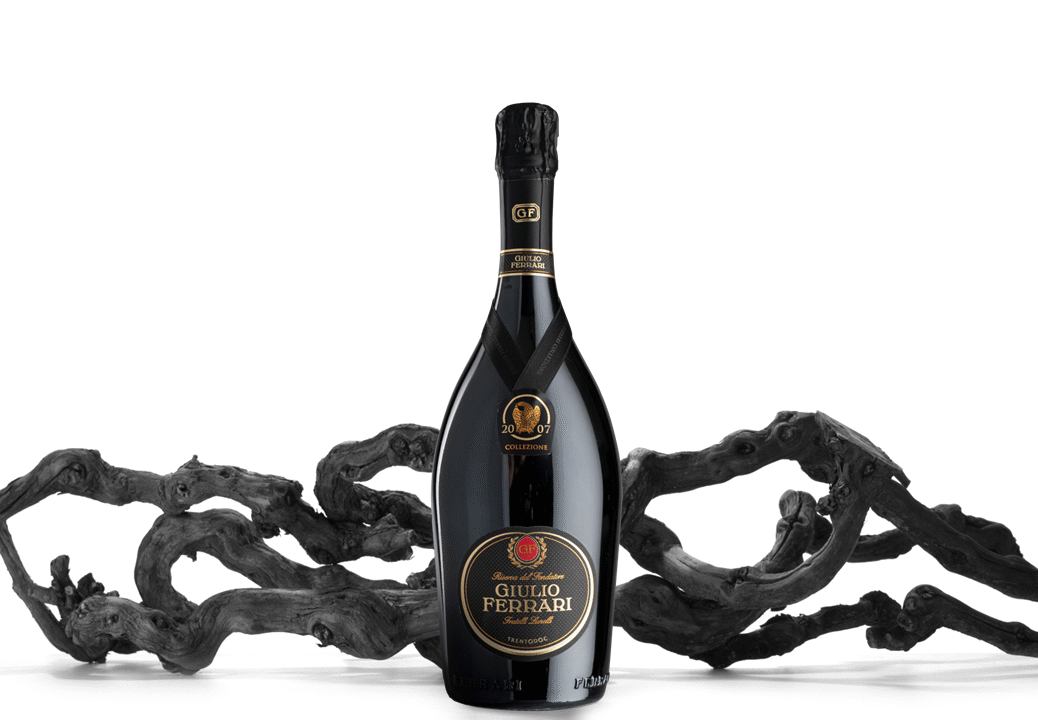
By aging its top wine for almost 20 years before release, Ferrari is clearly looking to compete with the elite tier of Champagne, says Giles Fallowfield—company in which it very much belongs.
Although we know that time, in bottle and in the cellar, plays an important part in the slow development of great sparkling wine, there are very few Champagnes where the release is delayed for 15 years or more. And the handful that do benefit from this long aging in the cellars before release, are among the very top and most sought-after prestige cuvées and single-vineyard wines. The likes of Bruno Paillard’s NPU, currently from 2008; Billecart-Salmon’s single-vineyard Clos St-Hilaire, where the next 2008 release is soon to be on the market; and Krug’s 2008 Clos du Mesnil, its current single-vineyard Blanc de Blancs.
In this trio we also have the three main possibilities in terms of the likely encépagement of a top Champagne: a 50/50 Chardonnay/Pinot Noir blend, from seven grand cru sites in the case of the Paillard wine; Billecart’s single-vineyard Blanc de Noirs (100% Pinot Noir) from Mareuil-sur-Aÿ; and Krug’s single-vineyard Blanc de Blancs (100% Chardonnay), from a walled site near the center of Le Mesnil.
It therefore says something significant about the ambition of leading Italian sparkling-wine producer, Ferrari, that it should emulate these iconic Champagnes in terms of the pre-release time lavished on its own top wine, Giulio Ferrari Collezione, the 2007 vintage of which has just been launched.
Related
This is only the fifth incarnation of this single-vineyard Blanc de Blancs—the four previous vintages being 1995, 1997, 2001, and 2004—and it’s made in minute volumes: just 3,870 bottles and 275 magnums in this case. The amount produced has varied with each release, sometimes a little more, sometimes slightly less.
The age-worthiness of top Trentodoc sparkling wine is not appreciated as fully and widely as it should be. I first experienced it at Bollicini su Trento back in November 2010 when, as part of a three-day festival, nine producers each showed one of the oldest wines in their cellars. The eldest two included the impressive, fully mature Riserva del Fondatore Giulio Ferrari 1994, disgorged in June 2010. Most wines demonstrated the kind of interesting development and textural complexity that top sparkling wines will show over time.
Returning to Trento during a visit to the Ferrari winery more recently, in July 2023, I was able to taste three different back vintages of their more commercial, larger production Perlé Bianco Riserva; the 2017 disgorged in 2023, the 2011 disgorged in 2017, and the 2006 disgorged 11 years earlier in 2012. All impressed—particularly the 2006, with its nutty aromas, mature exotic fruit notes, and quince and butter-richness on the finish.
Content from our partners
While 2006 is considered the vintage of the Millennium so far in Trentodoc, this wine was matched in intensity and complexity by a magnum of Giulio Ferrari Riserva del Fondatore 2001 that Ferrari President and CEO, Matteo Lunelli, served blind. Here we were encouraged to guess its vintage; and, while it was a rich, old-gold color, and in terms of aroma had moved into those tertiary notes of coffee and mocha (Lunelli’s own descriptor was “saffron”), no one successfully guessed its age, as it still had plenty of life left in it.
Ever higher
In contrast to 2006, the 2007 viticultural year was remarkable for its unpredictability: a snowless winter, a dry spring punctuated by May rain, and a summer characterized by heat, uneven precipitation, and sudden drops in temperature. The harvest itself began unusually early, in the first days of August, and despite the difficulties of the growing season, the grapes showed a vibrant freshness and refined equilibrium.
I suspect that in future incarnations, winemaker Cyril Brun (who only arrived in Trento from Champagne in July 2023) will be pushing the textural complexity of this and some other top Ferrari cuvées. In 2025, he installed some large Stockinger 40hl oak foudres, “just to support, get extra complexity, and gentle notes of vanilla—not to overwhelm with oak.”
One thing he isn’t trying to do is ape Champagne. “I came to Italy with a lot of humility, with the first objective of listening to what other people say. I didn’t come to make Champagne in Trento. We’ve created a panel of tasters; I needed the feedback of the people who had been working in the winery for 20 years.” Three new presses have also been installed, aiming at gentler pressing, to “search for the very essence and identity of the territory,” says Brun.
“While the whole notion of terroir is more closely linked to the soil in Champagne, here it’s much more about the changing temperature influenced by proximity to the mountains and lakes, plus differences in altitude. In the mountains, you suffer less as a result of the changing climate. Some 70% of Trentodoc is higher than 1,000 meters [3,300ft], 20% exceeds 2,000 meters [6,500ft], and there are 93 peaks rising above 3,000 meters [10,000ft]” (the vineyards are all planted at lower levels, of course).
While in Champagne winemakers are increasingly looking at more north-facing slopes and crus to keep freshness in their longer aging wines, in Trentodoc they can just move farther up the mountainside. “That’s what helps bring the unique crispy freshness to the wines,” says Brun.
The 2007 Giulio Ferrari Collezione Reserva comes from a very specific vineyard site called Maso Pianizza, on the slopes above Trento, on the opposite side of the Adige Valley from the city. The 14.6ha (36-acre) vineyard, which is exposed predominantly to the southwest, lies at an altitude of between 1,500 and 1,800ft (450–550m), which in terms of Trentino viticulture is referred to as “medium-high.” The vineyard is surrounded by woodland, which reinforces its distinctive Alpine character.
It’s the happy combination of the altitude, sloping ground, exposure to the southwest, cooling breezes, and the influence of all the lakes that helps moderate the climate and produce a large diurnal range in temperature of some 22ºF (12ºC) in the late growing season—something so important for quality sparkling-wine production and a feature that can no longer be guaranteed in Champagne in an August harvest (though it was a welcome feature of the 2025 harvest there).
The high-quality grapes from this site are used in several of Ferrari’s most prestigious wines, including Giulio Ferrari Riserva del Fondatore, but the Collezione wines, made only in particularly good years, get first pick when they are. The vines are on average 20 years old. The historic vineyard has gradually been replanted, with the traditional pergola system replaced with Guyot training, aiming to maximize the quality potential of the site.
This newly released wine was disgorged with an Extra Brut dosage in February 2025 (magnums one month later), so already there’s more than 12 months post-disgorgement aging, too. We tasted the wine last October (2025) with five other Ferrari cuvées matched with dishes in Silva restaurant in Mayfair, London.
These wines included the newly released 2018 Perlé (available at Hedonism, London, £45 per bottle), a light, fresh, and elegant all-Chardonnay cuvée, with enough edge to work well paired with a rich crab raviolo and langoustine bisque, a mineral note bought out by the oscietra caviar addition. The main dish was a rare Beef Wellington, which some might think a brave choice to match against the star wine, the 2007 Collezione Reserva. In many years of traveling to Champagne, I have had only two wines that were successfully married with rare beef: Krug Grande Cuvée and Philipponnat’s Clos des Goisses. The 2007 Giulio Ferrari Collezione Reserva rose to the challenge with consummate ease, underlining the fact that these top wines from Trentodoc are essentially for the table and arguably best served with simple, classic dishes.
Tasting
Tasted at Silva, London, with Matteo Lunelli, Camilla Lunelli, and Cyril Brun; October 30, 2025
2007 Ferrari Giulio Ferrari Collezione
Some 18 years on, the fine balance of the 2007 Giulio Ferrari Collezione Blanc de Blancs still resonates, with ripe citrus notes to the fore, thanks in part to the very warm summer temperatures, which reached record levels. Now like the 2006 Perlé of 15 years ago, it’s moved into that mature arena of butter, toasted hazelnuts, coffee and crème brûlée. Its most notable feature, however, is the long, creamy, silky textured finish.
Available exclusively upon request, with a recommended retail price of €420 per bottle.


