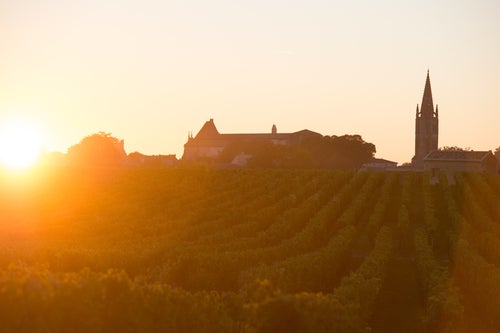
Initially marked by intense heat and drought, the 2025 Bordeaux growing season was transformed by late-season rain and cooler temperatures to produce wines of miraculous, mellifluous balance, with the Cabernet-led wines of the Left Bank a particular triumph in a small but beautiful vintage, says Simon Field MW.
In Bordeaux, 2025 is a most attractive vintage, marked out by low volumes of production, low alcohol levels, and before its annual en primeur campaign, low commercial expectations. There is, however, something magical—miraculous, even—about the wines, born, with mixed promise, in near-drought conditions but completely transformed by opportune rains and a felicitous conclusion to the season that was relatively cool. For once, there was no need to be “saved by an Indian summer”; quite the reverse. Rains at the end of August, allied to milder conditions thereafter, with marked diurnal variation, conspired to transform what had been set to resemble another 2022 into something different, something more nuanced and subtle of iteration. Classicism with the twist of technological progress that now underpins every winery. Something a little special.
The growers are certainly impressed, sometimes almost bemused: “2025 has all the advantages of a sunny year, with ripe fruit and flavors, but also wines of exceptional balance and, most importantly, freshness,” says Pierre Graffeuille at Montrose, describing the vintage as a “fascinating stepping stone between the phenolic intensity of 2022 and the drinkability of 2016.” He adds, “There is no trace of heaviness whatsoever,” the wines also reminding him of the styles of yore, 1989 and 1990 in particular. Axel Heinz at Lascombes, meanwhile, praises “a vintage nurtured by Mediterranean sunshine and yet culminating in clean, fresh elegance,” adding, “2025 epitomizes Margaux [and, by extension, Bordeaux] classicism, with wines that will evolve for decades yet are already perfectly capable of relating their story and charm. It is the fine line of power and grace, which we love.” For her part, Noëmie Durantou at L’Eglise-Clinet escalates the poetry, calling upon her experience as a violinist to describe her sentimental education as winemaker: “It is all about harmony; 2022 was a broad vibrato, but 2025 is a pure note that you can touch with the tip of your finger, with the poignant precision of a master craftsman.” She adds, “It was a small and sacred vintage, its tanks tiny diamonds. We create a framework and stretch the canvas, but at the end of the day, it is the grapes that paint the picture.” Quite so. A mellifluous painting.
The broader canvas
Before describing the seasonal conditions that prompted such a panegyric, it is well worth stepping back to view the broader canvas. And a somewhat challenging viewing it proves—more Rothko in a bad mood than Claude Lorrain at dawn. The broadest possible backdrop depicts a decline in global consumption, lifestyle warnings, and an era of geopolitical strife and political protectionism, itself increasingly underscored by mordant tariffs and import restriction. Focusing on Bordeaux provides little respite from the prevailing sense of doom. One must recall that the en primeur jamboree accounts for only 15% or so of a complex vinous economy, and its success or otherwise is of limited significance other than as a qualitative bellwether and flag-bearer. Unfortunately, the rest of Bordeaux is struggling just as much, if not more; this can be illustrated by the fact that more than 20,000ha (50,000 acres) have been grubbed up over the past three years; some with, but many without, government support. This is most clearly evident in less fashionable regions, such as Entre-Deux-Mers, but is evidenced more broadly on both sides of the Gironde. The trend is starkly underlined by the decline in the number of autonomous growers: 6,600 in 2016 but now, a mere decade on, only 4,400. The decline in the area under vine has been equally stark: In 2016, it was 110,000ha (271,800 acres); now that figure has been reduced to 86,500ha (213,700 acres). Total AOP production, finally, has dipped concomitantly: 577 million liters in 2016 have now slipped to 291 million liters. This shift, euphemistically described by some as a “recalibration,” has touched every corner of the region. If one takes the middle ground, for example, there has been a marked decline in the membership of the cru bourgeois category, down over the past decade from 249 to 170 members—a general malaise, it would seem, and a general pattern of decline.
Related
How can one square this circle, the lurch into sometimes self-fulfilling pessimism that has been so starkly rehearsed in the preceding paragraph? Those inclined to view their glass of St-Julien as half full may well decide that the fact that the 2025 harvest was the lowest since 1991 can be considered a good thing. There is a demonstrably inverted relationship between quantity and quality in 2025, so that must be good news in an environment where the supply/demand curve is challenged, surely? Well… up to a point, Lord Copper. There are multiple structural economic forces in play when a region slips so appreciably, and the fact that the overall yield was a mere 33.6hl/ha can, of course, be attributed to specific vintage conditions and the pursuit of excellence. But such things are of little consequence if one’s income and career are seriously threatened. This is underlined by the fact that it is not only overall production that has fallen, but also yields per hectare, which is in itself even more stark and potentially more consequential. An explanation will never be far away, be it the frosts in 2021, or the mildew in 2023 and 2024, or the drought in 2022 and (up to a point) 2025, but the arc of ultimate economic imperative can be unforgiving. The very thing that makes Bordeaux so special, namely its climatic diversity and unpredictability, continues to challenge, perhaps more so than ever, with so many worldwide pretenders to its crown—and this despite the undeniable technological advances.
The growing season and harvest
Time, then, to drill into the detail of the season that was 2025. The winter had been predominantly dry, but not too dry to neglect the water table. It was also mild, which set the pattern for precocity, with average temperatures nearly 2.7°F (1.5°C) above normal throughout the season. Budburst was early and easy and took place in the last week of March. Thereafter, with the exception of a rainy Easter holiday, the barometer was set fair for spring and early summer, which were predominantly both dry and then hot, with flowering starting a week earlier than normal (14 May) and an ever-present and slowly growing anxiety about hydric stress. Stressed or otherwise, the vines had already decided on a parsimonious yield, the inflorescence (flower initiation) dependent on the conditions of the previous year, which were wet and thereby dictated a poor volume for 2025. Ironically, the low number of clusters ultimately worked in the favor of the growers as the conditions got hotter; the vines were able to focus on the essentials of fruit ripening rather than structural growth, which, allied to interventions such as the lowering of the fruiting levels on the vines, served to focus on physiological growth without having to endure too much by way of desiccation or decoloration. The synthesis of the grapes’ polyphenols was therefore not jeopardized and contributed to their thick skins, which in turn offered protection from the excesses of the sun. This was guaranteed by the fact that there was very little by way of leaf-plucking, itself prompted by the good fortune of virtually no instances of rot of any kind, thereby ensuring a healthy crop of small, highly concentrated grapes.
The changing in the color of the grapes (veraison) was also early, its mid-period July 25. By now, the conditions were parched, with only minimal rainfall. The ensuing debate has focused on whether the vines actually entered a period of blocage, with all growth for the rest of the season terminated and a danger to the plants’ survival, or whether it was merely a temporary realignment. Semantics sometimes get in the way, but the consensus centers on the second option, summarized by Thomas Duroux at Château Palmer as “lockdown but not shutdown.” The danger, clearly, was an accelerated maturation, with degradation of acidity (especially malic acid) and levels of sugar, already elevated, now falling out of balance, despite a temporary lull in the photosynthesis. Two key factors changed the profile of the vintage: the timely rain, almost ubiquitous across the region, in the last days of August; then the cooler conditions in September. The rain came too late to cause the grapes to swell, but it did ensure that balance was restored, with pH levels not rising excessively and with ripeness, already assured, not straying into overripeness. These two factors mark out the fundamental difference between 2025 and other vintages described as solaire—2022 and 2023, for example—and they alone account for the almost paradoxical style of the wines, born out of heat and dust yet displaying modesty of alcohol, definition of color, and a striking aromatic profile. A Janus-like vintage, then, mercurial and, incidentally, presenting an almost mirror image to the challenges of 2024. In 2024, the rain was the punishment, whereas in 2025 it was the salvation. The squaring of a Giotto circle.
Content from our partners
Harvest was early in general, with the Merlot especially precocious; at Troplong Mondot, the picking started on August 28, the earliest in its history. The rain was too late to provoke any dilution in the Merlot, and in the Cabernet it has had minimal effect in terms of yield or quality, the thick skins providing sufficient protection. The timing of the Cabernet harvest was a little more contentious, however, with many growers opting for a start in mid- or even early September, while others, notably Philippe Bascaules at Château Margaux, waited a little longer, defiant of a rather precarious weather forecast. The grapes were collected at Palmer and Margaux, inter alia, by September 29 and benefited, physiologically speaking, from the extra hang-time, the additional modest gains in alcohol (Margaux is 13.9%) held in check by an overall synthesis of other components, most specifically tartaric acid. The harvest was therefore a little protracted, but very few strayed into October, when the rains finally arrived.
Soils, water, yields, and yikes
Key to understanding this most beguiling of vintages are the yields and their relationship with soil types. The soils with water-retentive characteristics were clearly best placed to endure the periods of stress, with clay and limestone theoretically at an advantage over the more free-draining gravel. Such is the theory, anyway, which makes it all the more ironic that the controversy that erupted focused on the commune of Pomerol, which is famed for its blue clay. Château Lafleur maintains that on a specific part of the plateau there is more sand and gravel than elsewhere—so much so that the health of their vines was endangered, prompting them to inject 10 liters of water per square meter into the area in the middle of their vines. The INAO deemed this to be forbidden irrigation—as indeed it was—and the upshot saw the Guinaudeau family quit the appellation, its 2025 wines to be labeled as Vin de France. The example illustrates the narrow line between plant survival and plant destruction, together with a raft of differing opinions on how to address it specifically, with more general reference to the ever-spreading tentacles of climate change. Lafleur maintains that its grapes were among the smallest ever and therefore in no way compromised by dilution or any other negativity. In addition, both the critics, initially, and now the market have been positive about the quality of the wines themselves, thereby providing at least partial respite in the face of a potential backlash to such apparent iconoclasm. This example is worth considering, because it provides a microcosm with which to illustrate the ongoing debates on political, bureaucratic, and qualitative matters—all three of which need to synchronize if the region is to lift itself out of its parlous state and to sail out of the doldrums of apparent commercial indifference. There has not yet been a rush to emulate Lafleur’s stance.
Be that as it may, the overall yields were conspicuously modest—the lowest ever, we are told, for a vintage that has not been touched by frost. Contributing to this were a seasonal rainfall level of 14.3in (364mm) (compare 2022, 10.9in [278mm], 2024, 25.6in [650mm], and the 30-year-average of 18.5in [469mm]) and an average temperature between April and June of 66.4°F (19.1°C) (compare 2022, 67.6°F [19.8°C], 2024, 64°F [17.8°C], and the 30-year-average of 64.8°F [18.2°C]). Less rain than usual, for sure, and also warmer temperatures, but nothing, prima facie, to explain the exceptionally low yields, which we can only understand in relation to the difficult flowering in 2024 and the precociously hot weather in 2025, which prompted vines to enter survival mode and their grapes to embrace the virtues of concentration.
The yields in individual communes also make for interesting reading; the clay in Pomerol dried out in 2025, and as a result (as we have seen with Lafleur), it suffered more than one might have anticipated, its yield of 25.9hl/ha the lowest in Bordeaux and nearly 30% down on the ten-year average. Other communes to struggle were Margaux (29hl/ha seems a long way from the 49.2hl/ha in 2019), St-Julien (26.4hl/ha, 27% down on the ten-year average), and Pauillac (30.2hl/ha, 25% down on the ten-year average). By contrast, St-Emilion (34.7hl/ha) fared better, though it was still down on previous years, and the results depended on specific soil types (there are 4,000ha [10,000 acres] of grand cru), with limestone and clay on the plateau and on some of the côtes faring better, unsurprisingly, than some of the sandier, more alluvial plots closer to the river. It is inevitable that yields should diverge over a relatively broad and heterogeneous landmass; it is clear, however, that the overall picture is stark. Whether this proves to be a trend for the longer term remains to be seen. It seems likely.
In the vineyards
The most fascinating part of my two-week trip to Bordeaux in late April, as always, was the opportunity to discuss with the growers themselves, to gauge the mood (cautious optimism) and crack the code behind the inevitable praise, as to whether or not they really rate the vintage in question. It turned out to be a definitive yes for 2025.
In the vineyards, it is interesting to monitor the current trends and to assess the extent to which they point to stylistic modification. There is increasing evidence of focus on individual parcels, whether formalized, as with La Côte, Lascombes’s new Merlot bottling, or merely demonstrating an increased emphasis on segmentation when it comes to vinification, the latter now possible by the increased purchase of smaller and more varied tanks and vats. This is the strategy adopted by, among others, Juliette Couderc at L’Evangile and Grégoire Bucaille at La Mission Haut-Brion. At Montrose and, to a certain extent, at Brane-Cantenac, the segregation is very clearly linked to the historical terrace matrix. Many producers, not unrelated, were keen to stress a focus on the actual terroir as delimited in the 1855 Classification, even if, inevitably, it has meant a reduction in the volumes available for the grand vin. Such an approach is advocated by Axel Heinz at Lascombes, who has proved that historically there was more Merlot in Margaux than elsewhere on the Left Bank and has justified it geologically by demonstrating the increased pockets of clay in some of his vineyards. In the same vein, Claire Villars at Haut-Bages Libéral focuses on the limestone parcels in her vines, their proportion unusually high for a Pauillac. Henri Lurton, for his part, has decreased the area for his Brane-Cantenac, from 95 to 72ha (235 to 178 acres) in the name of (re)capturing the essence of the 1855 Classification—only, presumably, because he feels that it is the most accurate reflection of the most appropriate terroir, rather than out of any nostalgic whim! Where Margaux leads, others follow—or seem likely to do so.
Attention to detail is also evidenced by painstaking practices such as the reorientation of the vineyard (Gazin is planting a north-facing parcel), increasing the environmental footprint through agroforestry projects (Lafite, Angélus, Léoville Barton, and Grand-Puy-Lacoste), shifting the varietal dial, in favor, for example, of Cabernet Franc (Ausone, Clos Fourtet), or by applying natural treatments rather than interfering too much with the canopy management to counter the hot sun (Pontet-Canet). The move to organic principles continues apace, with many châteaux undergoing their three-year conversion (Duhart-Milon among them) and several completing it in time for the 2025 vintage, Château Gloria in St-Julien an impressive example. Work is ongoing throughout the region on soil analysis, ditto rootstocks and clones, with châteaux such as Giscours, among several others, putting renewed focus on clonal selection, a project facilitated in its case by the establishment of an on-site nursery. The vineyard remains the cynosure for virtually everyone, and it is encouraging to see so much effort and innovation devoted to processes that harness rather than try to overcome the ever-changing whims of nature’s transformative gift.
In the wineries
Similar attention to detail was evidenced in the winery, with specific focus, in terms of negotiating the challenges of 2025, on the length of the cuvaison and the extraction methods employed. The rule of thumb has seen a reduction in the former from around 30 days to somewhere nearer 25, with extraction methodology focused more on “infusion” or, sometimes, gravity-fed systems. Pigeage and délestage are less in favor, it seems, and even remontage is only carried out gently. Significantly shorter maceration periods were widely evidenced, with Dominique Arangoïts at Cos d’Estournel needing only 21 days, though he did allow the fermentation temperature to climb to 84°F (29°C), higher than most. Claire Villars, for example, does not wish for temperatures above 77°F (25°C) and feels that anything other than infusion would be redundant (superfluous, at least) given the great generosity of the polyphenols evidenced in the grape skins. She compares the stylistic aspiration to the 1988 vintage but concedes that modern, more precise methodology is better able to ensure optimal extraction. A further example is provided by the irrepressible Philippe Blanc at Beychevelle, who reveals that, at 25 days, the maceration of its grand vin was between five and seven days shorter than normal; the wine has lost none of its incredible color or very fine, pixelated tannins. In other words, 2025 was not a vintage in which to try too hard in terms of intervention.
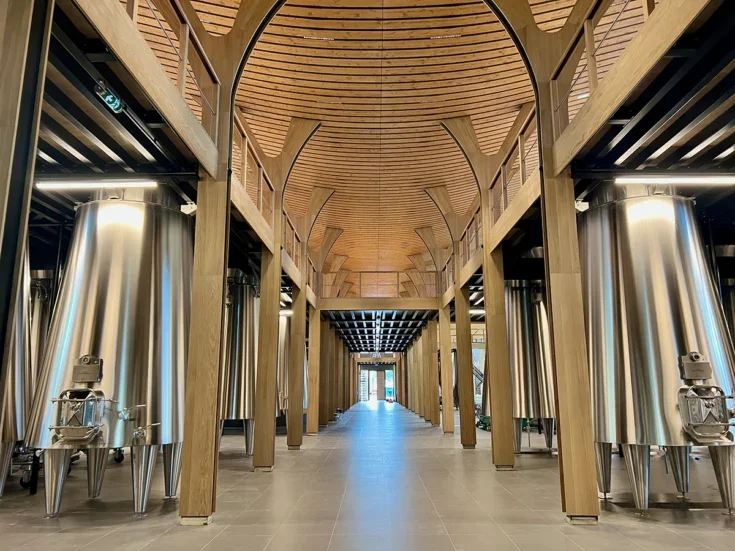
The same principle, of course, is of relevance to the use of the press wine, to the vessels employed for maturation, and to the putative length of such maturation. Again, the general thrust is for less new wood, larger containers, and the prospect of a shorter maturation. Press wines, for their part, were generally favored, their inherent quality adding depth and texture—though not to excess, given that an innate concentration had already been gifted. Some 10–13% of press wine seems to be the norm. Also normalized is the use of larger maturation vessels, foudres and the like, some of 500 liters and therefore not appreciably larger than the traditional barriques; others significantly larger, recalling the great cellars of Châteauneuf-du-Pape. To have 100% new barriques was exceptional, though not completely forgotten; Château Margaux has crafted the most extraordinarily complex and nuanced wine thus. More typical, maybe, is Angélus, which has invested heavily in its cuverie and now divides the élevage between foudres and barriques, with only 65% of the latter new. At Troplong Mondot, Aymeric de Gironde specifies that his goal is a 50/50 split between barrels and foudres; for the 2025 wine, the former is still a little ahead, with 60% coverage. At Beau-Séjour Bécot, Juliet Bécot is poetic; she employs only 50% new oak, because she does not want anything to distract from the quality of the wines, describing the year as one in which “the brightness [éclat] of the vintage meets the freshness of the limestone.” Precision is key—and all the more relevant with the relatively lower levels of alcohol this vintage. Guillaume Pouthier at Les Carmes Haut-Brion is equally sparing with new wood; he added 65% of whole bunches to his fermentation vat in the name of purity and precision and feels that the vintage is sufficiently concentrated to merit 70% rather than 100% new wood. He compares his wine to a ballet dancer: grace and elegance personified, but with the inner core of strength to be able to last for several hours sur les pointes. Such a poetic bunch, these Bordelais vignerons! Elsewhere, we find Stockinger oval vats at Larrivet Haut-Brion and a new purchase of 16 50hl foudres at Domaine de Chevalier, where Adrien Bernard says he and brother Hugo seek “gentle rondeur” without a trace of dryness, the latter virtually absent in the tasting of 2025, in no small measure as a result of the careful regimen employed for the wine’s upbringing. There are amphorae at Pontet-Canet (50% new oak barrels, too), and even some of the famously powerful wines, such as Pichon Baron, are using only 70% new barriques. Mouton follows Margaux with 100%, but Haut-Brion (59%) and Lafite (94%) both eschew the tradition.
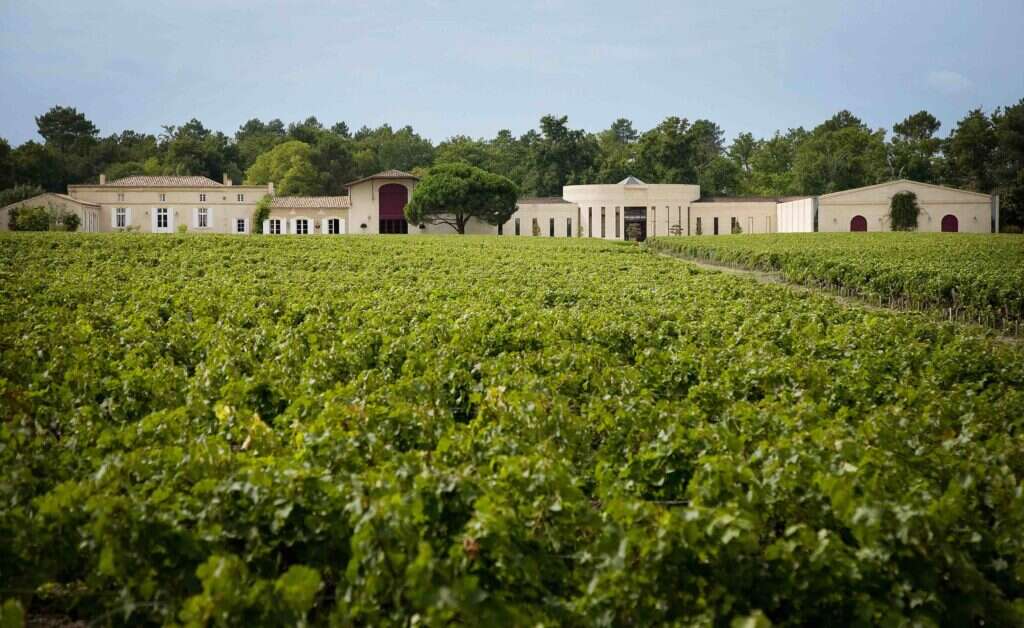
Another aspect of tradition was nearly challenged at Mouton, with a record 98% Cabernet Sauvignon in its grand vin; it is not quite clear why Jean-Emmanuel Danjoy, its technical director and head winemaker, has refrained from 100%, though he does refer to a small enclave of Merlot-friendly clay and, interestingly, to the fact that some have found it disturbing that the proportion of Cabernet should be so high. In a sense, given that the Merlot was picked just before or just after the late-August rain, there is a pleasing logic in the popularity of the Cabernet, which was able to achieve full phenolic ripeness, without the slightest hint of surmaturité. Thomas Duroux at Palmer admits to being slightly in two minds, since he feels that Merlot is well suited to his very particular Margaux terroir (echoed, as we have seen, by Axel Heinz at Lascombes), but he also recognizes that all three key types of maturity (technical, aromatic, and phenolic) were achieved in textbook fashion for his Cabernets, their low alcohol held in glorious counterpoint to the concentration of the fruit.
Overall, a victory for the Cabernets, then—and also, in all probability, for the Left over the Right Bank, with particular successes notched up by the “estuary” properties of the northern Médoc, with Pauillac and St-Estèphe especially impressive and, for me, some great outings from (relatively) lesser-known properties such as Pédesclaux and Meyney. Lynch-Bages was also impressive, less imperiously domineering than sometimes. According to near-ubiquitous consultant Thomas Duclos, “2025 is a vintage marked by creativity, where every estate has been able to show its own intrinsic style.” One has but to assess three of the grandees of St-Julien to appreciate this: a cerebral Gruaud-Larose made by Virginie Sallette; a magnificently rich Beychevelle, from the sensual end of the spectrum; and from a property that continues its ascent to the high table, Branaire-Ducru, a fascinating, complex wine that includes all of the property’s Cabernet Franc and Petit Verdot in the final blend, such was Jean-Dominique Videau’s admiration for these varieties. This point of view contrasts with Hélène Génin’s opinion that the Petit Verdot had too high an ABV to be included in her 2025 Château Latour. Each to their own.
Finally, a salute to the other two greats of St-Julien. Léoville Barton, celebrating its 200th anniversary in 2026, demonstrated a characteristic attention to detail by employing no fewer than ten coopers, again in search of the perfect blend. This practice was followed by many others, including Jean-Michel Laporte at Château Talbot. Léoville-Las-Cases also used ten coopers and 80% new oak, which, we were informed, was now deemed to be the optimal level. QED.
Dry whites and Sauternes
2025 was clearly an excellent year for red wine; yet ironically, especially in light of the deluge that was 2024, it was probably the fact that there was more late-August rain on the Left compared to the Right Bank (3.1in [80mm] compared to 1in [25mm]) that signaled the general superiority of the former. Such a backdrop was almost inevitably less successful for the whites, which often struggled in such conditions, the more so as much of the Sauvignon and a good deal of the Semillon had been picked before the redemptive rains. All the more of a shame, since this was an opportunity to showcase the new AOP of Médoc Blanc; we were treated to examples from, among others, Talbot, Brane-Cantenac, Cos d’Estournel, and, rather secretively, Léoville-Las-Cases. Struggles with pH and, by extension, absolute freshness have marginally undermined the quality of the whites: technically proficient and often aromatically charming, but on occasion lacking the edge of tension that marks out the greatest examples. For all that, I was very taken with Haut-Brion (often but not this time, I prefer La Mission Blanc) and Aile d’Argent. It will be fascinating to follow the new category.
It was a good year, too, for Sauternes, the yields at 12.5hl/ha a little below the ten-year average (12.7hl/ha) but higher than both 2023 (12.2hl/ha) and, especially, the ruinous 2021 (3.5hl/ha!). Generally, between three and five tries were needed, the first of which did not always produce botrytis. This was remedied with the most productive period, from the middle of September until the end of the second week of October. Impressive but not overwhelming levels of residual sugar (thank you, Lafaurie-Peyraguey for your relative restraint this year), with plenty of exoticism and structure. I was impressed across the board, especially by Fargues, Guiraud, and Suduiraut in Sauternes and by Coutet in Barsac. A very good year, though maybe not quite in the league of 2011, 2014, or 2023, which excelled.
Prospects for the golden mean?
2025 is a vintage of charm and luminosity: Its golden mean glistens through a halo of moderate alcohol, its concentration guarantees status as real vins de garde, its refreshing acidity marks out an individuality that separates it from years such as 2022 and 2020. There is, in other words, a lot to like about 2025.
But how will it fare in a ruthlessly competitive environment? The en primeur model is, many say, in crisis—an existential crisis for some, because either the prices come down to such an extent as to undercut all other extant vintages, thereby undermining the category, or they are held or even modestly increased to reflect the quality of the vintage, thereby risking a paucity of sales and a negativity that sometimes seems to border on contempt. If the wines themselves appear to have squared a stylistic circle, it may well be that the economic environment will need far greater prestidigitation to resolve its own dilemma, the more so as the more “approachable” style theoretically brings into question the concept of long-term keeping and therefore, indirectly perhaps, of investment potential. These wines, we should not forget, are expensive to make, their cost of capital weighed down by borrowing and technological aspiration (for all the talk of “non-intervention”). Not to mention a proclivity for indulgence, aesthetically speaking, to keep these magnificent châteaux and their parks and gardens in their almost suspended state of beauty.
The early indications are quietly positive. There have been several so-called recalibrations over the past two decades or so; the 2008 campaign after the financial crash, 2019 after the Covid pandemic, and so on. On the back of significant price falls from 2022 to 2023 and then the relatively weak 2024, 2025 seems thus far to be a case of “steady as she goes.” The first releases were priced either modestly below the 2024 level (Batailley) or modestly above them (Pontet-Canet, first out of the blocks once again); and if anecdotal evidence from friends in the London fine-wine trade is anything to go by, there have been some reasonable sales thus far. The mood, in any event, is far less gloomy than it was 12 months ago, when it was felt that Pontet-Canet was still too expensive, especially given the unappreciated quality of the vintage. 2025 is a far better year, and the pricing is generally regarded as fair.
The ensuing releases of properties at the top of the hierarchy have been a little more ambitious, but one must consider that when Cheval Blanc raised its price for the 2025 from €276 to €336 per bottle, it did so on the back of one of the lowest yields in its history (15hl/ha). And one must also remember that its 2024 was itself 43% down on its 2022. The first Left Bank first growth to release was Lafite, and its 16% increase on the 2024 (€336 v €288) still represents a 9.5% discount on its current availability of the 2019. The 2024 Lafite was 27% down on its 2023 release price, so once again the 2025, prima facie, seems relatively well priced. All in all, even without definitive sales analysis, it would appear that the Bordelais have at least done enough to justify their strategy, and it now remains to be seen if the market, moderately placated, will start to buy again. One can only hope so, given the quality of the wines.
For those who love definition, tension and—for want of a less loaded word—clarity, 2025 has a lot to offer. Frédéric Faye, the technical director at Château Figeac, sums it up well: “The 2025 is not a solar vintage. The aromatics are incredibly intense, but they are very Bordeaux.” Henri Lurton detects “two vintages in one, such is the power and concentration on the one hand, the freshness on the other.” Echoing this, Faye discerns the aromatics of 2019 and the tannins and texture of 2022. The square has been well and truly circled. The wines are faithful to origin in a manner that one might have considered impossible after such warmth over most of the summer. The unfailingly poetic Thomas Duclos summarizes elegantly: “It is a bit like cinematic lighting, where every finite detail of the terroir is exposed.” The essence, in other words, of high-class Bordeaux wine.