Joanna Simon finds the ideal wines to pair with calçots amb salvitxada.
If you think the onion is a rather ordinary vegetable, you haven’t visited Catalonia over the winter and early spring or don’t know any Catalans—and you are certainly not Catalan. The point, of course, is that not all onions are equal. Catalonia’s emblematic onion is the long, sweet, and tender calçot, which looks like a cross between a leek and a large white salad onion (scallion) and which, in the province of Tarragona, has its own Protected Geographic Indication (PGI), the Calçot de Valls.
The long stalk of the calçot comes from repeatedly piling-up, or hilling, the soil around it as it grows and the name calçot is derived from the Catalan verb for this hilling technique, “calçar” (which also means to put on footwear). There are various origin stories but the one with the greatest currency is that a peasant in Valls around the turn of the 20th century, Xat de Benaiges, was the first to plant onion sprouts and cover them with earth so that they would grow a longer, white, and therefore edible, stalk. He sometimes also gets the credit for developing the distinctive cooking method and even the salvitxada sauce with which calçots are invariably served, although the first appearance of the sauce in a cookery book was in 1924 in La teca: La veritable cuina casolana de Catalunya by Ignasi Doménech.
Calçots and calçotadas
During the season, which lasts until April, eating calçots with family and friends at dedicated feasts called calçotadas is tantamount to a religion, with all the accompanying ritual but none of the formality or solemnity. Indeed, the whole affair is a messy, hands-only business making it impossible for anyone to be serious about anything except enjoying themselves. Bibs are often provided but cutlery and plates are not. At the most, terracotta roof tiles may serve as plates.
Related
The calçots are grilled over an open fire, traditionally of vine cuttings. When the outer layers are black, they are wrapped in bundles in newspaper to finish cooking, or just to keep warm, and are then served to diners-cum-revellers in the newspaper with bowls of salvitxada or salbitxada (aka salsa de calçotada). Diners strip off the blackened layers from the top down (hands already getting black), then dip the bulbous white part in the bright orange sauce, hold the onions high above their tilted-back heads and lower them into their mouths. Delicious, messy fun.
The current season started on November 22, 2025, when Tarragona-born chef Eduard Xatruch, of Barcelona’s three Michelin-starred Disfrutar restaurant, harvested the first calçots in the Alt Camp district of the Valls PGI. He used the opportunity to urge the protection of local produce to promote Catalan cuisine, saying that the calçotada “is a huge part of Catalan cultural gastronomy.” Marking the opening of the season was the first ever Calçotfest in Valls, a celebration of the area’s twin enthusiasms, music and calçots, with dance, magic, a circus, and other activities (the town of Valls is about 20 minutes’ drive north of the city of Tarragona and about an hour and 20 minutes inland from Barcelona). It was expected to generate between €750,000 and €1m of business. Meanwhile, it is hoped that the season as a whole will yield 20 million units (clusters) of Calçots de Valls, matching last year’s crop.
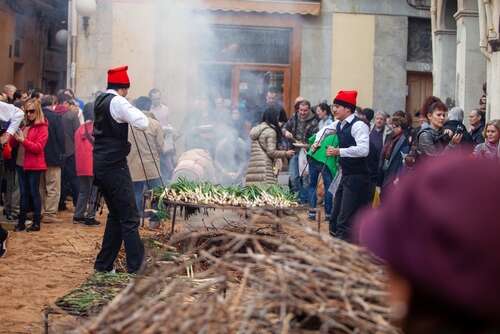
The PGI specifies that the length of the white stalk (before the green top) must be 15–25cm and the diameter of the bulbous base be 1.7–2.5cm. I mention the size because at the Gran Festa de la Calçotada, held in Valls on the last Saturday in January each year, one of three contests is the Concurs de menjar calçots, the eating competition (the others are for growers and for the best Salsa de la Calçotada de Valls, the preferred name for the sauce locally ).
Content from our partners

The world champion calçot eater, Adrià Wegrzyh from Barcelona, was ineligible this year, having won in 2025, but he is expected to be back to attempt his 14th win next year. He set the world record in 2018 when he ate 5.825kg (310 calçots) in the allotted 45 minutes. Although this year’s winner achieved the second highest weight in the competition’s 44-year history, he was a long way behind at 3.97kg. Do you really need to know all this? Not necessarily, but it illustrates just how significant calçots are in Catalan cultural and culinary life.
Quintessential sauce
Back to the quintessential sauce. Salvitxada, or salsa de calçotada de Valls, is a piquant, slightly smoky, textured, thick tomato, pepper, and almond-based sauce. It’s similar to the better-known romesco, although it’s best not to refer to it by the “r” word in southern Catalonia. Inevitably, as with romesco, there are infinite “authentic” variations and many a dispute within families as to who makes the best/true salvitxada, even when, or perhaps especially when, the recipe has been passed down through the generations.
The pepper usually specified is the mild, sweet ñora variety (nyora mostly sold dried, ready to be rehydrated), but a few recipes cite the hotter bitxo, and sometimes roasted red bell peppers with added paprika are included. Some recipes call for blanched, peeled tomatoes, others say roast, skinned tomatoes. If you have really flavorsome thin-skinned tomatoes and are using a food processor, you can even leave the skins on, but many cooks insist on a pestle and mortar. In most but not all recipes, the garlic is roasted. A slice of bread is used for thickening in some, but others are adamant that bread is not authentic. Toasted almonds appear to be universal, but not toasted hazelnuts—sometimes they’re included, sometimes not. And if there is at least agreement on the use of extra virgin olive oil and wine vinegar, there isn’t any on the quantities.
If eating calçots with salvitxada were not messy enough, the traditional drinking vessel at a calçotada is a porrón, a glass pitcher with a long spout that you hold by the base in order to pour the wine into your mouth, head tipped back, without your lips touching the spout. It allows diners to share wine without the need for individual glasses.
No wonder if you ask a Catalan which wine(s) they prefer with the dish, they say something along the lines of: “At a calçotada we drink whatever local red is available.” And it is red wine, even if diners might kick off with a glass of Cava. This is not, I think, because white wines are no match for calçots with salbitxada—I think some whites go very well—but because of the food that follows: usually botifarra (or butifarra) sausage and/or lamb chops, thrown on the grill after the calçots, and white beans (mongetes), culminating with crema catalana with which, presumably they don’t drink dry red wine, but you never know.
The best wines to pair with calçots amb salbitxada
The white wines I like to pair with the dish are incisive styles with clean-cut fruit, bright acidity, and subtle or no oak, but I should add the rider that I make a salbitxada that is sharper than some (I use either Silencio Cabernet Sauvignon vinegar or a Moscatel balsámico, both Catalan). Australian dry Rieslings, especially Clare Valley, with several years’ bottle age—up to 15 years for a wine such as Jim Barry La Florita (a favorite), or around seven for a wine such as the single-vineyard Pewsey Vale from Eden Valley. Without the bottle age, they can be too austerely dry, acid, and mineral with the natural sweetness of both the salvitxada and the onion and with the smoky spice.
Sauvignon Blanc can be equally successful, especially when small percentages of Semillon and/or oak and lees-ageing align with the texture, the roasted-nut depth and the light smokiness. Two good examples, both from Constantia and particularly with two to three years’ bottle age, are Steenberg The Black Swan and Klein Constantia Clara.
Chardonnay and Chenin Blanc can also be successful, for example, Zuccardi Q Chardonnay 2023 from the Uco Valley, fermented in concrete and used oak with native yeasts and aged on lees without malolactic. A very different style that can pair well is orange wine made from aromatic grape varieties. I’m thinking particularly of the biodynamic Maris Rare Orange 2024, a Muscat.
Many red wines that have natural fruit sweetness and no grippy tannins work well, especially Garnacha/Grenache-based reds. They need to be fairly generous, not the light, bone-dry, higher-acid mountain styles sometimes encountered in regions such as Terra Alta and Gredos. Oak—although not too much new—is an asset: for one thing, it can pick up on the chargrilled and smoky-spice characters. The mineral notes in Priorat and often Montsant can do the same. One Priorat among many I could recommend is Buil & Giné ‘Giné, Giné’ 2021. The plusher, simpler Bodegas Anadas Care Nativa from Cariñena is another very comfortable match, as are many of the reds of Empordà in Catalonia’s northeast corner.
Grenache-based southern Rhône, Roussillon, and Barossa often fit in the same way—from the ever-reliable Guigal Côtes du Rhône, a Syrah-heavy blend that can be matured for several years, to appellations such as Cairanne, or even, if following with typical calçotada type dishes, a wine of the stature of Torbreck The Hillside Vineyard Grenache 2021 or, from McLaren Vale, Yangarra Estate Vineyard Noir 2021 (a Châteauneuf-ish blend).
Garnacha, though, is far from the only companionable red wine. Other red grapes and wines that suit the food and the mood include oaked Tempranillo, not least Rioja Crianza, southern hemisphere Cabernet Franc, softer, fruitier styles of Dão and, I hardly dare mention them again, but, as so often, the wines of Beaujolais’ Crus.