

There are great Chardonnays now from many regions in Australia, but unquestionably there are more great Chardonnays made in Margaret River than anywhere else. The Gingin clone has found its perfect home here, and the wines offer unmatched generosity, richness, and intensity, supported by fine natural acidity. And yet they can be ethereal and amazingly elegant. The wines have also shown extraordinary longevity. When an authority such as Jancis Robinson MW writes, “I spent all last week tasting 2016 Burgundies, but the more whites I tried, the more I lusted after the Western Australian alternatives I came across during a visit there,” then perhaps it is time to acknowledge that this is a special place. Margaret River is simply one of the greatest Chardonnay regions on the planet.
Pierro
Serve someone a Pierro Chardonnay, and I can almost guarantee the response: “Why on Earth don’t I drink more of this stuff?”
Pierro was planted in 1980, in the Wilyabrup subregion, by young local doctor Mike Peterkin, who had an affinity for Burgundy and was one of the pioneers of the region. The soil is gravelly clay loam, with a high proportion of granite, and the vines are almost all the Gingin clone, with just 5% clone 95. The early wines were not quite what Mike was looking for, and so—after discussions with locals, including Robert Mondavi, who was then consulting for Leeuwin Estate—he took a different track, putting the wine through malolactic fermentation, which was simply not done in those days. He also looked to barrel-fermentation. Maturation is in Burgundian oak for 12 months; normally 50% of the barrels, or just under, are new. Needless to say, none of this was easy at a time when he was also operating a full-time medical practice, though in Margaret River, that was not uncommon. Since those early days, the Pierro Chardonnay has been unfailingly consistent and consistently excellent.
Chardonnay 2023
Related
A pale green/gold in color, while the nose unveils notes of lemongrass, ginger, stone fruits, cashews, and a touch of oatmeal. There is seriopeus intensity here, and the wine is beautifully layered. The tiniest hints of smoke add to the complexity, and the palate sees notes of peaches and figs emerge. Juicy citrusy acidity runs the length. This is a wine of finesse and balance that should drink beautifully for at least the next 10–15 years. | 96
Chardonnay 2018
The wine opens with notes of freshly baked lemon pie, supported by touches of apricot skins, ginger, citrus, and spices, with a chalky, slightly minerally backing. An absolutely gorgeous texture here, so seductive, with a line of fine acidity and impressive length. Still has a decade ahead of it. | 95
Content from our partners
Cloudburst
The evocatively named Cloudburst Winery created a stir far in excess of its size when it commenced operations earlier this century. From vineyards little bigger than postage stamps, Will Berliner, American by birth, has crafted some of the most exciting wines seen in Australia for quite some time. Eyebrows were raised and fingers pointed when one looked at the prices, set at a level well above the other top wines for the region at the time. Whether or not those prices were/are justified, Will seems to have no trouble selling out. A newcomer demanding and receiving the sort of money Will was charging saw a number of local noses out of joint. One wonders whether they would have been better realizing that the best wines in the region are, in fact, massively undervalued. (Easy to say for someone who doesn’t have to sell them.) Originally, Will had no intention of joining the local wine industry, moving to the region because of its natural beauty. It did not take long for wine to take a hold. He planted vines in 2005, following biodynamic principles. Original plantings were 0.2ha (0.5 acre) of Cabernet Sauvignon, 0.2ha Chardonnay, and a mere 0.1ha (0.25 acre) Malbec. Will has subsequently doubled those plantings. He favors close planting because he believes it “brings out the inherent flavor of the land.” For me, the Chardonnay is the superstar of the range. Cabernet can be spectacular, but Chardonnay consistently is. Situated in the “unofficial” subregion of Wilyabrup, Will notes that “everything is done by hand—think wheelbarrows and pitchforks rather than tractors and machinery.” The soil is sand on lateritic granite, with limestone caves nearby. He employs hand-harvesting, whole-bunch-pressing directly into barrel, and wild ferments, with the wine left on lees for nine months.
Will tends to think of his wines not so much as Margaret River or Australian, simply the result of a vineyard that has never seen a chemical with the wines, made in the same manner every year to reveal just what the site can offer.
Chardonnay 2022
Medium-deep straw. The nose offers notes of stone fruits, hints of blood oranges, nougat, oatmeal, and gunflint, with peach pits and apricot skins, along with a hint of hazelnuts and cashews. This is wonderfully complex, with a fine line of acidity. We see notes of lemon curd and crème brûlée on the palate. An intense style with a mid- to long finish, this is a superb Margaret River Chardonnay that surely has the best part of a decade ahead of it. | 96
Chardonnay 2023
Lemon in color, with flecks of green, this is tight, youthful, poised, and taut, with good focus. The nose exhibits notes of grapefruit, flint, stone fruits, matchsticks, crisp pears, and mandarins. What incredible texture it offers, so seductive and yet with an appealing creaminess. A wine of amazing length with bright energy; there is great intensity here, and yet the wine still dances. Will has mastered that ever so difficult trick of giving the impression of weight and almost a heaviness, and yet ensuring his wine remains fresh and light. Stunning stuff, this will drink brilliantly for the next 10–15 years. | 98
Woodlands
One of the very first vineyards established in Margaret River, Woodlands was planted by the Watson family in the Wilyabrup subregion in 1973. Current winemaker Stuart Watson took over in 2002. It was not until 1985 that the family first planted Chardonnay, 0.8ha (2 acres) of the Gingin clone, which they now call Wente (apparently, because clones are not already confusing enough). It was the only clone available at the time. Wines from those early days show just how long-lived Margaret Chardonnay can be, but high winds and hail can sometimes reduce production to levels where it is simply not worth releasing. In 2013, they planted a further 7.3ha (18 acres) a couple of kilometers away from the original vineyard, “using sélection massale from our own vines,” at 5,000 vines/ha, much of the newer plantings going to the Brook Vineyard Chardonnay. Since 2012, the wines have been 100% barrel-fermented, and in recent years they have moved to 500-liter puncheons, which they believe provide the wines with more refinement. Their early experience with a famous Meursault—where six bottles of the same wine and same vintage were all very different—confirmed their belief in screwcap. For the family, what sets Margaret River Chardonnay apart is its ageworthiness. They are excited that the coming years will see the young vines reaching a maturity that will enable them to provide a consistent level of quality, matching the older plantings. They do see a threat to Margaret River Chardonnay in what is turning out to be the word of the month: affordability. It is difficult to make a sub-A$40 bottle in the region. That may cause issues with those just looking for an enjoyable bottle of wine—but for serious fans of Chardonnay, it still places Margaret River in the bargain bin.
Brook Vineyard Chardonnay 2023
A youthful and yet quite muscular and powerful style, with all the generosity one expects from the region. There are notes of honeysuckle, gunflint, peaches, matchsticks, a hint of mango, and also some oatmeal notes. A Chardonnay for grown-ups. Fine, supple texture. The oak is immaculately integrated, and intensity is maintained on a very long finish. It should easily see its way through to providing pleasure for the next 10–15 years. | 95
Brook Vineyard Chardonnay 2022
Possibly a little more refined then the 2023, but we can put that down to differing vintage conditions and the exuberance of the younger year. We have hints of ginger, with grapefruit, florals, citrus, white jasmine, and stone-fruit notes. Good intensity and bright acidity throughout; there is impressive length, and the oak is superbly integrated. Much to like here. A decade. | 94
Cherubino
Larry Cherubino’s Chardonnays come from various sites across Western Australia. The current Margaret River and Pemberton releases must surely be among the very finest he has ever made. Handpicked fruit is whole-bunch-pressed to tank before eventually transferred to oak. These days, he uses tight-grained oak, low in toast and large format, larger than 500 liters. Overall, Larry has reduced the use of oak across his wines. The vineyards and winemaking are not certified organic or biodynamic, but Larry makes a serious effort to ensure everything is sustainable and to maintain those principles. He believes that improved soil health has been a serious contributor to better tasting fruit and vine health. The difference between the wines from Margaret River and Pemberton? Larry notes they are both maritime climates but with vastly different rainfalls, ensuring very different wines. The vines from Pemberton are also 100% Gingin clone. Larry believes it is early days for his efforts in Pemberton, and there is much more he will be able to achieve.
Chardonnay Margaret River 2023
It should hardly come to us as a surprise to anyone, given that Larry Cherubino has been making stellar wine for decades, but his current collection of Chardonnays might just match anything he has done. This wine was fermented in a mix of new and one-year-old French oak, and given eight months maturation. A stunning nose, complex, lingering, and intense, yet the balance is knife-edge throughout. Notes of honeysuckle, oatmeal, stone fruits, glacé ginger, and gunflint are evident. The length is extraordinary. It will easily see 10–15 years. | 97
Chardonnay Pemberton 2023
We have included this wine as compelling evidence that Margaret River is not the only region in Western Australia providing excellent Chardonnay. The nose exhibits notes of ginger, spices, white peaches, citrus, nectarines, and a lovely, bright limoncello note. Juicy acidity runs the length, and the wine maintains full intensity. Beautifully balanced and very long, it should drink magnificently over the next 15 years. | 96
Deep Woods
Situated in the Yallingup Hills subregion, this estate was established in 1987, but it would be fair to say that its rise to the highest level came about after it was purchased by the Fogarty group and, more importantly, the arrival of Julian Langworthy as winemaker in 2011. His achievements have been extraordinary, even in a region where such sentiments seem daily utterances. In the time since his arrival, the estate has won more than 60 trophies and 200 gold medals.
As well as estate fruit, Julian sources from Wilyabrup and Karridale, focusing on the Gingin clone. While Deep Woods has some 40ha (100 acres) of its own Chardonnay, it also sources from a dozen growers across a range of local subregions. As a general guide to the winemaking, whole-bunch-pressing is followed by a wild fermentation and then time in a mix of new and seasoned French oak, with minimal stirring, before the wine spends nine months on lees. A self-confessed white-Burgundy tragic, Julian tries very hard “to drive the structure/tension” of the wine. He believes that the Margaret River region has “some of the most compelling Chardonnay in the world.” He loves the “good fruit, power, and natural acidity” that the region attains.
Reserve Chardonnay 2023
Shimmering lemon in color, this is a touch more refined than the single vineyard. Beautifully balanced, with impressive length, the wine is focused and concentrated, offering notes of stone fruits, ginger, gunflint, mandarin, and a touch of nutmeggy/cinnamon oak. It should also handle a decade in the cellar with ease and continue to develop complexity over that period. To be honest, the choice between these two is simply down to personal preference, but both are superb Chardonnays. | 95
Single Vineyard Wilyabrup Chardonnay 2023
At the time of tasting, this was all a bit of a secret project. Under cork, which is extremely rare for both Margaret River and Australian Chardonnay; the local price is sitting around A$500, placing it very much at the pointy end. At that price, it also has to compete more than favorably with the better wines from Burgundy. It is intended largely as an overseas release, and Julian considers it his “Montrachet.” There are only 100 dozen each vintage. A blend of parcels from three vineyards. The color is a golden hue, and there are notes of kumquats, hazelnuts, ginger, peaches, white chocolate, and nectarine. It is intense and muscular, giving an appearance of weight but dancing and not heavy in the least. There is complexity already evident, with a seductive, creamy texture and superb oak integration. Citrusy acid runs the length, and there are hints of lemongrass on the palate. At this stage, there are some green notes running through the wine, but it is early days, and this is undoubtedly designed for the long haul. If you can leave it in the cellar for the next five years and then enjoy it over the following 10–15, the benefits should be more than apparent. It will undoubtedly improve over that time. | 95
Leeuwin Estate
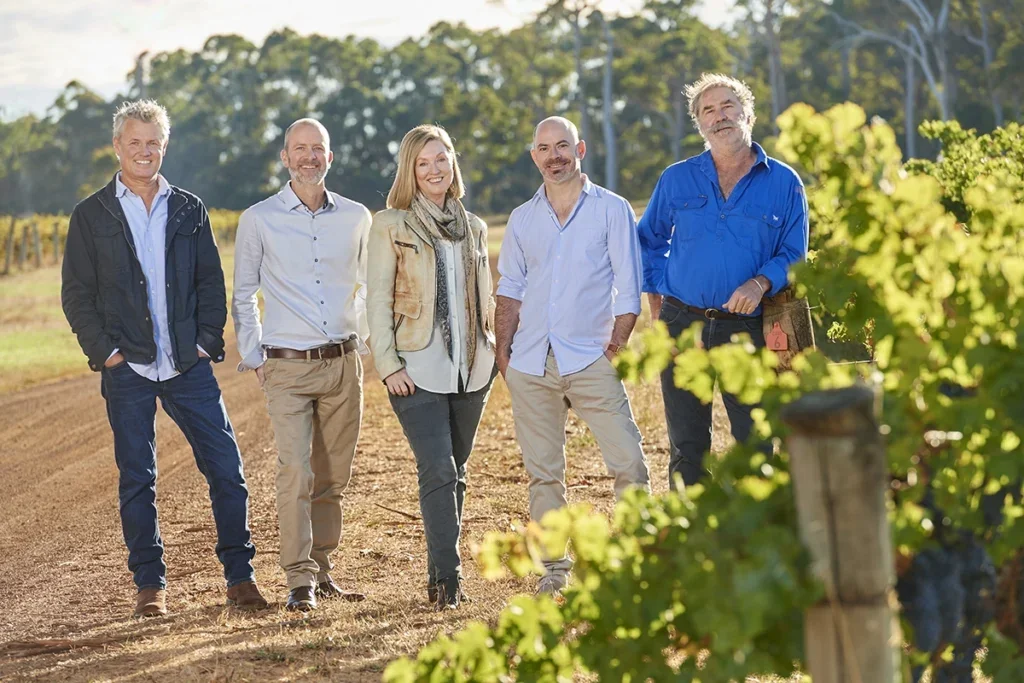
There might be no more famous Chardonnay in Australia than the Art Series Leeuwin Estate. Now one of Australia’s wine icons, it raised eyebrows when the first release, the 1980, hit the shelves. At the time, it was priced well in excess of any of its competitors and had also spent far more time in the cellar. Not only that, but the Horgan family had adopted the Château Mouton-Rothschild concept of selected art for the labels. Those eyebrows hit the roof when that wine was named as one of the very best Chardonnays in the world by a British wine publication.
The story of Robert Mondavi’s involvement in the establishment of Leeuwin Estate and his subsequent work with Denis Horgan has been told numerous times. It was Mondavi’s suggestion to the Horgans that they plant Chardonnay on their cattle farm in the southwest of the state, which at the time was one of the remotest places on the planet, or so it seemed. They established a nursery and in 1975 planted the famous Block 20. Block 22 followed in 1977 and Block 97 in 1997. These are the three parcels that are the focus of the Art Series Chardonnay. The soils are pre-Cambrian granitic gneiss bedrock, with free-draining gravel loam on clay subsoil. The team attends to each parcel of Chardonnay discreetly, as required. Simone Furlong, Denis’s daughter, notes that when they harvest, they are looking for “lime, pear, and nectarine.” She describes the winemaking: “Roughly 70% is processed adopting skin contact, 30% is whole-bunch-pressed. Free drain and light press to 100% new, mainly Bordelaise coopered oak for fermentation. No malolactic fermentation after primary, only extensive bâtonnage weekly to build texture and cohesion. Total time in barrel 11 months, before light fining to bottling.” The deft use of oak has always been crucial to the style. Simone continues, “100% new French oak fermentation and maturation has always been a hallmark of the Leeuwin Estate style. An enormous amount of focus goes into selecting the French oak we use on each parcel of fruit in our wines. We select barrels that are of super-tight grain for Chardonnay and of light to medium toasting, which really amplifies the shape and frame of both the nose and the palate. Each barrel provides its own footprint on the wine, whether that be structure, complexity, preservation of acidity, texture, and most importantly, preservation of fruit.” The wine has been under screwcap since 2004. They take great pride in the wine’s ability to age. A recent 2005 was one of the best wines I’ve seen in the past couple of years. The team has planted new vineyards with cuttings from its best vines, suggesting that the future is as exciting as the past. One of the reasons that the Gingin clone is so prolific in the Margaret River region is that the Horgan family’s generosity saw cuttings of their precious vines provided to many prospective operations.
Art Series Chardonnay 2022
This iconic Australian Chardonnay never allows standards to drop, and this is yet another stellar effort from the great Chardonnay production line. A shimmering pale lemon, with notes of spices, lemon curd, ginger, pink grapefruit, lemongrass, florals, peaches, nectarines, jasmine, and stone fruits. There is a whiff of smoky oak as well, and integration is proceeding well. There is complete balance here, with focus and energy. The wine is still very young, and it will certainly be better if you can wait for two or three years before opening—then enjoy it for a further 10–15 years. There is juicy acidity here, with a supple texture and a long and lingering finish, along which the intensity is maintained for the full journey. A cracker. | 97
Art Series Chardonnay 2021
It is fair to say that this Leeuwin Art Series Chardonnay will do its reputation no harm at all. For the vast majority of Australian wine lovers, this wine is always one of the very best Chardonnays made in the country. The old saying in the stock exchange is that the market is never wrong. Well, the wine market loves this wine, and it is not wrong. The only thing I would say is that it is perhaps a little more elegant, more gentle than usual, but I have no doubt that the magic of time will see it climb to its usual lofty heights and possibly the score will inch up a notch or two. The fermentation was by way of barrels—new French oak barriques—before 11 months’ maturation and then blending. A gleaming, pale green-gold. A nose of immense class here, the wine is seamless, focused, and with a seductive, creamy texture. There are notes of cashews, white peaches, figs, and a minerally backing, with a hint of limes. Evocative and expressive, ethereal and elegant. Juicy acidity, knife-edge balance and excellent length, with intensity maintained. An intricately crafted Chardonnay, quite stunning. Fifteen to 20 years. | 98
Art Series Margaret River Chardonnay 2020
Always one of our very greatest Chardonnays—grand cru all the way. Crafted in 100% top-notch new French oak, on release this was considered by many to be as good as any they had made. Hard to disagree. The wine is the palest yellow, with a nose immediately screaming complexity. Hazelnuts, stone fruits, florals, pears, matchsticks, and spices; there is a fine minerally backing here, supporting the wine and maintaining intensity for the full, very long journey. Integration of the oak is immaculate. Touches of the lime notes, typical in this wine, are evident, as is that moreish salinity on the conclusion. Great intensity, and yet such is the balance that it seems almost imperceptible. Power, layering, elegance, and extraordinary length. | 98
Art Series Margaret River Chardonnay 2019
Just a brilliant wine, world-class. An extraordinary blend of opulence, fresh energy, purity of flavor, intensity, and length. Stone-fruit, lemon-zest, oyster-shell, and almond notes. Hints of mandarin and peach and even a touch of ripe mango. The oak is integrated well and will become even more so over the coming years. The focus is laser-like. Glorious now but so much more ahead, with more complexity and tertiary flavors to emerge. Expect this to be thrilling wine lovers in a decade. This release, as they all are, will inevitably be compared with the finest from both Australia and Burgundy. Different from both, but it sits very comfortably among the best. Wonderful now but still has so much more to reveal. | 98
Art Series Margaret River Chardonnay 2018
This is the wine that took Australian Chardonnay from the dark ages of oak-embalmed curiosities or simple sunshine in the bottle, to wines of supreme quality, able to sit comfortably with the great Chardonnays of the world. And it continues its magic. It always improves even further with time in the cellar. Fermentation in French oak and then a further 11 months in barrel. This wine explodes with stone fruit, nectarines, grilled nuts, peaches, and a hint of vanillin oak, but it is well integrated and quite transparent. A note of honey emerges on the finish. The creamy, supple, seamless texture is a highlight and promises to become ever more thrilling in the coming years. It is already showing some early complexity, and the flick of acidity carries it through to the extremely long finish—a finish that never drops in intensity. This wine confidently walks the tightrope between elegance and sheer power, but at all times—as with everything to do with this wine—it is impeccably balanced. 2018 was yet another truly brilliant vintage for the region. This scintillating Chardonnay will improve in the coming years, so be in no hurry. | 98
Art Series Margaret River Chardonnay 2005
Anyone doubting the ability of top-notch Australian Chardonnay to age brilliantly need look no further. Granted, this was a superb vintage for the region, but this wine was something truly spellbinding. Barrel-fermentation in a range of new French oak from different coopers, and the wine was blended after 11 months. Straw in hue, this was wonderfully complex and still alive. Finely balanced, with exotic aromas of stone fruits, grilled cashews, mandarins, mangoes, tropical characters, and a hint of citrus. Beautifully layered; the oak has long disappeared into the wine, adding to the richness and the seamless nature of the structure. A seductively creamy texture; a line of fine acidity is still evident, and the most extraordinary length seemed never-ending. This is a truly amazing wine and one that surely has another decade ahead of it if well cellared. | 100
Vasse Felix
Another producer of stunning Margaret River Chardonnay; it really must sound like the proverbial broken record, but the wines that Virginia Willcock is making at Vasse Felix, particularly the flagship Heytesbury, are simply world-class. Virginia, who has just completed her 19th vintage at VF, describes part of her work as “accentuating the flinty funk, power, and tension of some very special vineyard plots. This winemaking approach continues to inform our house style.” She’s quick to identify advantages that Australia holds over France, such as not having the constraints of the appellation system, and notes that Australian winemakers can simply do whatever is best for the wine. She also suggests that some blocks love new oak, whereas others do not. While there is consistency among the blocks providing fruit for the very best wines, in some years they may not step up and can be put to one side for other wines.
This is another wine made largely from the ubiquitous Gingin clone, and Virginia talks of the “power and al dente tension—characters exclusive to only a handful of revered blocks in the Vasse Felix vineyards,” describing it as “a deep and layered, terroir-led Chardonnay.” She sees the use of Gingin in Margaret River as “serendipitous” and finds that this clone can preserve acidity through ripening better than any other clone with which she works. This becomes critical to the power of the wine. Fortunately, it is ideally suited to the maritime/Mediterranean environment. 100% wild fermentation, maturation in French oak, and then time on lees is a standard method of production, because it works. She describes the house style as having a “struck-match/flint/lamb-fat note.” Needless to say, the 2023 is something very special. Heytesbury is a combination of a number of plots, meticulously selected. In 2023, the final result was 70% from their Gnarawary Vineyard in Wallcliffe, and 30% from the Home Vineyard in Wilyabrup. The wine spent nine months in French oak barriques (52% new) and a further seven months “harmonizing” on lees in tank. Virginia identifies the excitement surrounding the 2023 vintage but also notes how ridiculously good 2018 was. She also thinks 2020 might come to be seen as a dark horse. For drinking at the moment, 2013 and 2014 are looking “mind-bogglingly good.”
Heytesbury Chardonnay 2023
Focusing on the region’s favorite clone, Gingin, the wine had nine months maturation in French oak barriques, 52% of them new. Gorgeous aromas here, with flint, mandarin, glacé orange rinds, lemon sponge cake, white peaches, and ginger. So much packed into a single glass. The balance is superb, the length impressive. This is a wine that dances, and it will surely continue to improve for at least the next 10–12 years. | 97
Cullen Wine
One of the most revered wineries anywhere in Australia, Cullen Wines has been at the top of its game for many years, producing some of the finest Chardonnay (and Cabernet Sauvignon), made in Margaret River. Vanya Cullen has held the reins for a long time now, taking over from her parents, who were some of the earliest pioneers in the region. The top Chardonnay is named for her father, Kevin John, who always believed that the Wilyabrup subregion could produce Chardonnay to challenge the best in the world. He has been proved right many times. So firm was Kevin’s belief that he established the International Chardonnay Tasting in 1986. It is still one of the world’s great events focusing on this grape.
Vanya has taken the estate down the biodynamic path, and it really does seem as though the wines get better year after year. She describes their winemaking process as follows: “We hand-harvest on fruit and flower days, guided by the moon. We sort them at the table, but prior to that we taste the grapes each day during harvest to see exactly when they’re ready. We do a little bit of whole-bunch amphora-fermentation, while the pressed juice is placed into a concrete egg and biodynamic ‘flower day’ barrels. Fermentation is natural, using indigenous yeasts and no additions—letting the land’s song sing loudly through the wine.”
The Chardonnay was planted in 1976, the Wente clone. (Others call it the Gingin clone, but it seems much work on exact identification remains to be done.) Vanya has described her biggest evolution as occurring in 1998, when both her mother, Diana Cullen, and Vanya felt that the change to organic viticulture was “the right direction for our vineyard.” Biodynamic certification followed in 2004. “As a result, our wines show enhanced expression of fruit, minerality, and integration of flavors. They have higher natural acidity and a pure expression of terroir.” For Vanya, “Chardonnay has personality. It can be fine and elegant, bold and lustful, refined and mysterious. It’s an exciting variety that tempts wine drinkers to continue exploring. Every region produces unique characteristics, and each winery has individual style and distinction. There really is a Chardonnay for everyone.”
Kevin John Chardonnay 2024
Always one of our greatest Chardonnays, not just a great Margaret River Chardonnay. Full biodynamics as always, Gingin clone from plantings made between 1976 and 1988, largely new oak. We are seeing this wine released in the new lightweight bottles—environmentally positive, though it does seem to rob the wine of some of its gravitas. Fortunately, it is what is in the bottle that counts. A straw/lemon hue, this is a very youthful Chardonnay, but it is elegance personified, with energy and focus and the signs of early complexity. There is a beautifully creamy texture here, with fine, citrusy acidity. The nose offers notes of peaches, florals, ginger, hints of nectarine, bergamot, and lemon curd. This is poised and taut, a wine of precision; long and lingering. There are notes of oatmeal on the palate. Leave it for a couple of years, and it will be very special. Then enjoy for a further 12–15 years. | 97
KJ Flower Day Legacy 2024
This really is a “drink on bended knee with head bowed” kind of wine. Harvested on a single day—a flower day in the biodynamic calendar—this is simply thrilling. A mere 600 bottles were made. Sure, it is not for everyday drinking, but it should be on every bucket list. The team used whole-bunch carbonic maceration in beeswax-lined amphorae. Maturation was for six months in new French oak puncheons. Deep yellow in color, this is Chardonnay with an entirely new level of intensity of flavor. We have notes of lemon curd, cashews, stone fruits, glacé orange rinds, honeycomb, fresh croissants, and citrus. A wine of immense complexity and great length, notwithstanding the enormous generosity of flavor; it is perhaps the textural aspects that are the highlight here. The wine has power, length, concentration, and balance. Extraordinary length, actually, and it should drink beautifully for the next 15–25 years. How many of us wouldn’t be just a little bit nervous putting away our white Burgundies for 25 years? We need have no such concerns here. | 98
Kevin John Chardonnay 2023
From the excellent 2023 vintage in Margaret River, the Kevin John Chardonnay is Cullen’s “standard” Chardonnay—and yet what a wine it is, never being less than thrilling these days. The fruit for this wine was harvested over a three-week period and then whole-bunch-pressed before fermentation in a mix of vessels—biodynamic puncheons, amphorae, and a concrete egg. Eight months’ maturation in the puncheons, 80% new. The wine is 100% Gingin clone. Balance, elegance, and complexity are the hallmarks here, even at this early stage. Great energy. The nose gives us notes of cashews and other nuts, along with peaches, stone fruit, a hint of river stones, and orange blossoms. Vanilla, florals, honeycomb, and a hint of crisp pear. The focus is superb, through to an impressively long finish. Expect this to drink magnificently for at least 15 years. | 98
Kevin John Moon Day Chardonnay 2022
There was a time when, if one wanted to talk about Australia’s greatest Chardonnays, it tended to be a debate between Giaconda and Leeuwin Estate—or more likely, how good they both were, any final decision coming down to personal preference. These days, Cullen has muscled into the argument, deservedly so, with vintage after vintage of world-class offerings. This is not just with its standard (though there is nothing “standard” about it) Kevin John, but with the amazing special releases from Vanya. Thrilling stuff. These wines sit not just with the very best from this country but with the best from anywhere, including Burgundy. After my tasting, there was no way these wines were going down the sink, so I took them to a lunch with friends, where they were up against a Montrachet from a famous name. It was no contest. The trio soared, while the Montrachet slunk off with its tail between its legs. That won’t always happen, of course (the Montrachet was off its game), but it does show that these wines sit comfortably with the best. Harvested on a full-moon day, the bunches went into amphorae for three days, before pressing to a flower-day puncheon, for fermentation and four months’ maturation. The thoughts that come to mind here include elegance, balance, a seamless nature with great length, impressive concentration, and the quality of etherealness. This is a wine with such intensity, with a layered palate. Citrus notes here are to the fore, with orange rinds and glacé lemons. A fine line of grapefruity acidity. Florals and pears, with mandarins on the finish. Wonderful stuff. A brilliant Chardonnay, this has the structure to last 15–20 years, if you can hold on that long. | 98
Kevin John Flower Day Chardonnay 2022
The other special-release Chardonnay from the 2022 vintage was picked on Valantine’s Day, which happened to be a full-flower day (which seems appropriate). Whole bunches went into clay amphorae, lined with beeswax. Pressed after two days on skins, the juice was then transferred to a flower-day puncheon (meaning the puncheon was coopered on a flower day) for a stint of four months’ maturation after fermentation. This is punchy, focused, and concentrated. There are notes of lemons, nuts, figs, peaches, touches of honeysuckle, and an array of stone fruit. There is a fine line of saline acidity. Impeccably balanced and with seriously good length, this is so exciting now, but it has 10–15 years ahead if well cellared. | 97
KJ Flower Day Legacy 2021
A superbly complex wine. There is still a hint of oak to integrate, but it is the balance and the intensity for the full journey that impress. Seductive texture; there are notes of peaches, lemon curd, spices, white jasmine, stone fruits, and hints of oatmeal, with a flick of citrus and grapefruit. Ever so finally balanced. It is early days for this wine, but it will prove to be very special. | 97
Kevin John Chardonnay 2019
Just where one ranks Kevin John Chardonnay among Australia’s best will come down to personal preference, but it would surely make the top few, every vintage. This is a Margaret River gem. Conditions in 2019 meant that this is the smallest volume since 1997, largely due to frost. Birds were a problem for those without nets (fortunately not Cullen). Only 3,972 bottles made. Harvesting occurred February 12–28; one picking was on a “Moon opposite Saturn flower day” and the rest on fruit days. This is all part of the biodynamic calendar, taken extremely seriously at Cullen Wines. This will be something either fully understood or perhaps raise eyebrows. If the latter, I’d suggest looking at the results. Clearly, whatever they are doing works. Bunches were hand-harvested, then whole-bunch-pressed and the juice racked to barrel. The fruit, which was harvested on the “Moon opposite Saturn day,” was fermented in amphorae before aging in puncheons. 100% natural malolactic fermentation and a total of eight months in French oak, 30% new. Opens with stone-fruit notes, hints of pear, oatmeal, lime, and peaches. Alluringly fragrant. A complex, finely crafted Chardonnay and one that will certainly do nothing but add to the illustrious lineage of the KJ Chardonnay. The oak is extremely well integrated. This is intense and yet so light on its feet. Gloriously supple texture and offering a fine flick of acidity. Peach notes, fig, quince, apricot kernel, and more on the palate. Finely balanced. A beautiful, complex Margaret River Chardonnay that just soars. Ten to 15 years ahead. An absolute cracker. | 97
Xanadu
Glenn Goodall, who has been guiding Xanadu for a quarter of a century, produces two flagship Chardonnays: the Reserve and Stevens Road. Both are single-vineyard wines. Boodjidup, in the Wallcliffe subregion, is not a district often spoken about, but Glenn notes that it “is home to a disproportionate amount of great sites (from other producers also).” For Glenn, the winemaking follows the standard path we see with most top producers. He describes it as “pretty simple: hand-picked, whole-
bunch-pressed, wild ferment; hopefully the expression of the Gingin clone, and the different sites, is what shines through the most in the wines.”

For the Reserve Chardonnay, the fruit comes from the original Lagan Estate block planted in 1981. It is a 3ha (7.5-acre) vineyard located next to the winery on Boodjidup Road. Despite the Chardonnay being planted back in 1981, the team did not release a Reserve until 2008. (Stevens Road followed the next year.) Glenn describes the wine as “a modern Australian style. Generous in flavor, with tight acidity, fine and focused. Probably at the racier (acidity) end of the spectrum, but essentially it is the fingerprint of the Gingin clone and the vineyards that are driving the wine […] hopefully offering ‘substance over style’ with purity of fruit rather than funky, oaky wines.” He sees the Reserve as having become tighter over the years. Originally using around 40% new oak, that has been throttled right back in recent years to around half that. The wines have never looked better. The final question for Glenn was simple: Why Chardonnay? The answer was just as uncomplicated. “Greatest white variety on the planet!” He sees the future as very bright, believing that the “diversity that celebrates exceptional sites in exceptional regions will future-proof the success of top-end Australian Chardonnays.”
Stevens Road Chardonnay 2022
An intriguing and appealing nose here, with notes of figs, ginger, apricot kernels, spices, lemongrass, slight hints of toasty oak, well integrated, and a minerally backing. A line of grapefruity and saline acidity runs the length. Very impressive balance and a lengthy finish; this is still very young and needs more time. Ten years should not trouble it. | 94
Reserve Chardonnay 2022
Pale lemon in color, with flecks of green, this is powerful but still very youthful and needs all the time you can give it. There is tight oak, which is in the process of integration. The nose reveals notes of stone fruit, peaches, and mandarins, with a line of grapefruit in support. Juicy, citrusy acidity and a seamless texture; this is seriously impressive and promises so much. Twelve to 15 years will ensure that you have something very special in the cellar. | 96
Moss Wood
Another of the region’s pioneers… There was a time some years ago when I wondered if we were seeing a little too much variation in the Moss Wood Chardonnays. At their best, as good as one could wish, but there seemed to be a few vintages where they dipped, for want of a kinder way of putting it. Whether that was my imagination or not, it certainly has not been an issue for many years. These are stellar Chardonnays and wines I very much look forward to seeing every year.
The estate was established by Bill Pannell in 1969, and the Mugford family has had an involvement since the late ’70s, including purchasing the place. Chardonnay was first planted in 1976, with the first vintage being 1983. The top Moss Wood wine still comes from that single-vineyard site. Winemaking begins with hand-picking and hand-sorting, before clarification by flotation. Fermentation begins in stainless steel and is completed in barrel. The wine then spends a year and a half in French oak, 50% of the barrels new. The team has used five different Burgundian cooperages for many years. The Gingin clone accounts for 86% of the wine, with the remaining 14% a mix of Dijon clones. The track record of these wines confirms just how well they can age and how complex they can become during the journey.
Chardonnay 2023
Amazing to think that Moss Wood’s oldest Chardonnay vines are now 48 years of age. Fermentation for this cracking Chardonnay was finished in 228-liter French oak barriques. The wine was then blended in tank and returned to barrel, 49% new, for the next year and a half. The color here is a deep but attractive lemon gold. A superb Margaret River Chardonnay. Complexity is already evident, as are notes of stone fruits, cashews, oatmeal, ginger, lemongrass, peaches, and immaculate oak handling. The supple, creamy, cushiony texture is an absolute highlight. A wine of fine balance and serious length, this has at least a decade ahead of it. A stunner. | 96
Chardonnay 2022
A vintage of contrasts but certainly yet another of the seemingly endless procession of superb years in Margaret River. The juice was clarified in stainless steel, seeded with an array of yeasts for a controlled ferment. Racking to oak, 228-liter French oak, 54% of which was new. Full malo, blending of all components, and then back to oak for 16 months. Margaret River Chardonnay has firmly established itself as one of the great styles of Australian wines, and this is simply yet more evidence. Pale yellow-gold hue, while the nose offers florals, figs, citrus, a hint of pear, and a touch of honey. Peaches and an early note of nougat. There is quality oak, giving the character of grilled cashews, but the integration proceeds apace. It seems to me that this vintage of the Moss Wood Chardonnay is a little more elegant than is usual. A really impressive, refined wine, exhibiting early complexity. There is a fine line of acidity, with excellent length. Balance and an appealing texture. There is room to improve further over the next six to eight years. | 94
Chardonnay 2021
If one may begin with the bottom line, I think that this is the very best Moss Wood Chardonnay I have seen for a very long time, and it sits with the finest the region can offer. Perhaps the cooler vintage suited the style a little more. The future will reveal if that is so. The fruit was whole-bunch-pressed, settled, and seeded with a variety of yeasts for fermentation that sees the juice transferred to French oak barrels, half new, at the halfway mark. Maturation then continues for over a year. Straw yellow, it is immediately apparent that this is one of the more complex Chardonnays you’ll find. Wonderful stuff. The nose exhibits cashews, mandarins, white peaches, and stone fruit, through to a fabulous palate, immaculately balanced and with unrelenting intensity. There is oak, but it has melded so well that you hardly notice it. Supple, creamy, and a finish that seems to linger forever. Hints of lime marmalade. An absolutely brilliant Marg River Chardy. Stunning. And it should live for many years. | 98
Chardonnay 2020
This is an exciting Chardy from Moss Wood. (Aren’t they all?) Scintillating color, the greens mixing with a pale sunrise. Notes of limes and lemons, some ginger. Good oak integration adds to the complexity. A ripe style, with rock melon, herbs, and nuts. It really needs another three to five years, though it is attractive now, with a lingering finish. Give it time—it will reward you. | 94
Chardonnay 2008
A glorious mature Margaret River Chardonnay, this is deep gold in color, offering obvious depth and maturity. The nose exhibits notes of hazelnuts, stewed peaches, honeysuckle, and gunflint. Fully developed and utterly delicious; there is power and intensity, and yet we still have refinement. Immeasurably long, this is finely balanced throughout. Still fully alive, but there seems no legitimate reason not to enjoy it now. | 98


