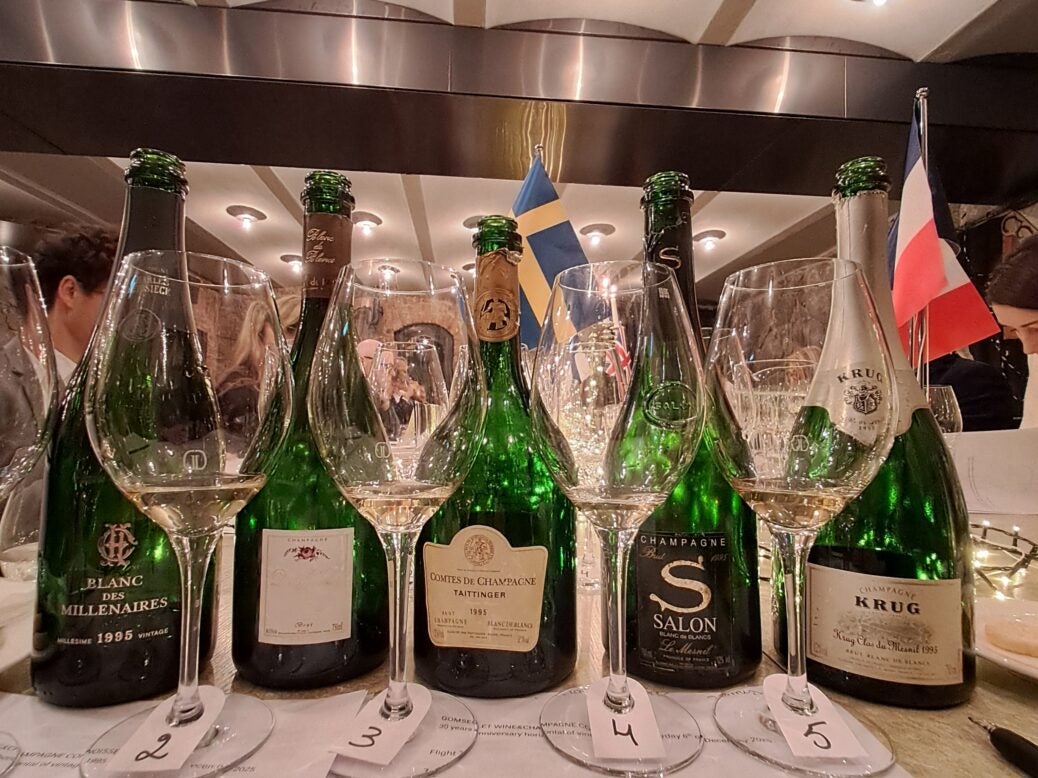
Simon Field MW takes a chance to reappraise 1995 Vintage Champagne, which may be even finer than its much-lauded successor.
Stockholm in early December is gearing up for the annual Nobel Prize Ceremony, to be held in the presence of the king of Sweden on the anniversary of the death of Alfred Nobel, also known as the man who invented dynamite. My annual presence has less to do with vainglorious expectations of winning one of the five prizes and more to do with legendary Champagne tastings hosted by the indefatigable Marina Olsson. Marina’s compatriot, the near-reclusive Alfred Nobel, had, it turns out, a preference for claret but did nothing to stop Mumm de Cramant being served at the second awards ceremony in 1902, then Roederer, then Pommery, and so on. A good start.
Even by Marina’s extravagant standards, this is to be rather a special tasting—a comprehensive assessment of the 1995 vintage, 30 years on. There are plenty of subtexts here, among them an assessment of the extended aging potential of fine Champagne, the analysis of which styles have fared better over the longer term, and, perhaps most intriguingly, judgment of how the 1995s now compare with the 1996s, the latter tasted by Marina’s Gomseglet Connoisseurs group in 2021. To help in this onerous task, Marina is joined by journalists, by dedicated collectors, and by friends from Champagne itself, including Gilles de la Bassetière, the CEO of de Venoge; François Philipponnat, representing the eighth generation of his eponymous house; and Gaëlle Goossens, enologist at Veuve Clicquot. There has been, intriguingly, an unspoken chasm over the years between the producers, who favored the 1995 vintage from the outset, and the critics, who shrouded 1996 in praise and glory, a lot of it at the expense of the more prosaic 1995. This tasting, by way of a teasing subplot, set itself the mission of finding out who was correct.
1995 followed a sequence of four thoroughly mediocre vintages, its early comparisons with the sunny 1990 later refined to reflect the greater elegance and precision of the latter. The Champagne market, however, was still in the doldrums, four years after the first Gulf War, and President Mitterrand had set interest rates at a high level. What’s more, the area under vine in Champagne had been increased to more than 30,000ha (74,000 acres; today it is 34,000ha [84,000 acres]), meaning more to sell, but the qualitative regulations had been tightened over things such as the use of the taille, meaning more expensive winemaking… So, it was a year not without challenges, commercially speaking.
Related

The vintage itself yielded relatively highly, despite frost issues after budbreak and a rainy start to the summer, which provoked mildew and potentially jeopardized the fruit-set. Warm and dry weather ensued, temperatures above 99°F (37°C) in late July exceptional but sufficiently moderated thereafter to ensure that the harvest itself—which did not start until September 18 and was not completed until the second week of October, relatively late by modern standards—happily concluded under clear, often blue skies. An average yield of 13,100kg/ha was appreciably more than the maximum permitted (11,400kg/ha), and a number of grapes had to be discarded. Those remaining were said to have acid levels similar to 1985, a good point of reference, and sugar not dissimilar to 1990. Neither approximated the 10/10 “panacea” (10 degrees of potential alcohol and 10g/l of acidity) that provoked so much excitement in 1996. Balanced but not intense, therefore, with less of the “bombastic fruit” (to borrow Marina’s term) to be found in 1990 and cleaner, more precise flavors evidenced from the early vin clair tastings. A discreetly satisfying vintage, allowed to mature with grace and dignity, while 1996 excited the scribes with tales of premox (premature oxidation, also prevalent in Burgundy in 1996) and how it may be related both to the nascent taste for reductive winemaking and almost preternaturally high levels of malic acidity. So there is plenty to write about 1996, in other words, and plenty of interest from collectors and investors alike, many of whom all but ignored 1995, for all the ongoing admiration from the growers themselves.
Surely the voice of the critic, as Richard Brinsley Sheridan reminded us, is not more important than that of the artist himself? Surely not… Indeed not. For this was a fabulous tasting, and it fully vindicated the ongoing support from the growers and the early presentiment that the golden mean is always preferable to the sound and fury of broken analytical records. “I found this tasting more than gratifying—indeed, I am euphoric,” enthused Gilles de la Bassetière, recommending a head to head with 1996, Marina’s previous 1996 review having taken place four years earlier. A head to head, he advises, will settle the matter once and for all! Maybe include a few 1928s, he adds to Marina, smiling; now she really does have her work cut out for her.
Why the euphoria? Primarily because the tasting clearly demonstrated prestige Champagne’s eligibility to be described as a serious vin de garde, three decades down the track. Marina, ever the realist, reminds us that there were more issues with TCA and light strike at the time (both of which we encounter during the tasting) but agrees that, in general, the quality of the wines is exceptionally high and that the relatively low acidity (anything appears low next to 1996) has not jeopardized aging potential. Equally poignant are discussions on the approaches to factors such as malolactic fermentation, wood maturation, “jetting” during disgorgement, and dosage, the last of these especially relevant because the majority of the wines tasted were from the original disgorgements that took place more than 20 years ago. The vinification extant at the time has not been found wanting, and it may well be that subsequent changes have been more reactive than anything else, with climate change pushing the agenda. In 1995, sustainability was less of an issue, with organic viticulture scarcely practiced in the region. Husbandry and hygiene followed a less rigorous template, and sulfur was frequently overused. Many potential problems, in other words, but very few of them had any demonstrably negative impact on this excellent tasting. We were all fascinated.
Content from our partners
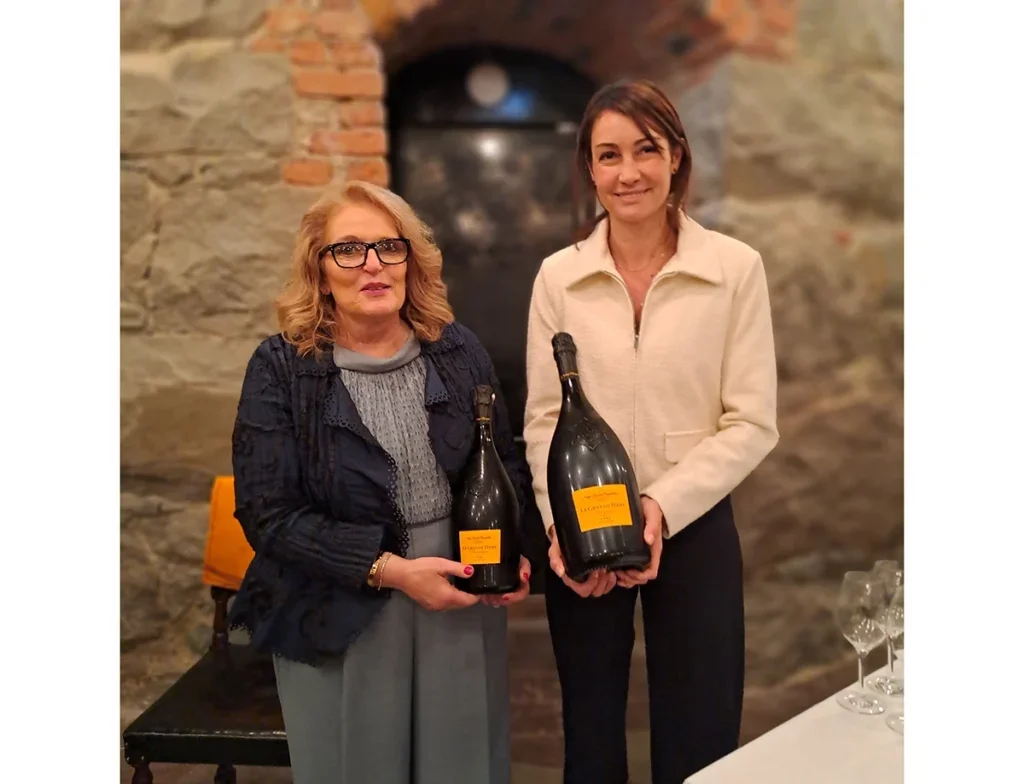
The vintage is “delicious and voluptuous,” says M Giraud; many 1996s, however, “have tended to oxidize quickly and are now tired and unbalanced,” is the view of M Philipponnat. Marina, for her part, is far from disillusioned, singling out the little-known Diebolt Fleur de Passion for special praise, alongside more usual suspects, Krug Clos du Mesnil and La Grande Dame, the latter served by Gaëlle with some ceremony from both magnum and Jéroboam. Flight 6, the blancs de blancs, was probably the best of all (Salon, Charles Millénaires, and Comtes were all outstanding), but it was a close run affair, with flight 4, Pinot Noir-dominant, showing off magisterial wines from Dom Pérignon (two of them) and Bollinger RD, inter alia.
This was a seminal tasting, uplifting for producers, collectors, and critics alike. Champagne as a wine to collect for the medium to long term is clearly a safe and maybe undervalued option, qualitatively speaking. The 1995s are drinking magnificently, and their “rivalry” with the 1996s is at least equally interesting as that of other significant recent historical pairings—1988 v 1989, say; or 2002 v 2008. Maybe next December in Stockholm would be a good moment for a head to head/rematch between 1995 and 1996. It would be sure to be an explosive tasting. Dynamite, even.
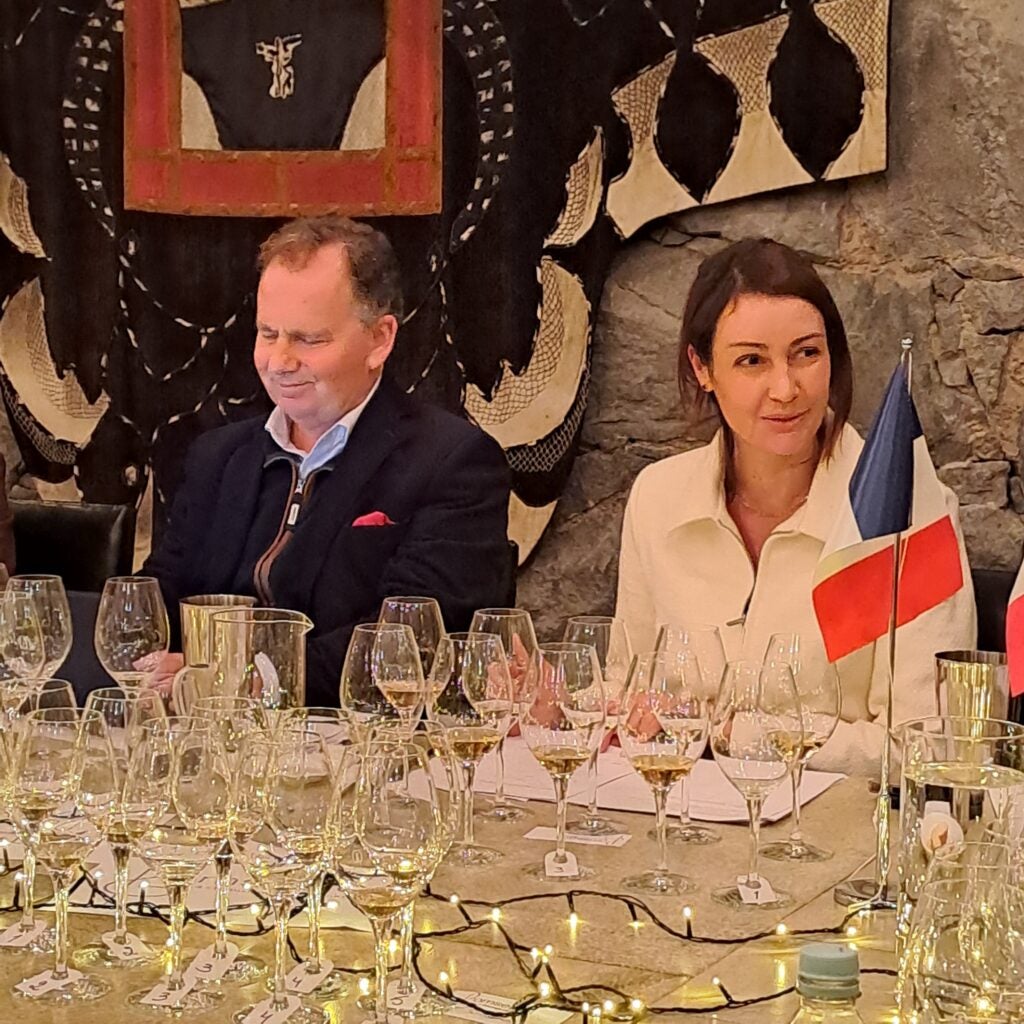
Tasting 1995 Vintage Champagne
Stockholm; December 6, 2025. All wines were the original disgorgement unless specified. Most wines were purchased ex-cellar in 2025; others (specified) were bought on release and stored by Marina. Little information was forthcoming on disgorgement dates or dosage levels.
Flight 1: Vinothèque from Maison (2025)
Moët & Chandon Grand Vintage Collection 1995 (magnum; 50% PN, 40% C, 10% PM)
Deep but lustrous gold, with a flinty aromatic betraying a nascent tilt toward reductive winemaking. Rich, almost explosive on the palate—gunpowder, then! A backdrop of guava and plum; firm cleansing acidity and a strong finish. | 93
Palmer & Co Collection Blanc de Blancs 1995 Late Disgorged (magnum; 100% C)
Bright almost luminous, careless of the passage of time. Uplifting, with late-disgorged precision. The aromatics confirm the mood, their pointillist detail, weight of vestigial Chardonnay fruit and savory backdrop all worthy of a toasty, late-disgorged style on a plateau of excellence. | 93
Lanson Collection 1995 (bottle and magnum; 53% PN, 47% C)
The same wine but in different formats and, crucially, different disgorgement dates: June 2014 for the bottle and March 2023 for the magnum. Both disappoint a little, the more so as one has so often appreciated the famous Lanson non-malo imprint with age. There is a touch of TCA on the magnum maybe, closing it down and throwing the structure out of balance. The bottle has attractive biscuit notes at the front of the palate; thereafter hints of syrup and candied apple, with the dosage, unusually, standing out, and the balustrade of acidity appreciably angular. Magnum | 89 Bottle | 91
Pommery Grand Cru Royal 1995 (50% PN, 50% C)
Welsh gold, with flecks of green and an impressive mousse after all these years. An attractive nose recalls greengage and quince, the calm of a sun-dappled autumnal orchard. Just a hint of mushroom and incense behind it. The Pinot Noir appears more persuasive on the palate, with savory elements, hints of woodsmoke, dried fruit, and a comforting textural balm. A strong, allusive finish. | 94
Flight 2: Marina’s Cellar
Veuve Clicquot La Grande Dame 1995 (65% PN, 35% C)
The first of a trio of the Grande Dame (a quartet, indeed, because the tasters enjoy another bottling as an apéritif). Deep flaxen color, a weave of still lively bubbles, then a beguiling nose of sourdough, hazelnut, and white tobacco. The palate is marked by a rich, vinous depth, toasty glycerol, and a firm, authoritative finish. The Grande Dame is most definitely not for turning. | 94
Krug Vintage 1995 (48% PN, 35% C, 17% PM)
Dense and matted, from the sandy sheen, through to its almost-resinous coat of mature vanillin and white tobacco. Layers of orchestration, the initial lurch to coconut and cream forestalled by an indulgent swell of flavor and a buoyant seam of acidity. Generous and powerful. Although this is not the greatest Krug ’95 I have tasted (I have tasted it only three times, to be fair), it was easily identifiable in the flight: sui generis, uncompromising, satisfying. | 95
Bollinger Grande Année 1995 (63% PN, 37% C)
It is interesting to compare the Bollinger with the Krug—both oaky, magisterial, and immense of structure—with the Krug often “winning” the day for its sheer complexity. Not so today; this Grande Année is bright if deeply pigmented, refreshing if clearly bulwarked by sturdy oak. A savory sweetness completes the web of contradiction and marks it out from its more linear, possibly more cerebral outing in 1996. | 96
Billecart-Salmon Cuvée Nicolas-François Billecart 1995 (60% PN, 40% C)
Macaroon color, with a gentle, disciplined bead and aromatics of sun-drenched autumn straw, figs, and mirabelle plum. The wine has a vinous, gastronomic texture, the acidity discreetly supportive, the secondary notes now ceding to hazelnut, linseed, and a touch of demerara sugar. Accomplished, quietly assertive, and ultimately very satisfying. | 94
Pol Roger Cuvée Sir Winston Churchill 1995 (approximately 60% PN, 40% C)
Alas, a slightly tarnished example: TCA rather than oxidation, though the latter was perhaps evident, too. We have never been told the precise blend of Sir Winston, but we can be sure that Pinot is king, lending power and a firm, gastronomic mouthfeel. The phenolic structure is persuasive, and one can discern what might have been, what could have been. A pity, but it still merits an honorable score. | 91
Flight 3: Vinothèque from Maison (2025)
Perrier-Jouët Belle Epoque 1995 (50% PN, 45% C, 5% PM)
Gold, going on pewter; dreamy Turner seascape. The mousse is lively, however, with plenty of spume forward and aft. Orchard-fruit aromatics, something resembling chamois, pale tobacco perhaps, quince. Fully mature, slightly earthy. Sturdy of hull, with resolute purpose. | 91
Pommery Cuvée Louise 1995 (60% C, 40% PN)
Louise sometimes comes out into society with breathtaking self-confidence—almost too much aplomb. Sometimes, usually in better vintages, she thereafter retreats into a period of introspection, emerging refreshed and with more focus. This appears to have been the case here. Generous, almost tropical fruits vie for attention with tense rejoinders from lime juice and lemongrass; an intriguing and almost completely successful juxtaposition, which just tails off a little too quickly. | 92
GH Mumm Crémant de Cramant Blanc de Blancs 1995 (100% C)
Soft gold color, with a gently billowing mousse and pleasant aromas of butterscotch and roasted hazelnut, lemon posset, and almond oil. The palate is characteristically generous, with hazelnut and melted butter, ripe nectarine and mirabelle plum all evidenced, all happy to entwine a state of languid maturity. The crémant pressure and texture are well suited to 1995, striking a hedonistic line before indulgence fades to overindulgence, before vestigial tension is sacrificed in the name of amorphous decline. | 93
Deutz Amour de Deutz Blanc de Blancs 1995 (100% C)
Several tasters were anxious that the clear glass may have dulled the message over the years, but to this taster the wine was anything but dull. Lively, in other words, of color and aroma, and with plenty of zest chasing down the palate, itself complex, lifted, and richly embroidered. Macadamia and fig, tobacco and iodine, a seam of yellow fruit and Chardonnay composure. Light strike is an ongoing issue, for sure, but clearly it does not have to be. | 95
Flight 4: Vinothèque from Maison (2025)
Philipponnat Clos des Goisses 1995 Late Disgorged (60% PN, 40% C)
Ivory, fulgent; a restrained but persistent bead. Then an aromatic dominated by sherbet, honey, and nutmeg—a pleasant whiff of unabashed maturity, in other words. Goisses power then takes over, umami and gingerbread, persistent and powerful. A finely sculpted finish, too. | 94
Dom Pérignon 1995 (60% PN, 40% C)
Buckwheat, shimmering at dawn; a modest bead and aromas of truffle oil, hemp, and bergamot. Behind that, slate and flintlock—a clue to the reductive approach to the winemaking all those years ago. The palate is firm, near monolithic, sturdy and honeyed, with hints of umami and mushroom. Savory, complex, and assertive from start to finish. | 95
Dom Pérignon 1995 P2 (60% PN, 40% C)
Brighter than its sibling, almost nacreous, cherubic Boucher clouds, the white horses crashing against the chalk cliffs. The nose is flinty: iodine, gunpowder, and tobacco leaf. The palate is broad and confident, with dried fruit, truffle oil, and digestive biscuit, candied peel and crystallized pith. Firm acidity and an uplifting sense of purpose and drive, reductive winemaking once again proving its long-term worth, reductio ad perfectum. Nietzsche inverted. This ’95 is worthy of 96 points; how will the ’96 fare by comparison, one wonders? | 96
Bollinger RD 1995 (63% PN, 37% C)
The comparison between Bollinger RD and Dom Pérignon P2 is an instructive one, seldom enunciated but in itself a good test of differing winemaking and its impact three decades on. The Bollinger is broader, more obviously “aged,” with appreciable vanillin and spice layering a rich (richer?) texture, with what my preliminary note describes as “old school” dignity. Hazelnuts, almonds, and tobacco pouch, with caramel and beeswax to the fore. An elder statesman, influential in the House of Lords maybe but less urgent and challenging than the P2. No bad thing, maybe; an Old Master, thickly layered on wood. | 95
De Venoge Cuvée Louis XV 1995 LD (50% PN, 50% C; disgorged 2024)
Another late-disgorged example, this one with a little more Chardonnay, which shares the blend equally with Pinot Noir. In this, our most successful flight, the Louis XV was far from daunted; on the contrary, its pithy freshness and intriguing aromatic of lavender and patisserie introduced, with enchantment, a wine full of energy and zest, surprisingly taut at first, but then opening generously. A magnificent tapestry of mature flavor: nuts, herbs, spice, and even hints of exotic fruit (mandarin and guava maybe), then acacia and a sprig of jasmine. A terrific wine. Louis XV sometimes gets overlooked in all the excitement about Louis XIV and the Grand Siècle, but his reign was as significant as it was long, as consequential (if you will forgive the neologism) as it was influential. | 96
Flight 5: Vinothèque from Maison (2025)
Deutz Cuvée William Deutz 1995 (55% PN, 35% C, 10% PM)
Lively green gold. Generous, almost sappy nose, careless of the passing of time. A pulse of energy reverberates, underwriting a textural weave that is dominated by mandarin, lemon oil, and smoky chalk. Deutz elegance writ large but not missing a beat in terms of the celebration of longevity and the gaining of wisdom. | 94
Bruno Paillard Nec Plus Ultra 1995 (50% PN, 50% C)
Sturdy, vinous, and gastronomic, for sure—maybe even a little foursquare. There is richness here, however: chalky intent, now splattered with linseed and oaky tree-rings. The acidity is buried, teasingly, beneath an assertive structure that longs for crustacean accompaniment. | 93
Boizel Joyau de France 1995 (55% PN, 45% C)
Soft gold, paler than some of its peers. A nose of pressed flowers and van Gogh hay. Warm and cold at the same time; late-season apples and cashew, something a little leafy (just the faintest hint of TCA was the consensus) and therefore subdued beyond the initial promise of sour honey, acacia, and gingerbread. No second bottle of this one was available, alas, but one dares to suggest a score. | 92
Pol Roger Cuvée Sir Winston Churchill 1995 (approximately 60% PN, 40% C)
Two wines to finish, both of which have featured elsewhere in this tasting, in the case of SWC, with one wine (Flight 2) bought on release and stored domestically and this example from Vinothèque stock bought by Marina from the maison in 2025. In this instance, there was little competition: This, the wine stored in Epernay, won hands down, a symphony of Pinot power and Pol elegance. Savory and rich, for sure, yet with lift and an almost ethereal finish. Another very confident showing from the “traditional“ camp in general and from Sir Winston in particular, this memorably featured in Marina’s previous coverage of the entire Sir Winston canon, which I was privileged to attend (WFW 84, 2024). | 96
De Venoge Cuvée Louis XV 1995 (50% PN, 50% C)
The comparison between the two Louis XV wines is even more interesting. This is the original disgorgement, whereas the wine from Flight 4 was late-disgorged (2024). In this instance, the victory goes to the late-disgorged example; both are excellent, with their floral complexity neatly braided to an intriguing body politic, but the recent disgorgement has a winning crystallized, citric freshness that adds an extra dimension of complexity and pleasure. It may well be, of course—as is often the way with late-disgorged examples—that the bottle that dazzles so much at the tasting actually matures more quickly and fades before its sibling. But today it is singing. | 93
Flight 6: Côte des Blancs from Marina’s Cellar
Charles Heidsieck Blanc des Millénaires 1995 (100% C)
Refined color, almost canvas, with a calm luminosity. Sourdough then spices, then the warming of the dough, then the opening of the doors to the patisserie—a gradual escalation of excellence. Typical Carolingian majesty; generosity, too. There was once exotic fruit, now truffle oil, mushroom, and hints of baking spice. Most important, a sense of completeness, which gives complete satisfaction. Well named. | 96
Diebolt-Vallois Fleur de Passion 1995 (100% C)
Anomalous, maybe, in such company, but holding its own. Indeed, I seem to recall that it was Marina’s top-scoring wine. Praise indeed. I enjoyed its cerebral challenges; it appeared to have a generous dosage yet to be drying a little at the same time—the legacy of 100% barrel-fermentation, perhaps. There was a seductive briny, dried-flower character, too, but no lack of gentle vanillin and a billowing creamy cushion of support. All very intriguing. | 93
Taittinger Comtes de Champagne 1995 (100% C)
Lustrous pale gold; an impressive mousse and persistent bead. Late-summer flowers dominate the nose, a view of The Hay Wain, composed and gently persuasive. Vestiges of tropical fruit, garlanded by spice; a chalk-mineral foundation stone, the balustrade ornate, the finishing touch compelling in its definitive precision. Elegant above all else, as we have come to expect. | 94
Salon Cuvée S 1995 (100% C)
On the subject of elegance, here is an object lesson. A floral weave beyond the soft precision of the mousse, careless of the rigors of the decades. Great Chardonnay from the south of the Côte des Blancs can play tricks, its initial austerity gradually assuming a disciplined richness, nutty, honeyed, spicy, allusive. The faintest hint of amertume noble on the finish, the overall impression of a phoenix spreading its wings, rising if not from the ashes then from an enigmatic and restrained gestation. A joy to behold. | 96
Krug Clos du Mesnil 1995 (100% C)
A triumphant flight of blancs de blancs is crowned by the Clos du Mesnil, a paean to the virtues of complicated simplicity, its single-vineyard focus transparent through the rigors of an oaky upbringing and the challenges of three decades of aging. Unlike the Salon, the Clos du Mesnil appears to shed layers of texture, by design, in a spine-tingling ballet of rediscovery of its essence, the essence of an unassuming 2ha (5-acre) plot of Chardonnay behind the church in Le Mesnil-sur-Oger. A fascinating comparison, albeit not at the same time in my case, with 1996. Both scored the same, but which will fare better in a head to head? I need to have a word with Marina! | 98
Flight 7: Grand Finale
Veuve Clicquot La Grande Dame 1995 Vinoteque (magnum and Jéroboam)
Gaëlle advises that the magnum has been stored under crown cap, the Jéroboam under cork; the latter filled by transvasage, the former aged naturally. She also reminds us how the blend has changed over the years: These days, it is closer to 90% Pinot Noir. She also reveals that the sourcing of the Pinot Noir has shifted, largely as a result of climate change, now favoring the cooler northern villages of Verzy and Verzenay but at the time dominated by contributions from Aÿ and Ambonnay. Equally interesting is the revelation of an increased avoidance of malolactic fermentation, which would certainly have been undertaken in 1995. Add to this the decrease in dosage, and one has an illustrative primer of how things have changed over the past three decades: everything, except a fundamental quality, maybe. Both are excellent, and if the group overall preferred the fresher, more restrained Jéroboam, I was immediately seduced by the rich and savory character of the magnum; a feast of umami, cèpe, spice, and glycerol; richly textured but neither cloying nor oxidized. The quintessence of the Grande Dame, gourmand and yet chiseled, generous and disciplined by a distinctly woven thread of freshness. Magnum | 97 Jéroboam | 96