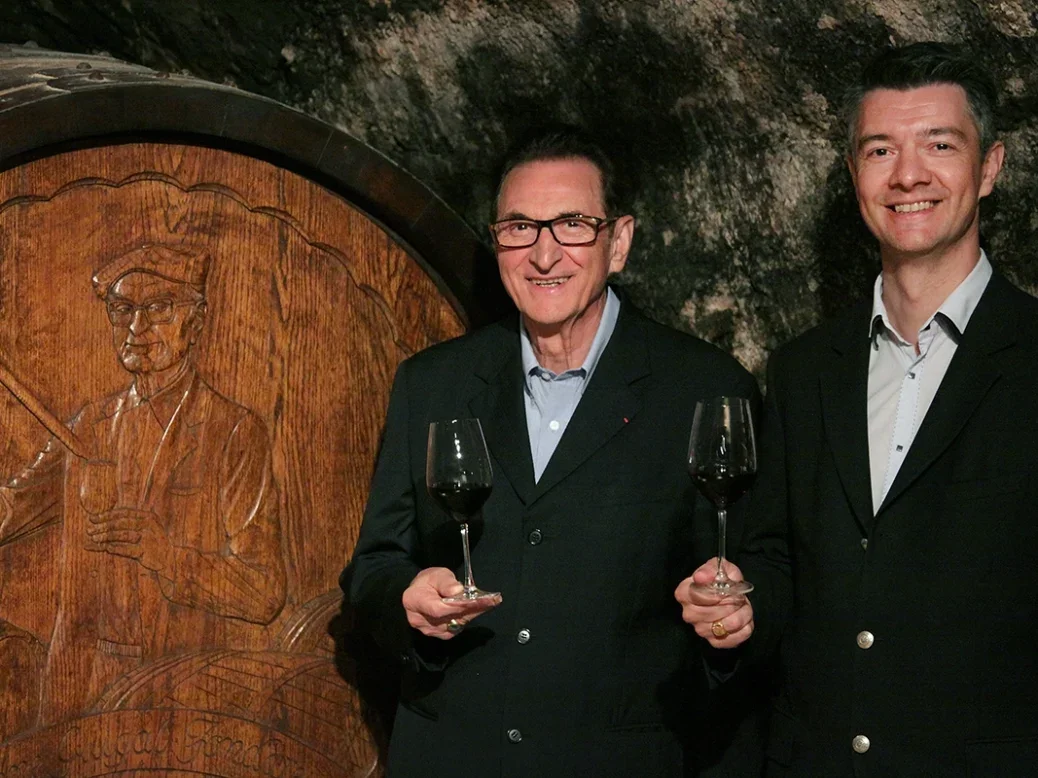
Having suceeded a father (Marcel) and a grandfather (Étienne) who are both among the most significant figures in the modern history of the Rhône Valley, Philippe Guigal has made his own name by overseeing a process of gentle evolution during his time at the head of the family estate, says Margaret Rand.
Do you have any brothers or sisters, Philippe?”
“No, I killed them all.”
You know quite quickly that interviewing Philippe Guigal is going to be fun.
Related


Guigal is the single child of a single child, who has broken the pattern by having twin boys—fraternal twins rather than identical. And the reason for the question was the thought of the pressure there could have been, as the third generation of Guigals, if this one had really wanted to be a brain surgeon or a train driver, and there was nobody else to take on the company. But the question didn’t really work, because Philippe tends to deflect questions about himself by talking about his father or his grandfather or his children.
“It’s the kind of job you can’t do without passion—and passion is the right word. There is zero pressure with my kids. My job is to give them this passion. I spend time with them in the vineyards and the cellars; we talk about wine, and it comes very easily. It’s easier to transmit a passion than to teach a job. I never felt pressure. I’ve always been impressed by the work done by my dad and my grandfather. I realized it was in my genes, in my blood, very quickly.”
And the transmission is going well, it seems. “One boy wants to be a winemaker—they’re 14 now. They’re young, but when I think of myself, I knew exactly. The other boy is a complex chap: He likes wine, but he doesn’t want to do what his brother does. He wants to run the company and study business administration.”
Content from our partners
Early years
Okay—that’s the succession dealt with. What of Philippe himself? Children usually want to outdo their parents in some way, but when your father was Marcel Guigal and your grandfather Etienne Guigal, who founded the company in 1946 despite never having been to school for a single day in his life, how can you do that?
“I work hard. They’re an inspiration,” says Philippe—again, you see, not quite answering the question. “When I think of my grandfather… I was 13 when he died, so I remember him very well. My dad was working very hard, so I spent most of my time with my grandparents. Lunch and dinner were with my grandparents. Etienne had 67 vintages. It’s a full life in wine. My dad had his 64th vintage in 2024.” Marcel is 81 and in very good shape, still able to deal with the fearsome slopes of northern Rhône vineyards. “I feel very small and humble when I look at what they’ve done. But time flies. It’s already 30 years that I’ve been in charge of the winery, and I feel like a baby.”
When Philippe was a baby, and when he was a child, the company was much smaller than it is today. The dining room of the family house was the tasting room for customers—which the next generation finds rather startling.
“My dad took over from my grandfather at a very young age, because my grandfather lost his sight. My dad became leader of the winery at the age of 17, in 1961.” He would drive a truck and deliver wine—all without having a driving license, which the local gendarmerie presumably knew (it’s a small town) and chose not to address. “My dad does things with a lot of strength. His vision of things is straight to the point. If he has to decide something, it takes him 15 seconds—I take two minutes. The most important thing is that we finish at the same point.”
Etienne recovered part of his sight, but he never drove again and never read a newspaper again. However, he could taste in the cellars. When Etienne died in 1988, Philippe was 13, and he started to do tours and tastings for visitors in the summer. “People treated me very kindly. But it would be complicated now for kids. Since they were very young, my kids have been able to smell wine, or later they might dip a finger in wine.” He firmly believes that raising children to drink nothing means that when they go out as teenagers, they will simply hit the beer and get drunk; more sensible to ensure that they have a better relationship with alcohol. “They understand the amount of work behind every glass of wine.”
When he was nine, Philippe’s parents shipped him off to Ireland to stay with their importers there. He stayed with them in Blackrock, Dublin, and also in Cork and went fly-fishing and pike-fishing and rabbit-shooting and generally had a terrific time. He doesn’t fish anymore, though he’d love to teach the boys fly-fishing, but he does still shoot: feather in the center of France, fur in Alsace. Not at home? “Our vineyards are too steep for sangliers [wild boar]. There are some on the plateau. We have chevreuils [deer] in the vineyards. They eat the buds and the young leaves, but not too much.”
The young Philippe enjoyed school and would have rather liked to study medicine, “though I would have hated to be a doctor. I hate seeing people in pain… My grandfather never spent a single second at school. He was born in 1909 and had an older brother and sister. When he was eight, his mother said, ‘You’re the youngest and the cleverest, but there is no money to educate three children, and you must take care of yourself.’” He looked after the cattle and found it pretty boring, so he took newspapers with him and taught himself to read and write. “He had very beautiful writing. He was a genius at math, though he was never taught anything.
“My dad stopped his studies at 17. I was told by my grandfather and father, ‘If you can study, study as much as possible.’ I followed their advice.”
Philippe went to Lyon to study biochemistry and organic chemistry—“a logical way of joining enological studies”—and then Dijon for wine studies. He chose Dijon for many reasons: The structure of wineries in Burgundy is similar to that in the northern Rhône, and it wasn’t too far away, so he could go home every weekend. At 21—very young—he had finished his studies, and Marcel said, ‘I’m still in good shape, so you can go and do whatever you want.’ The French system enables anyone who has studied science to continue their studies in any field: Philippe went for an intense OIV MBA, which enabled him to travel—with a group of students from France and other places—to 18 countries in ten months.
“I had traveled a lot before that with my parents, and there were only a few countries I hadn’t visited. I was surprised by Eastern Europe. Wine culture was very strong in Georgia and Bulgaria—and I went to Hungary for the first time and ate blood soup. We had local teachers, and in Hungary I felt very happy to be fluent in German, because they didn’t speak English.” (His children learn French, English, Spanish, and Japanese, and one wants to do German as well.)
His parents loved Corsica, and Philippe had been there many times. In the end, they bought a house there and spent the summers there. Philippe was traveling a lot, but one year managed three days on Corsica at the house and one evening was invited over by the neighbors, who had a daughter called Eve. “Boom! I was the kind of man who says a coup de foudre doesn’t exist—but it does exist. I married the girl next door.” The girl next door discovered a fascination for wine and now handles marketing and PR at Guigal; she also handles the French national accounts. Slightly difficult buyers become much less awkward, he suggests, when they deal with Eve rather than with Philippe.
Taking over
Back in the Rhône, Philippe took over the winemaking. “Nothing much changed except my vision of the world. It’s a small world, especially the wine world. You always meet the same people. I love this world.” His father was, he says, extremely generous, and “I hope I will be as generous. He did it in a very funny way. He said, ‘Remind me about your studies—did you do an enology degree? So, go ahead.’”
He started with the Indian summer of 1997, when there was no pressure to pick, and Marcel left him alone. “I would go to him and ask if we could we do this or that. And he would say, ‘We tried it 20 years ago, but it’s a good thing to try again.’ So, we would try it together, and afterward he would say, ‘This is why we didn’t go for it.’”
There have been no radical changes of style under Philippe; he calls it “continuous evolution,” with changes every year somewhere or other. It’s all about resilience. “We’re very resilient, because we’re in a world where resilience is a key word. If you’re not resilient, you’re dead. We’re the most resilient people in the world—we’ve never made a vintage like another vintage.” What he did push through, though, was a change to organic farming. “My father is sometimes nostalgic for pre-organic ways; he struggled a bit.”
Marcel is also firmly anti-technology. “He’s never used a computer or a mobile phone. He says, ‘Why? They’re totally useless.’ He’s another generation, and I respect that. It’s the only point on which we argue. On the vision of the company and the wine, we always agree.”
Philippe is in the winery seven days a week, and he and Marcel taste together every day—samples from barrel, samples sent by brokers from the south; 100–120 samples every day, for about an hour and a half. “The business closes from noon till 2pm, and rather than having a five-course meal, we taste for an hour and a half and eat quickly and properly.”
That négociant business for which brokers send samples is a key part of Guigal. The company now owns 250ha (618 acres), of which 75ha (185 acres) are in the north, the rest in the south. But it buys in grapes for 80% of its activity in the north. And despite its being based in Ampuis, 91% of the volume comes from the south. What has changed most since Philippe took over in the winery is the acquisition of land.
When Philippe joined, Guigal owned 9ha (22 acres). Marcel, thinks Philippe, probably just needed motivation to buy land; it wasn’t so important in the past because getting good grapes was easy, and farming costs were high. “Today, you can find beautiful grapes to buy, but the price of wines allows us to work properly in the vineyards. In the 1960s and ’70s, you could spend a lot on land and it wasn’t relevant. Today Côte-Rôtie is about €50 a bottle, and you can buy land and work it. Twenty years ago, we laughed at the price of land in Burgundy. Twenty years later, we’re there, too.”
As an example of the difference in costs between northern and southern Rhône, he points to Château de Nalys, Guigal’s core property in the south. It is 75ha (185 acres), the same size as the holdings in the north. But Nalys needs seven people to work it. Yes, it’s organic while the vineyards in the north are still moving toward organic, but the northern vineyards need 37 people. In Châteauneuf, you can mechanize; in the north, Guigal has just one tractor, used only for moving the grapes to the winery at harvest. If big international groups decide to invest in the Rhône, Philippe thinks, they are more likely to invest in the south than the north. There are few big companies in the north, and “only two big family companies now in the Rhône—Guigal and Perrin. The rest are not totally family-owned.”
Expanding the business
Guigal has four shareholders, and Philippe is officially the owner. His parents started the transfer when Philippe was 18, and it ended three years ago, “though we’re still having a fight with the French state over the value, which is normal.” And soon, presumably, the transfer process will have to start again, for the next generation.
Would he buy more vineyards? “There are a lot of opportunities to invest in different vineyards”; he mentions California, South Africa, Australia. “Never say never. But my generation still has a lot to do in the Rhône Valley before going elsewhere.” He often quietly buys small plots in Côte-Rôtie, St-Joseph, Cornas—wherever good parcels crop up—but buying in the south is less quiet “because you don’t move to another place for 1 or 2 hectares [2.5–5 acres].”
They bought Nalys because of its potential. The terroir was terrific; the wine not. “We knew what we wanted and what we didn’t want… It took 25 years.” Nalys was owned by Groupama, the insurance company, which didn’t need to sell. Marcel was at a meeting of INAO (the Institut National de l’Origine et de la Qualité) and was sitting next to a grower from St-Joseph, who happened to be president of Groupama Mediterranée; this man invited the two Guigals to Nalys. Philippe tried not to go, but went. M Le Président knew the Guigals were looking and made it clear that Nalys was not for sale, and Philippe thought to himself, “The wines are so bad, how on Earth could he think we would want it?”
But Groupama needed a valuation for insurance, and valuing vineyards was a specialty of Marcel’s. They were both aghast at the property—the buildings, the equipment… Yet the terroir was as good as it gets in Châteauneuf. As his father’s secretary, Philippe sent an email with an estimate of the value. And with one line more: “If by chance you were selling for €x, we would consider it.”
Three days passed with no reply. Then there was a telephone call. M Le Président said, “You put me in a difficult situation with your last line. When I have an offer, I have to go to Paris and tell the president of Groupama. The president considers your offer ‘not totally ridiculous.’”
Another email, five lines long: “Our last offer is €y. We are a family group, and we know our limits.” Again, three days passed. Again, a telephone call. This time it was the president of Groupama: “You have a deal.”
The paperwork took another eight months, and in the meantime “LVMH heard about it. They could pay two or four times what we could. But Groupama didn’t have that vision. What is their job? Insuring the agricultural world. Some 95–97% of estates in Châteauneuf are insured with Groupama. If they had sold to LVMH, they would be dead locally. They would have lost more money by the loss of reputation than they would have gained by selling Nalys to LVMH. So, they were happy to sell to us as a respected Rhône family. And we’ve been very well received in Châteauneuf.”
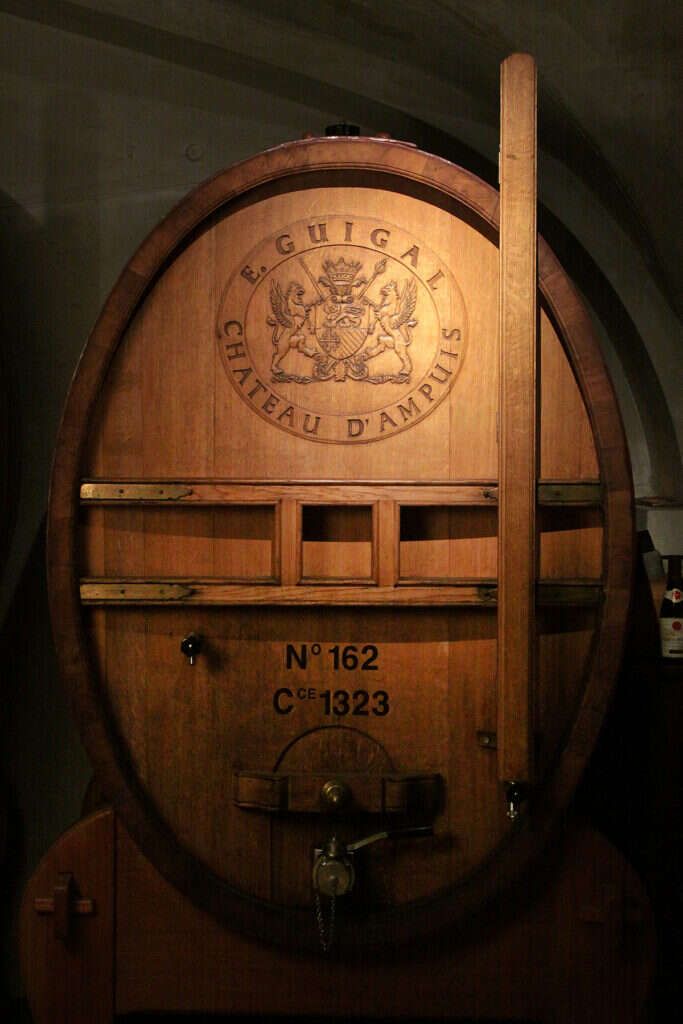
They’ve replaced all the buildings bar the 17th-century cellar with its beautiful foudres, and they’ve kept the 16th-century farm; but the rest have gone. The 2024 and 2025 vintages are being made in a temporary cellar, but the new one will be open for 2026. And it’s all funded by themselves, with no banks involved. All the materials for the buildings are being sourced within a radius of 62 miles (100km), though the flesh-and-blood architect is from Corsica (no, not Eve).
But Eve shares, or shared, a sport with Philippe—which apparently is a sport, rather surprisingly. It’s competitive ballroom dancing. “At 35, I was at the highest level in France, and I competed with people who practiced every week.” He’s given up Latin American because it’s super-intensive, and he reduced his competitions last year. And Eve dances, too: Her mother had a dance school in Corsica—mainly ballet and modern jazz, but Eve already danced when they met. She then took to ballroom dancing, and she danced until a year or so ago, when she had an argument with her dancing partner “and switched to boxing.”
Philippe has a knack for the one-liner that floors you. And I’m not sure how much I found out about Philippe—but it was fun. ▉