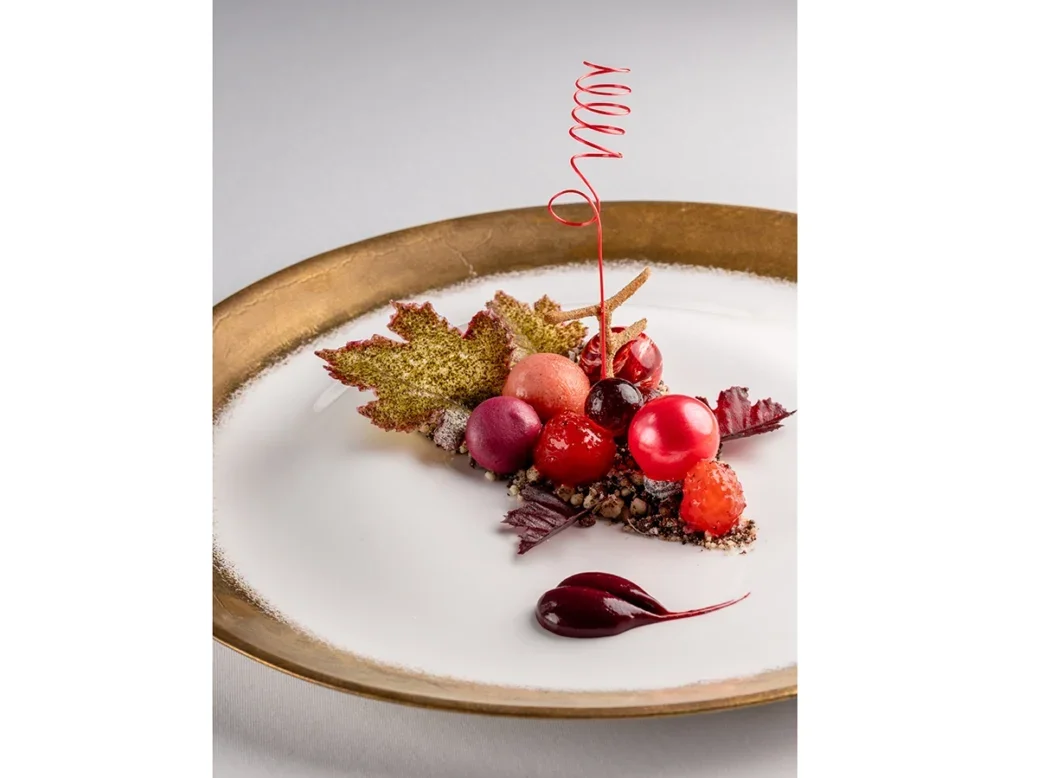
Domaine de la Romanée-Conti Echézeaux 2017 was the inspiration for a fiendishly complex Pinot Noir dessert created by chef Heston Blumenthal at his restaurant, The Fat Duck. Joanna Simon reports on a rare sampling of the dish, and a further 11 elaborate courses, at a specially prepared meal.
About a decade ago, on a trip to Burgundy, Heston Blumenthal and his group of ten or so were tasting at Domaine de la Romanée-Conti (clearly, this was no Joe-Public sort of group). Heston had heard that the domaine produced a Bâtard-Montrachet in tiny quantities for private consumption. “Cheekily, I asked if I could taste it,” he says. Their host turned on his heel and went out. In the suspenseful quiet that followed, Heston heard the creak of a door and the crunch of gravel underfoot before his host returned with an unlabeled bottle (one of about 600 bottles from two barrels produced from a 0.1746ha [0.4314-acre] parcel each year). He poured.
“It was one of the greatest wines I’ve ever had,” says the chef, who needs no introduction but who, as a matter of form, I shall remind readers, is the founder and owner of the three-Michelin-starred The Fat Duck in Bray, Berkshire. He is also a pioneer of multisensory dining and of the flavor-pairing principle (uniting ingredients with similar molecular profiles in a dish—scallops, white chocolate, and caviar, for example). He is an OBE, an HonFRSC (Honorary Fellow of The Royal Society of Chemistry), has been the star of several television series, and recipient of honorary doctorates, multiple awards, and many other things.
Heston tells the DRC story when I ask him when and where he first tasted Romanée-Conti. He can’t remember but says it was a long time ago—and, yes, it was love at first taste. How often does he drink it—monthly? No, but he wishes he did. And that’s how Romanée-Conti, or, in practice (and there was a lot of practice), the estate’s Echézeaux 2017 came to be the inspiration and model for his Pinot Noir dessert, created last year for a DRC dinner at The Fat Duck to celebrate the restaurant’s 30th anniversary and 21 consecutive years of three Michelin stars.
Related

The Pinot Noir dessert has been served since then and will return to the menu in late-spring or early-summer, when good strawberries are again available, but there is more to the decision than whether it’s strawberry season. With more than 14 components on the plate when it reaches the diner, more than 50 stages in preparation and up to 80 ingredients, the chef team needs about 10 days’ notice to prepare it, starting with the picking of suitable blackberry leaves.
On paper, creating the Pinot Noir took about six months from start to finish, but that was with the benefit of years of knowledge and experience, as James “Jocky” Petrie, chef and global culinary director, points out. Those years included the creation of Botrytis Cinerea in 2012, a dessert echoing the flavors of Château d’Yquem and designed to be eaten with it, which had a similar number of components and preparation stages and gave them a visual blueprint for its successor. There was also a strawberry, black olive, and leather dessert, elements of which were integrated into the Pinot Noir.
Strawberry, olive, and leather give a glimpse into the types of flavor constituents involved, but that’s the only glimpse for now. I’ll return to the new dessert after an excursion into the 11 courses of The Journey menu that preceded it at The Fat Duck on a stormy day in January, when the Pinot Noir had been prepared specially for The World of Fine Wine.
Content from our partners
All sorts of wonderful things happen
Heston Blumenthal’s cooking style hardly needs an introduction. Even readers who have not been to The Fat Duck, a comfortably unassuming 16th-century building, with low ceilings, white walls, and exposed timbers, will almost certainly be aware of his second-to-none reputation for culinary invention, daring, and artistry (it’s tempting to call it wizardry, but it’s all based on science, as the Royal Society of Chemistry and university science departments have recognized). And most readers will have heard of dishes such as snail porridge, egg and bacon ice cream, and sound of the sea. But not everyone will know when it all began. The answer is that, three years after opening The Fat Duck in 1995 (a former pub), Heston put a new and original dish on the menu, crab ice cream, and from that moment began to realize, that, “ultimately, the pleasure we get from eating comes from our brain and, in particular, from our memories and associations and the emotions they trigger.” Add imagination and “all sorts of wonderful things happen.”

The result is dishes of great complexity and ingenuity that taste not as your eyes would have you believe and dishes that often evoke happy nostalgia, all served in a room of welcoming, elegant simplicity. Or, in the case of a single diner per service, if they have booked it, served at the Top Seat: positioned at one end of the pass, close enough to see all the action in the kitchen and to talk to the chefs. That’s where I sat and where I learned after about the third call from Tom, the sous chef leading the team at the pass that day, that none of the ten chefs was called Hans. The call was for “Hands please” and it always elicited a lightning-quick response. As someone who has never worked in a professional kitchen, I also learned that cotton buds and tweezers are invaluable for removing the tiniest of extraneous drips, smears, and specks of food just before the plate or bowl is whisked away to the dining room.
Let’s begin. The wine pairings from The Fat Duck’s appropriately impressive list, which includes an interesting and varied selection by the glass, were by acting head sommelier Jonathan Teixeira. Things got off to a promising start with a Champagne apéritif of Henri Giraud Hommage au Pinot Noir, a low-dosage, low-sulfite Blanc de Noirs from Aÿ. Its vinification in oak, with a little in stone amphora—and, as the label says in capital letters, “zero stainless steel”—gives a straw color and adds a note of honeyed oxidation to the appetite-whetting apple and salted sourdough, the chalky freshness, and fine texture. And then we began The Journey. Described as “a journey into Hestonland”, the dishes travel through the day, from a breakfast bowl early on, to a closing, multisensory bedtime dish.
Nitro-poached Aperitif
Prepared on a trolley alongside the table (or pass), the nitro-poached aperitif is an egg-white mousse infused, in my case, with Campari and orange zest (rather than paloma and grapefruit or vodka and lime), poached very briefly in liquid nitrogen to produce a firm case around a liquid interior. It is designed to be a palate-cleanser and refresher and is presented on a spoon to down in one. Only I couldn’t because it was too large (I don’t have an opera-singer’s mouth) and so made a bit of a mess. But it didn’t stop me enjoying it. Ice cold, zingy and lighter than light.
Aerated Beetroot
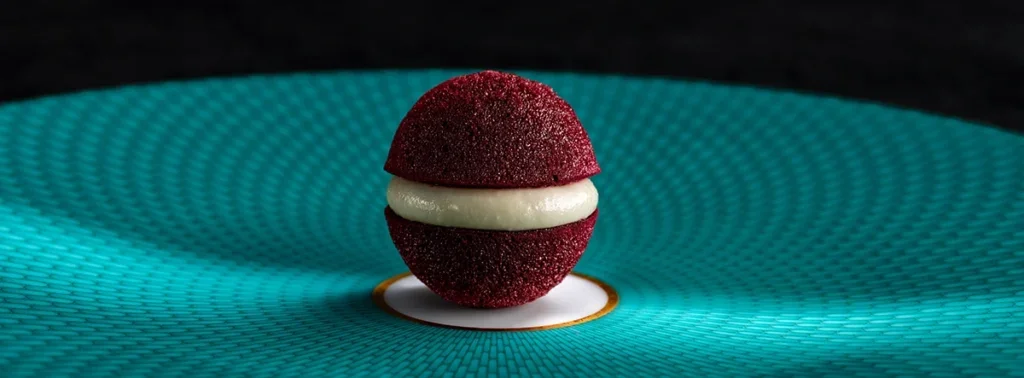
This is intended to stimulate the palate (via the trigeminal nerve) and, again, to be eaten in a single bite. The smooth macaron-like dome of aerated beetroot has a sandwich-layer of horseradish and mascarpone cream in the middle and dissolves in the mouth immediately, the sweet, rooty intensity contrasting with the hot ping of horseradish. I followed it with an Hommage au Pinot Noir chaser which was less cruel on the Champagne than you might expect. Higher dosage would have suited the beetroot better, but the Pinot Noir fruit was right with it, and the acidity and bubbles tempered the horseradish.
Tonic of Botanicals
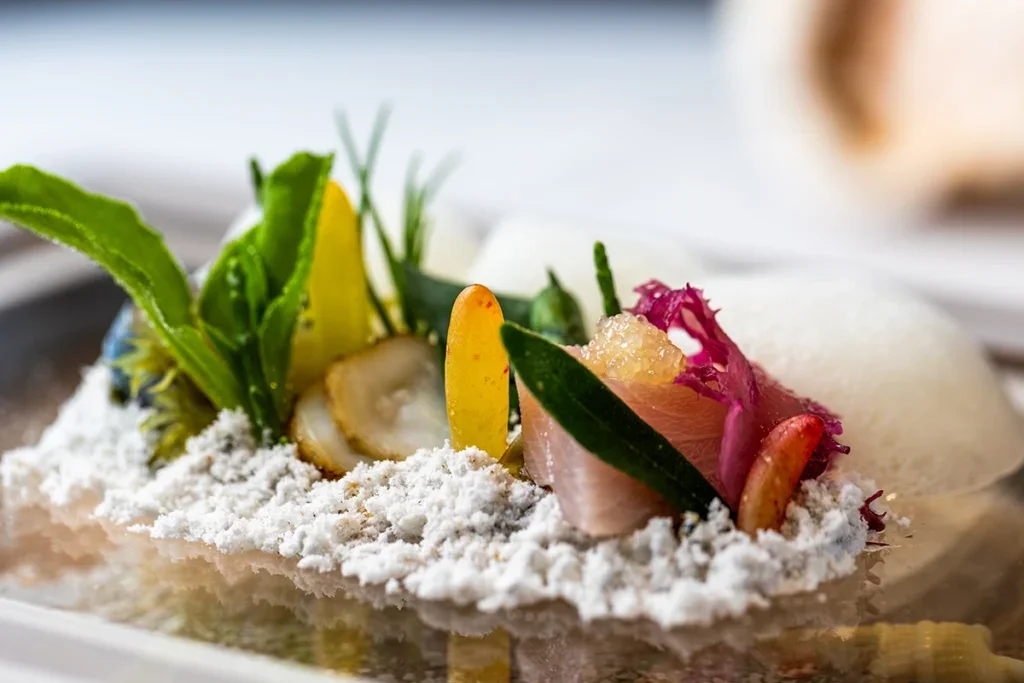
Another dish designed to stimulate the palate and, with its edible flowers (viola, nasturtium, and marigold among them), a feast for the eyes as well. A scoop of celery sorbet sits on smoked cumin royale, surrounded by charred onion, salsify, Jerusalem artichoke, turnip, and pickled celeriac and a cooling green-tomato, fennel, and cucumber broth. It was served with The Fat Duck martini—quite the best martini I have had, with both richness and purity—but, even so, I am a wine drinker, so I sneaked in a sip of Champagne. Had I been choosing wine, I would have tried a Riesling, such as Emmerich Knoll Riesling Ried Kellerberg Smaragd 2022, which has been on the The Fat Duck list recently and may still be, or a Grüner Veltliner from the same producer.
Hot & Iced Tea
Lightly sweetened Earl Grey arrives in a glass. You sip it to find that one side is hot and the other is cold and gel-like. It’s perplexing, amusing, and delicious.
Bacon & Egg Cereal
Presented with a bowl and a tray of small boxes like children’s breakfast-cereal variety packs, you take a box and tip the contents into the bowl onto a pale, creamy, scrambled-egg custard that also has egg-yolk and roast-tomato gels and bacon cream. The individual “cereal” pieces turn out to be a tomato puff, mushroom pillow, sausage cracker, and bacon crisp. What do you serve with the flavors of a traditional English breakfast? Jonathan chose Laurent-Perrier Grand Siècle Iteration 26, a great Champagne (“the balance is perfect, the flavor goes on and on […] exhilarating,” I wrote in WFW 88, 2025, p.56). I could not have been more delighted, even if I might have paired the dish with a still Chardonnay (a Domaine Roulot Meursault, perhaps, or a top Mâconnais).
Crab & Passionfruit 99
A brik-pastry miniature cone containing passion fruit and vanilla jelly, crab ice cream with a swirl of red-pepper reduction, and a tiny dark-chocolate flake is never going to be easy on accompanying wine. Bubbles and acidity can cut through the numbing chill and the creaminess, and the dosage is there for the sweetness of the crab and the red pepper reduction, but I couldn’t say the dish did the luxurious Champagne any favors. As the sake intended for the next dish had already been poured (arrestingly, from a conch shell), I tried it and felt it was relatively successful, but Jonathan thought it was too powerful.
Sound of the Sea
For Heston’s first multisensory dish (dating from 2007), you wear headphones to hear crashing waves, gulls calling, children playing. A glass-lidded wooden box containing sand takes the place of a plate for cured halibut and yellowtail, pickled razor clams, “sand” made of panko breadcrumbs, miso oil, furikake seasoning, and shirasu (whitebait), a foam made from vegetable stock, seaweeds, and shiitake mushroom, and various other seasonal seaweeds. This umami sea dish found its echo in Daishichi Minowamon Junmai Daiginjo, a sake of great complexity, subtle creamy sweetness, and umami flavor, made from super-flat polished Yamada Nishiki rice and served cold. It is an outstanding sake, but I would also be very happy with wine—Grand Cru Chablis, for example, or Champagne.
A Walk in the Woods
A mushroom log with a button-mushroom parfait, together with chestnut mushrooms, portobello mushroom crumbs, oak-truffle butter, and fresh truffle, delivers an umami hit, but there is a blackberry gel providing a sweet note (a tiny touch too much?), pickled beetroot giving sharpness, a lovage emulsion, juniper salt, and lightly crunchy meal worms (which I don’t think were in the dish when I first had it some years ago). It would be hard to go far wrong with a distinguished Piedmont Nebbiolo. The one chosen, Gaja Sorí San Lorenzo 2007, was a rare treat—fragrant with dried cherry, rose, peppery spice, and sandalwood, savory with tobacco and leather, and the texture of nubuck. I would not have guessed it was 18 years old. The sweetness in the dish threatened to upend it. It didn’t, but it was on a knife edge.
Bread & Butter
An interlude to keep guests grounded: smoky, toasty, burned-wheat Grano Arso sourdough, Meadow Blend bread (multi-grain, multi-seed, dried peas, meadow flowers, and dried nettles) and homemade butter.
Beef Royal
Versions of beef royal(e) have featured at The Fat Duck and at Dinner by Heston (his two-Michelin-starred London restaurant) for a while. This one, created in 2021, is described as “a reinvention” of a dish served in 1685 at the Coronation Feast of James II and Mary of Modena. It’s a deeply savory dish of the tenderest beef fillet (cooked sous vide), smoked beef fat, smoked anchovies, mushrooms in various forms (fresh, pickled, and ketchup), fried bone marrow, onion and tarragon fluid gel, truffle emulsion, and veal sweetbreads served potato chip-style in a paper cone. It could be paired with many mature reds and, at home, I might have pulled out the velvet-rich 1989 Château Tertre-Roteboeuf. Jonathan went in a different direction with the first vintage, 2010, of Porseleinberg Syrah, a wine with sweet aromatics and an unshakably powerful, stony-mineral, peppery personality.
Cheese & Grapes
With Tunworth and truffle semifreddo and a “grape” element that included fig pâte de fruits and gel, fig-leaf tuiles, dried grape with Roquefort powder, and Tokaji-soaked sultanas, the inspired pairing was Domaine Macle’s exceptional Macvin du Jura—aromatic, sweet, and fresh with orange, peach, and walnut, and the complexities of age and fortification with the Macle family’s own marc (rather than a younger, purchased spirit).
Pinot Noir
Returning to the 80-ingredient, 50-step new dessert. The very obvious difference from the earlier Botrytis Cinerea is that the wine being mirrored here is dry and red, not sweet, so there are tannins to consider, as well as acidity. To start the development process, head sommeliers Melania Bellesini and Jonathan Teixeira contacted Domaine de la Romanée-Conti and asked for their input on Echézeaux’s flavor characteristics (not something they had done with Château d’Yquem). At the same time, they conducted their own tastings of Pinot Noirs, including, of course, DRC 2017 Echézeaux.
The list DRC produced highlighted cherry, rose, tobacco, strawberry, and leather. The sommeliers didn’t have leather but had more fruity notes, including raspberry and blackcurrant. Working with the pastry team, they then added elements such as cep, balsamic vinegar, blackcurrant, truffle, parmesan, and black olive, to up the savory side.
The most difficult thing was incorporating the acidity levels and the tannins, particularly the structure and texture of the tannins, and balancing them with the sweetness of the dessert, which was gradually reduced through the multiple trial versions. The “soil” component in the dish helped a lot and is a more critical component in the Pinot Noir than in Botrytis Cinerea. The final version of the “soil” is made of parmesan, truffle, crystalized rose petals, dried olives, cocoa nibs, portobello mushroom powder, grapeseed oil crumble, crystalized chocolate, and vanilla salt. I say “final” but, as Heston explains: “When we put […a dish…] on the menu, it’s definitive, but we know that there will be tweaks. It’s like a train: you put it on the tracks but keep upgrading it—painting it or changing the curtains.”
Under the “soil” there is Kalamata olive and leather purée, strawberry and rose fluid gel, cherry pâte de fruits and tobacco ganache. On top: mini churros dusted in cep mushroom powder, blackberry fluid gel, strawberry and pepper sorbet, raspberry gum, blackberry leaves, macerated strawberries (peeled and seeded—to think that Shirley Conran thought life too short to stuff a mushroom), sparkling grapes (again, peeled), semi-dried grapes (finished with a Roquefort powder made from Roquefort, Valrhona Ivoire white chocolate, and tapioca powder), blackcurrant meringue, a red dark-chocolate ball filled with tobacco ganache (made with Perique tobacco liqueur) and almond paste, and a strawberry and rose fluid gel.
Definitive or not, I thought Pinot Noir was a triumph—the sweetness skillfully tempered by the many savory elements and the dark chocolate—a testament to the expertise of the chefs and the knowledge of the sommeliers. But, reluctantly, I confess that I am not entirely persuaded about pairing it with red Burgundy. The chosen wine on the day was Domaine Faiveley Corton Clos des Cortons Faiveley 2011, a majestic wine—powerful, dense, darkly fruity, earthy, and spicy with fine but still-firm tannins—and I can think of many things I would like to drink it with, but none of them is sweet. I would love to know what Domaine de la Romanée-Conti thinks of the dessert with their wine, but no one has come from the domaine to try it yet. Would Heston like them to? His answer is emphatically crisp: “Yes.” I hope they’re listening in Vosne-Romanée.
Counting Sheep
In truth, I didn’t need another dessert, but it was time for dimmed lights, a sleep mask, lullaby music, a floating pillow, a fur-handled spoon, and a puff of baby powder. Such is the childhood-bedtime setting for components such as malt meringue, milk ice cream, milk crumble, tonka pannacotta, earl grey and lavender mousse, and steamed vanilla sponge. I was served this famously multisensory dish upstairs in the hidden wine room because the lights couldn’t be dimmed at the pass, as they are over tables in the dining room when it’s time for counting sheep. The accompanying wine was the off-dry Egon Müller Scharzhof Riesling 2020, a beautifully precise and elegant Saar Riesling, but not sweet enough for the dish.
Like a Kid in a Sweet Shop
The theatrical finale arrives as a dolls house-like trolley in which drawers pop open randomly when you insert the coin you have been given in the slot on the side. Each drawer holds a tobacco chocolate, a wafer-thin blackberry Queen of Hearts card, a caraweight (caraway “After Eight”), and a banoffee pie caramel. They are scooped into an old-fashioned pink and white striped paper bag for you to eat there or take away. It was dark outside, the rain was still hammering down, and I had a three-hour journey home. I took mine away.
I spent much of the journey trying to answer the question that several of the chefs had asked as lunch progressed: “Which is your favorite dish […so far…]? How many favorites can I have? If it’s three, they are sound of the sea, beef royal, and Pinot Noir. If it’s four, I will precede them with aerated beetroot. But to pick and choose slightly misses the point: the extraordinary, imaginative, gastronomic journey through the day and Hestonland.
I have a simplified version of the Pinot Noir. I would love to attempt it, but it is stratospherically above my pay grade.