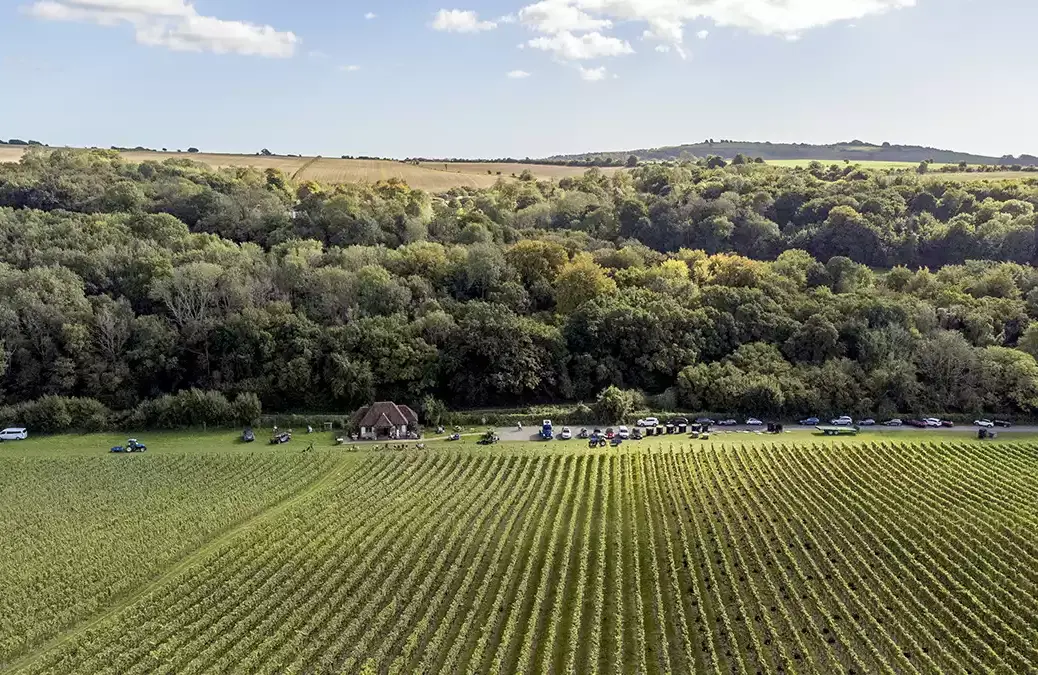
Essi Avellan MW introduces a fascinating and encouraging tasting of English and Belgian sparkling wine shared with Simon Field MW and Anthony Rose.
This original tasting unfolded in a particularly intriguing context, as our regular Champagne panel, Simon Field MW, Anthony Rose and I, was invited to evaluate a diverse selection of English and Belgian sparkling wines. Producers were granted full freedom to nominate the wines they felt best represented their work. English producers responded with enthusiasm, offering a strong and varied showing. In contrast, engagement from Belgian producers was minimal, making it essential to approach the conclusions with caution.
English sparkling wine is no longer a novelty—it’s coming into its own with confidence. What began as a quiet experiment in 1952, when Sir Guy Salisbury-Jones planted the UK’s first modern vineyard in Hampshire, has evolved into an ambitious and thriving wine industry. Today, the UK is home to 238 wineries and more than 1,100 vineyards, with pioneering names like Nyetimber, Ridgeview, Chapel Down, and Camel Valley leading the charge. While exports remain modest, at just 9% of production volume, the energy within the domestic market is quite unmistakable. One clear signal: Vineyard plantings have surged 510% since 2005, reaching 4,841ha (11,962 acres) under vine by 2024. Despite the headwinds introduced by Brexit and the current global economic uncertainties, the momentum has continued.
Sparkling wine now accounts for approximately 70% of all English wine produced, making for a 6.2 million-bottle business as of 2024—an impressive 187% increase since 2018. The traditional method dominates, representing more than 90% of production, and it’s no surprise that the classic Champagne varieties form the industry’s backbone: Chardonnay leads plantings at 32%, followed by Pinot Noir (27%), and Meunier (9%). Cold-climate Vitis vinifera varieties and hybrids like Bacchus and Seyval Blanc also retain a foothold, although their use in sparkling wines is becoming increasingly niche.
Related

In terms of price, English sparkling wine sits in the premium bracket. According to a Wine Lister study of Wine-Searcher data from March 2025, the average bottle sells for £32.47 in the UK—considerably more than Prosecco (£13.40) or Cava (£11.00), though still a large step below Champagne (£50.53).
Although the Gulf Stream plays a role in softening the climate, frequent rainfall continues to challenge grape growers. The eastern side of England enjoys greater protection, which explains why the bulk of the nation’s vineyards are clustered in the southeast. In fact, Kent, West Sussex, East Sussex, and Hampshire make up 64% of total vineyard plantings, with Kent alone responsible for more than one quarter. Though certain regions share the prized chalky soils of Champagne, the English wine industry has evolved well beyond mere imitation.
The UK’s notoriously capricious climate remains the greatest challenge to consistent wine production, impacting both quality and quantity. Over the past five years, average annual sparkling wine output has hovered around 8.8 million bottles—but the extremes are telling. The 2023 vintage yielded a record-breaking 16.4 million bottles, while 2020 saw a meagre 5.6 million. Such sharp fluctuations highlight the need for smart use of reserve wine to offer greater consistency and stability in both style and supply.
Content from our partners
Belgium today occupies a position reminiscent of where the UK stood three decades ago—an emerging contender on the sparkling-wine stage. Production remains modest and is primarily consumed domestically. It’s notable that two of the UK’s largest wineries (Nyetimber and Chapel Down) together produce more than Belgium’s entire output, from its current 695ha (1,717 acres) of vineyards. Yet Belgium’s vineyard area has expanded dramatically, increasing fivefold over the past ten years. Sparkling wine now accounts for 45% of Belgium’s total wine production, with a strong emphasis on the classic Champagne grape varieties. Terroir-wise, Belgium shares much in common with the UK: a cool, maritime climate characterized by moderate summers and mild winters, combined with varied soils, often with chalk and limestone.
Unlike the UK, which has deliberately avoided creating specific sparkling-wine appellations, Belgium has developed a structured classification system, including Vlaamse Mousserende Kwaliteitswijn, Vin Mousseux de Qualité de Wallonie, and Crémant de Wallonie, each reflecting regional identity and quality standards.
Tasting English and Belgian sparkling wines
The 34 sparkling wines we tasted made for a truly eclectic lineup. While the English contingent responded enthusiastically, we were able to secure only five Belgian entries—hardly enough for a comprehensive view of the country’s output. Yet one wine stood out as a beacon of promise: the Zilveren Parel Brut from Wijnkasteel Genoels-Elderen secured a shared fourth place, a performance that speaks eloquently of Belgium’s emerging potential.
Because producers were given free rein to submit the cuvée of their choice, the wines spanned a wide spectrum of vintages, from 2022 back to 2009, with a handful of Non-Vintage bottlings included. A frequent criticism of English sparkling wine is its tendency to hit the market prematurely, often with searing acidity. In the conventional wine lexicon, high acidity has been equated with aging potential. If that holds true, these wines should be well-positioned for graceful evolution! And indeed, some of the older vintages shone. Our top three wines hailed from 2009, 2010, and 2016, highlighting the rewards of patience. Particularly noteworthy was the inclusion of Breaky Bottom’s Cuvée Koizumi Yakumo 2010, crafted from the hybrid Seyval Blanc, an unconventional grape variety, tasted against classic expressions like Wiston Estate Blanc de Blancs Library Collection 2009 and Chapel Down Kit’s Coty Coeur de Cuvée 2016.
While the perception of acidity can mellow slightly with time, and dosage can be used to soften its initial attack, the reality is that fundamentally unbalanced acidity tends to remain just that—unbalanced. This remains a key challenge for English sparkling wine. In our tasting, the most recurring flaw was a searing, unresolved acidity that overshadowed the wine’s other qualities. And yet, acidity should be viewed not as a liability, but as a potential hallmark of style—as long as it is handled deftly. Climate change is already shifting the acid profiles across all traditional sparkling-wine regions. For England, freshness could evolve into a defining strength, provided the right tools are in place. Careful management of malolactic fermentation, without the accompanying lactic notes, along with finely calibrated dosage and meticulous protection against oxidation, are critical. After all, few things are more jarring than a prematurely oxidized wine running on acidity.
Fortunately, the trajectory is promising. English producers are increasingly learning to harness their terroirs, and the growing experience in the cellar is paying dividends. As vineyards mature, so, too, does their potential; older vines typically deliver higher concentrations of phenolic compounds, which not only bring greater structure and complexity, but also serve as natural antioxidants. With that in mind, I was blown away by the quality of the inaugural release from Champagne Taittinger’s Kent project, Domaine Evremond Classic Cuvée Edition 1 NV. Remarkably, this 2020-based wine, incorporating reserve wines from 2019 and 2018, was crafted from vines that were just one to three years old at the time!
With nearly 300 years of sparkling-wine expertise, Taittinger clearly holds a significant advantage. The Champenois’ foray into English terroir is being closely watched—and for good reason. Following Taittinger, the other major Champagne house to invest in England, Pommery, made a strong impression with its Louis Pommery England Blanc de Blancs 2020, which earned a shared fourth place in our tasting.
As both of my colleagues noted in their verdicts, blanc de blancs wines stood out in this tasting—and they were well-represented. Of the 34 wines submitted, 12 were blanc de blancs, with an impressive five placing within the top five. Blends dominated the lineup, with only one producer presenting a blanc de noirs and none submitting a rosé, a noteworthy absence in itself.
Predictably, warmer and more successful harvest years shaped the vintage spread, with 2020, 2018, and 2016 delivering the strongest performances. In contrast, wines from more challenging years often wrestled with searing acidity and green, underripe flavors. Among the seven Non-Vintages tasted, few were standout successes. Nevertheless, this category holds immense potential, as outlined in the introduction. Establishing and maintaining a robust reserve-wine system is crucial for navigating such capricious climates. Indeed, reserve wines are gaining interest, evidenced by Langham’s recently launched perpetual cuvée, which Simon particularly praised.
Overall, this was a fascinating, versatile, and ultimately encouraging tasting. While consistency remains a work in progress, the heights English sparkling wine could achieve over time are compelling. With vineyard plantings projected to reach 7,600ha (18,780 acres) by 2032, this burgeoning industry must now look beyond traditional borders—exploring new markets and inspiring regions like Belgium to follow suit, heralding a new era for Northern European sparkling wines.
The top five: The best English and Belgian sparkling wine
Chapel Down Kit’s Coty Coeur de Cuvée England 2016 (12% ABV) | 94
EA | There is good intensity to the lemony color. A richly scented nose, too, with intense fruit complexed by slightly stony, earthy minerality. Meadow flowers, hay, sweet lemon, and quince. Full palate, with a sweet, vanilla, and toffee flavor from oak, which comes out a little too much. Rather full on the palate, with balanced acidity and a long, fruity finish. Time will probably mellow the oaky notion somewhat. 2025–30. | 91
SF | Pale stucco color, a gentle mousse. Aromas of hazelnut, vanillin, and crushed chalk, with pineapple and apple crumble. The palate is fresh, finely structured, and beautifully integrated; its primary and secondary notes entwined engagingly. Hints of tobacco and sous-bois lend the softest of betrayals to age, and the acidity subtly underscores the gently billowing texture. Nearly a decade on, this wine eloquently rehearses the glorious potential of the category and demonstrates that its elevation has been of a lengthy gestation. | 95
AR | A mid-gold in color, this is super-fresh and yet also showing a degree of vanilla-oak in the aromas, and by that I mean classy oak and not excessive, in my humble opinion; the ripe, rich fruit flavors are nicely concentrated, rich and full-flavored, underpinned by a more understated element of oak-vanilla toastiness; all excellent complexing factors, while the bright fruit is underpinned by a firm spine of classically English, tangy, appley acidity. 2025–28. | 95
Wiston Estate Blanc de Blancs Library Collection Brut England 2009 (12% ABV) | 94
EA | There is evolution to the intense lemon color. Sweet nose, with vanilla and toffee tones, a nose somewhat on the lactic side. Powerful, with vanilla and woody notions. Rich and textured, with a good backbone of acidity lining the brisk, vibrant palate. The wine has peaked but remains a delight, despite the toffee notes. 2025–27. | 92
SF | Outstanding aromatic; hazelnut, quince, and plum; chocolate and fig; a beautifully evolved but not inherently oxidative example. Deep gold, then a seductive nose, tight, complex, and complete. The palate confirms these positive suspicions and redoubles them courtesy of the sheer potency of the fruit, its carefully managed development, and its subtle integration eloquently entwined to the autolytic subtext. Aging very gracefully indeed. 2025–31. | 95
AR | Mid-gold in color, this shows rich farm-butter and salted-caramel notes in its bouquet; the oxidative effects of maturing have kicked in to produce a wine of considerable complexity in goût anglais style, with lots of mature, buttery rich flavors buoyed by classically tangy English acidity, all of which add up to a richly full-flavored and stylish Dorian Gray of an English sparkler. 2025–27. | 95
Breaky Bottom Seyval Blanc Brut Cuvée Koizumi Yakumo England 2010 (12% ABV) | 93
EA | Bright lemon color. The nose is equally youthful, with lemon juice and green apple leading the fruit profile. On the palate, some more fragrant floral tones emerge. There is good volume to the silky palate but also impressive acidity. The finish is clean, leaving a balanced overall feeling. The wine has taken time very well but is no longer improving. 2025–28. | 93
SF | Lightly colored, lime and pale citric; the hue belies the age. Stone fruits and a flinty grip, the phenolics evidenced but not overwhelming. Tilleul and lime juice, hints of grapefruit, even. Incredibly youthful for such a senior example, all components beautifully integrated and defined with pointillist accuracy. 2025–30. | 91
AR | A pale youthful gold in color, this shows great depth and toasty complexity in its bouquet, with English apples and light toast, and on tasting, it’s remarkably bright for its age, with a youthful cushion of bubbles carrying an energetic fruit quality that seems to be just getting into its stride, thanks to high-quality fruit and concentration, underpinned by a remarkable quality of acidity, bright, ripe, and with just-enough appley tartness to help maintain its stylish balance. 2025–34. | 96
Louis Pommery England Blanc de Blancs England 2020 (Pre-Release) | 93
EA | There are youthful green hues to the color. Clean, softly fruity nose, with both lemon and green fruit. Lemon, lime, green apple, and peach. There is lovely lightness to the palate of creamy mousse and delightfully balanced acidity. Long, with a dosage that sticks out somewhat. Nevertheless, a very correct, well-made, and enjoyable wine. 2025–30. | 93
SF | Pale gold, the mousse somewhat lazy, pedestrian. A pleasing aromatic marries orchard fruit with sourdough and soft spice. The palate is nicely constructed, the tension from the acidity harnessed more by the fruit than by dosage, the latter thus discreet by way of backdrop. The crisp and slightly lean personality identifies provenance, but, in this case, with no lack of justifiable pride. Or prejudice. 2025–29. | 94
AR | Pale-lemon in color, there’s a note of sweetly ripe apple in the aroma, albeit somewhat faint; and when you taste, there’s also some attractively ripe apple notes behind a delicate mousse, while the ripe and richly concentrated fruit is attractively juicy and delicate and approachably tasty. 2025–27. | 92
Nyetimber Single Vineyard Brut England 2016 (12% ABV) | 93
EA | Bright lemon color. There is emerging complexity to the nose, with both toasty and spicy nuances elevating the fruity tones. A mix of pristinely ripe orchard fruits. There is fine, sweet juiciness to the balanced palate, where opulent fruit and brisk acidity meet. A long and succulent finish, with appetizing lemony bite. 2025–32. | 94
SF | Soft Welsh gold, with a pleasing luminosity. A nose of poached pear, fig, white chocolate, and dried fruit, harmonious and generous, albeit subtly. The palate is complete and harmonious, with medium concentration and an elegant interplay between the primary and secondary notes, with reliable autolytic support. Notes of spearmint and even caramel come through with a little air. Aging gracefully and still on a pleasing plateau of excellence. 2025–27. | 93
AR | Pale gold, this is fresh and bright, with a pleasant, fresh appley fruit aroma and a hint of background nuttiness, albeit just a tad shy; while on tasting, there’s plenty of ripe Cox’s apple fruitiness here, supported by a complexing trace of nuttiness from autolysis and a lively bite of crisp, tangy acidity. 2025–30. | 92