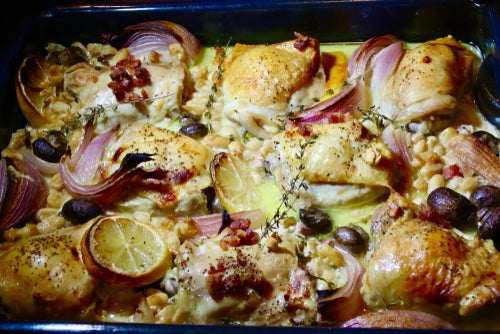
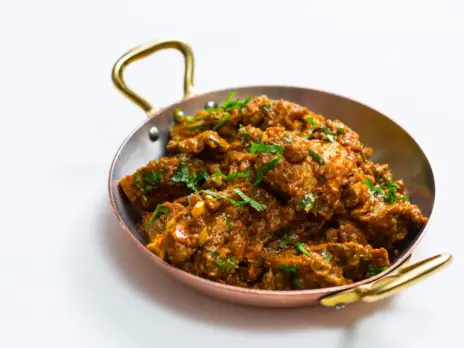
It always seems slightly unfair, a little dismissive, to describe coq au Riesling, one of the classics of Alsace cuisine, as merely a regional white-wine variation on Burgundy’s coq au vin. Cooked in a white wine notable for its acidity, and with the important addition of crème fraîche, coq au Riesling is distinctly different from the classic red-wine coq au vin de Bourgogne.
It’s even more different in recipes such as the one on the Vins Alsace website and in A Taste of Alsace by Sue Style (1990, Pavilion Books) in which there is no sign of the salty, umami contribution of lardons, unlike in most contemporary recipes. And it’s more different again when, as in Recipes from the French Wine Harvest by Rosi Hanson (1995, Cassell), neither mushrooms nor lardons feature. On the other hand, Hanson does add depth to the flavor by flambéing the chicken in Cognac before adding the Riesling, as does Vins Alsace.
Interestingly, while Burgundy’s coq au vin seems as if it’s a dish of great lineage – and it probably is, although I’m not convinced by suggestions that it dates back to ancient Gaul or was enjoyed by Julius Caesar—the first known documented recipe is 1906 in a book published in Paris, La cuisine française: l’art du bien manger, compiled and edited by Edmond Richardin. Moreover, it’s predated by a recipe for poulet au vin blanc in a book of 1864, incongruously, an English cookbook (in an Oxford University collection) with the quaint title of Cookery for English Households by a French Lady. The wine it calls for is white Burgundy. It’s just conceivable, then, that Burgundy’s coq au vin was preceded by an original made with white wine rather than vice versa, but that’s a rabbit hole for a rainy day.
What we don’t know is when coq au Riesling emerged but, as it’s a recipe for coq (cockerel/rooster) rather than poulet (chicken) or poularde (older but specially fattened for eating), it’s perfectly possible—likely, even—that the dishes developed independently in Alsace and Burgundy, but did so for the same reason: to render tough old birds into something more tender and tasty by cooking them slowly in wine. And in both regions, the recipes were probably passed down the generations orally for long before any made it into print. They were certainly dishes prepared and served in domestic homes as well as in restaurants—and still are.
Related
While they were devised for old birds, you would be hard pushed to find a recipe for coq au Riesling from the last 50 or more years that specifies cockerel/rooster. Chicken has taken over, or occasionally a flavorsome but tender poularde. I can’t say I’m sorry, but it goes without saying that if the dish is to be interesting it needs a chicken that has developed flavor from having a varied diet and exercise; ideally, then, an organic or pasture-raised slow-growing breed.
Apart from chicken, dry Riesling, and double (heavy) cream, the essentials are shallots, butter or oil for frying, homemade chicken stock/broth (although Rosi Hanson uses wine only), and in most cases mushrooms and lardons. Many recipes also include some garlic, thyme, and parsley, a little flour, and an egg yolk. The traditional accompaniment is Spätzle, which are broadly akin to egg pasta, but with a rough surface and a slightly more dumpling-like texture.
The best wines to pair with coq au Riesling
As for the traditional wine accompaniment, it’s obviously Alsace Riesling. Equally obviously, it’s not as simple as any dry Alsace Riesling with any version of the dish, or at least not for a gastronomic pairing. Recipes vary in their relative proportions of wine to stock (broth) to cream. Cream is the smallest component, but some recipes use a greater quantity of Riesling than broth, giving a tangier sauce, while some use equal quantities. Even with its tang, and even without lardons, this is a fairly rich, umami-accented sauce, thanks to the cream, mushrooms, sautéed shallots, and the stock (broth), so it’s worthy of a Riesling Grand Cru on the table, although not, as far as I’m concerned, in the cooking pot.
Content from our partners
So many Alsace Grands Crus to choose from, so many fine Alsace Riesling producers! I don’t think anyone needs to get hung up on the idea that one particular soil type or one or other particular Grand Cru has a higher calling than all the others with coq au Riesling, so the following, in no particular order, are just a few, among many, Riesling Grands Crus that I would happily choose: Albert Boxler Sommerberg, Domaine Weinbach Schlossberg, F E Trimbach Schlossberg, Albert Mann Furstentum, Zind-Humbrecht Brand or, although not a Grand Cru, Zind-Humbrecht Clos Windsbuhl. Alsace has had such good fortune with vintages in the last decade that you could try almost any from 2023 back to 2015. And for a more mature wine, any from 2010 to 2007.
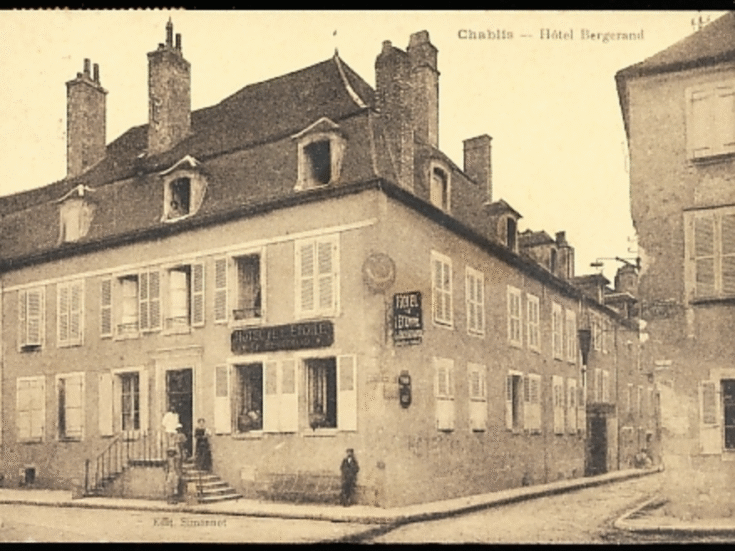
Alsace is not the only Riesling possibility. I don’t find the chiseled Australian classics of the Clare Valley and Eden Valley Riesling work, but Germany can field many a suitable Riesling Trocken GG from across the regions: to name just two producers, Weingut Robert Weil in the Rheingau and Philipp Kuhn in the Pfalz. And it doesn’t have to be Riesling. Old-vine Sémillon can provide a complementary rich and tangy echo: wines such as Château Suduiraut Pur Sémillon or Tyrrells Vat 1 Semillon, preferably with at least 10 years under its belt. Chardonnay, too, has a place, especially top, cool-climate Australians with at least three to four years’ age, for example, Tolpuddle Vineyard, Tapanappa Tiers Vineyard, and Shaw & Smith M3. Then as so often, there is Chablis premier cru or even grand cru, the balance of acidity and subtly creamy complexity tapping into the sauce.