Joanna Simon explores the history and preparation of piperade au jambon de Bayonne, a Basque Country dish made from peppers, tomatoes, and onions—and picks out the best wines—red, white, and rosé—to pair with it.
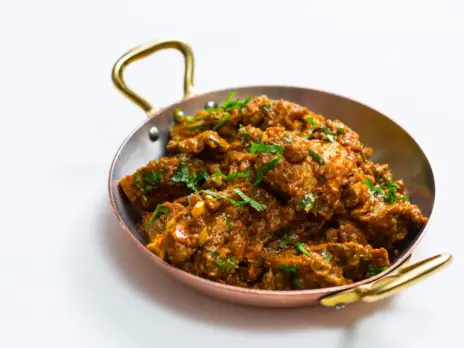
Piperade, or piperrada in Basque and Spanish, is ubiquitous across the Basque country that straddles France and Spain at the western end of the Pyrenees and, as such, is a strong contender for the title of signature dish of the region’s cuisine. Known as the edible Basque flag thanks to its colors—red tomatoes and peppers, green peppers, and white onions—it has been around since the 19th century and appears not only as a dish in its own right but as an accompaniment and as an integral part of other dishes, such as poulet Basquaise. In France, the most popular way of serving it is piperade au jambon de Bayonne, with crisp, dry-fried slices of jambon de Bayonne placed on top or alongside.
Much the greater part of the Basque country lies in Spain but, if either country can make a stronger claim for piperade, it is the much smaller part lying in France. It’s here, in the French province of Labourd, that the key spice, the medium-mild chilli pepper Piment d’Espelette, the only French spice to have Protected Denomination of Origin status (PDO), is grown, dried, and mostly turned into powder, in accordance with stringent regulations. And it’s in Espelette, one of the 10 PDO villages, that an annual festival is held to celebrate the eponymous pepper.
La Fête du Piment is an action-packed, appropriately colorful weekend at the end of October (24th and 25th this year) when ropes of red Espelette peppers are hanging down the outer walls of the houses to dry. During the weekend, the new season’s peppers are blessed at a solemn mass in Espelette’s Église Saint-Étienne, the Confrérie du Piment d’Espelette intronises new members, there are costumed parades, marching bands, a Basque song concert, dancing, animations, a gastronomic market, a banquet, and much else.
Related
Meanwhile Salies-de-Beárn, just over the Pays Basque border in the Béarn Pyrenées, holds an annual Piperardère, a day devoted to the dish on August 15. Highlights include a piperade-making contest, a large communal piperade feast and, for reasons that elude me, the World Espadrille-Throwing Championship.
To clinch the claim, it was also a French chef, restaurateur and cookery writer, Marcel Boulestin, who first mentioned piperade, giving his first recipe for it in his 1931 book What Shall We Have Today? 365 recipes for All the Days of the Year.
Having said that Piment d’Espelette is the key spice, I now have to backtrack a little. In some recipes, particularly Spanish, it doesn’t feature—a fresh chilli pepper often being used instead, as in Claudia Roden’s recipe in The Food of Spain (2012). I don’t intend to wrestle here with the slippery concept of authenticity in recipes but, to me, piperade without the smoky, fruity, slightly sweet flavor of Piment d’Espelette (1500—2500 on the Scoville heat scale) seems a bit like making boeuf bourguignon without red wine or without small onions.
Content from our partners
Although production of Piment d’Espelette is limited to an area of just 300 hectares (740 acres), the specific variety of chilli pepper, Capsicum annum Gorria, can be, and is, grown in Spain (gorri is a Basque word for red or ruddy). Indeed, it was a Spanish navigator who brought this variety and others from Mexico to the Basque country in the 1520s.
What isn’t clear is which navigator. Two names are regularly thrown into the ring. One is Gonzalo Percaztegi, who sailed with Christopher Columbus and is said by some sources to have planted the Gorria variety in the Nive Valley, where Espelette and some of the other designated villages are located. The other is Juan Sebastian Elcano, the navigator famous for being the first to circumnavigate the globe, on the Magellan expedition to the Spice Islands. The Syndicat de Piment d’Espelette AOP (French PDO) credits the first great explorers with its importation but doesn’t commit to names. What it does say is that by 1650 piment was already being grown in kitchen gardens around Espelette.
How to make piperade au jambon de Bayonne
Another thing the Syndicat doesn’t commit to is a recipe for piperade, although its website has more than 30 others using Piment d’Espelette, covering every course from apéro to dessert. I was banking on there being a piperade recipe—and one that came down firmly in favor of incorporating beaten eggs. These, stirred in at the end of cooking, are an essential element in most recipes for piperade and piperrada and result in a dish in which, according to Boulestin, it should be impossible to distinguish between the egg and the vegetables. Contemporary chefs who think this looks, in Claudia Roden’s words, “a mess” sometimes cook the beaten egg separately and serve it alongside, as she does herself.
Essentially, this is a dish of olive oil-stewed onions (sliced), to which peppers are added (in ribbon-like strips) then, after about 15 minutes, tomatoes (peeled, cored, and roughly diced), garlic, and Piment d’Espelette. After another 10–15 minutes, the beaten eggs are quickly stirred in and left briefly on the heat. The whole dish takes very roughly 40 minutes.
Traditionally, the peppers are a local, long, sweet, green variety called Piment d’Anglet, but these are difficult to get hold of outside France (and often in France), so most cooks use a mix of standard green peppers (bell peppers), which are sweeter than they used to be, and red peppers. With two medium-small onions, I use two medium green peppers and one red, four or five large tomatoes (the best I can get hold of), one large clove of garlic, one tablespoon of Piment d’Espelette (I usually start with a little less), and four large eggs.
The best wines to pair with piperade au jambon de Bayonne
With its sweet vegetables, olive-oil and egg richness, gentle piment piquancy, and the saltiness of the crisped ham, this is a dish that can swing several ways with wine. The local wine is Irouléguy, the tiny appellation for red, white, and rosé in the foothills of the Pyrenees about 20 minutes’ drive southeast of Espelette. The reds are too tannic for piperade, but the whites are worth trying: they are good with the vegetable mix and the spice, but their tangy acidity and tropical-leaning fruit, which has something in common with Jurançon Sec, can be slightly discordant with the egg. Irouléguy’s rosés, which are fairly bold, fruity, and often mineral, are more companionable (Maison Arretxea and Domaine Ilarria are two to look for), but better again are Bandol rosés (Domaine Tempier and Château de Pibarnon, for example), gastronomic southern Rhône rosés, especially Tavel, and Provence rosés intended for the table rather than the piscine (such as Château Galoupet and the trio from Château d’Esclans).
While red Irouléguy is too tannic, some reds go very well with piperade au jambon de Bayonne—the dry-cured ham making all the difference. The best are lithe, nimble styles with elegantly juicy red fruit, a savory accent (often pepper-spice or herbal) and minimalist fine tannins, allowing the wines to be lightly chilled.
Two that work particularly well are Arbois Poulsard from the Jura and Slarina, an extremely rare grape variety of the Monferrato hills in eastern Piemonte. If you haven’t tried it, I urge you to. The one I know is Il Cascinone’s Avamposti Cerchi Slarina 2022.
Other reds to consider include lighter styles of Xinomavro from very high vineyards or young vines, new-wave granite-grown Garnacha/Garnatxa from high-elevation old vines in Spain, old-vine Chilean Pais and Cinsault from similarly granitic soils, Beaujolais Crus (even, with some bottle age, the more powerful, fleshy wines—I enjoyed a 2019 Château de Jacques Moulin-à-Vent) and Pinot Noirs with fragrant, pure fruit and delicate savory spice, such as Weingut Braunewell Spätburgunder 2020.
There are white wine matches, too. Basque Spain’s wine is Txakoli, stereotypically a flyweight, razor-sharp, spritzy wine that piperade can make taste even tarter and lighter, but there are also some boundary-pushing, fuller, more complex wines from producers such as Astobiza in Txakolina Arabako, where concrete eggs and lees ageing are part of the mix.
Chardonnay is a rather more accessible option. Among the many possibilities worldwide that combine appropriate youthful acidity with some creamy volume, the Mâconnais is an obvious source, for Chardonnays such as Domaine Barraud Saint-Véran en Crèches 2022 and from estates such as Domaine Guerrin and Domaine des Héritiers du Comte Lafon. A by-no-means-exhaustive list of other whites includes wines based on Grenache Gris in Roussillon (Collioure among them), Garnatxa Blanca in Montsant and Empordà in Catalonia, Valdeorras Godello, and oaked Chenin Blanc from the Loire and South Africa.